Slicing software does not need a gaming rig. Cura, PrusaSlicer, OrcaSlicer and Bambu Studio all run their heavy lifting on the CPU, lean on a few gigabytes of RAM, and ignore your graphics card almost entirely. That changes the maths for anyone shopping for a budget PC for 3D printing slicing in South Africa, because the parts that drain a build budget, a strong dedicated GPU and 32GB of memory, are exactly the parts slicing does not reward.
Quick Answer
A capable slicing PC in South Africa starts around R8,000. You want a recent dual or quad-core CPU, 8GB of RAM (16GB if you slice large multi-part plates), an SSD for fast project loads, and integrated graphics. No dedicated graphics card is required. Spending extra on a GPU buys you nothing in Cura or PrusaSlicer, so put that money toward an SSD and more RAM instead.
What Slicing Actually Asks Of A PC
Slicing is the step where your printer's brain is fed. The software takes a 3D model, divides it into hundreds or thousands of horizontal layers, and calculates the exact path the nozzle follows for each one, including infill, supports and travel moves. That path calculation is sequential maths, and it runs on the processor.
The CPU does the real work
When you hit Slice, the program walks the model layer by layer and works out toolpaths. A faster CPU finishes that calculation sooner, so a complex model that takes 40 seconds on an older chip might take 12 on a current one. For everyday parts the difference is small, but if you slice large or detailed prints often, CPU speed is the single upgrade you actually feel. Both Cura and PrusaSlicer make use of multiple cores during slicing, so a modern quad-core is comfortably ahead of an ageing dual-core.
RAM holds the model, not the game
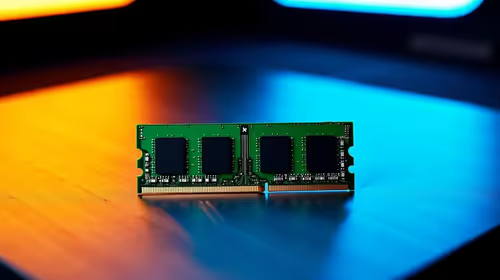
Memory matters when the model is big or when you arrange many objects on one plate. A single bracket needs very little; a full plate of parts with dense supports needs more headroom. 8GB handles the vast majority of hobby work without complaint. Step up to 16GB if you routinely slice large architectural models, scanned meshes with millions of triangles, or whole print farms' worth of objects at once.
Why the GPU sits idle
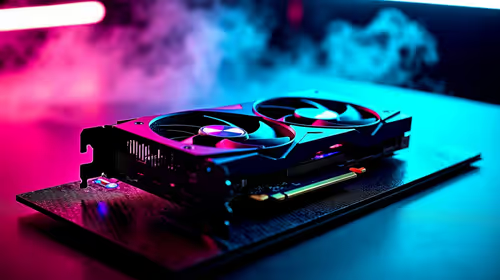
Slicers use the graphics card only to spin the 3D preview around on screen, and integrated graphics in any recent Intel or AMD chip handle that smoothly. The slicing computation itself never touches the GPU. This is the part SA buyers most often get wrong: there is no reason to pay for a discrete graphics card on a machine whose only job is preparing print files.
Building The Right Machine Near R8,000
At the entry level, an SA desktop built around a current-generation integrated-graphics CPU, 8GB of RAM and a small SSD lands close to the R8,000 mark and slices everything a hobbyist throws at it. That is the sweet spot: enough processor to keep slice times short, enough memory for normal plates, and a solid-state drive so projects open and save instantly.
Where to spend the extra Rand
If you have a little more to spend, the smart order is RAM first, then SSD capacity, then CPU. Going from 8GB to 16GB future-proofs you against bigger projects. A larger SSD lets you keep a growing library of STL and project files local rather than shuffling them off to a slow external drive. Only after those would a faster CPU be worth chasing, and even then a mid-range chip is plenty.
What not to buy
Skip the dedicated graphics card. Skip 32GB of RAM unless you genuinely batch-slice farms of parts. Skip a high-refresh gaming monitor; a clear, comfortable display is all the preview needs. Every Rand you redirect away from gaming hardware and toward storage and memory is a Rand working for your actual workflow.
Slicing PC Versus Gaming PC
It is worth being blunt about the difference. A gaming PC pours its budget into the GPU because games render in real time. A slicing PC pours nothing into the GPU because slicing is offline path maths. If you already own a gaming machine, it will slice beautifully, but you do not need to build one just to drive a 3D printer. A focused, affordable desktop does the job and leaves money in the budget for filament and the printer itself.
If you are still choosing the printer that this PC will feed, the current range of 3D printers at Evetech covers entry-level FDM machines through to larger-volume models. Once the printer is sorted, the 3D printing accessories and consumables shelf keeps you stocked on nozzles, build surfaces and the bits that wear out.
Who This Build Is For
Students printing project parts, hobbyists running a single printer at home, and small workshops preparing files for one or two machines are all well served by a budget slicing PC. The only people who genuinely need more horsepower are those doing heavy CAD modelling alongside slicing, since CAD does lean on the GPU and RAM. If your workflow is design plus slicing, treat it as a CAD build and slicing comes free. If it is slicing alone, keep it lean and keep it affordable.
Frequently Asked Questions
Do I need a graphics card for 3D printing slicing?
No. Cura, PrusaSlicer and the other major slicers run their calculations on the CPU and use only basic graphics to display the 3D preview, which any integrated graphics handle. A dedicated card adds cost without speeding up slicing.
How much RAM do I need for slicing in Cura or PrusaSlicer?
8GB is enough for typical hobby prints and single-part plates. Move to 16GB if you slice very large models, dense multi-part plates or high-polygon scanned meshes, where the extra memory prevents slowdowns.
Will a R8,000 PC really handle 3D printing slicing?
Yes. A desktop near R8,000 with a modern integrated-graphics CPU, 8GB of RAM and an SSD slices everyday models quickly. That budget covers the slicing workload comfortably because the demanding parts of a gaming PC are not needed here.
Does a faster CPU make slicing quicker?
It does. Slicing is mostly sequential CPU maths, so a quicker, multi-core processor cuts the time between pressing Slice and getting a finished file, which is noticeable on complex models. It is the one upgrade that directly speeds up slicing.
Can my existing laptop slice 3D models?
Most laptops from the last few years can, as long as they have a reasonable CPU and at least 8GB of RAM. Slicing does not need a gaming laptop, so a standard work or study machine usually copes fine with hobby-sized prints.
Sorting out a 3D printing setup on a sensible budget? Browse the 3D printers and consumables at Evetech, pair them with an affordable integrated-graphics desktop, and get everything delivered across South Africa.