


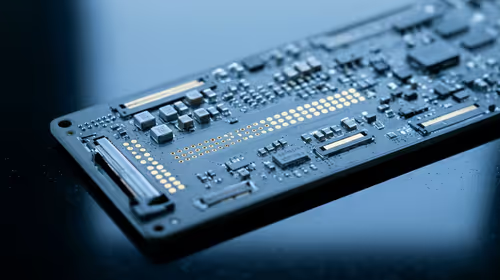
Hot-Swappable PCB Architecture in Modern Keyboards: Guide
Learn hot-swappable PCB architecture in modern keyboards—what it is, how sockets and traces work, and how to pick the right board. Speed up swaps, reduce risk, and upgrade faster 🔧⚡
Read moreFinding the best CPU for music production is critical for a lag-free workflow. This guide compares top Intel and AMD processors, analyzing cores, clock speeds, and real-world performance in popular DAWs. 🎧 Uncover the perfect chip to power your studio and eliminate bottlenecks. 🚀
Hitting playback on your DAW only to hear clicks, pops, and a stuttering mess? That lag is killing your creative flow. In South Africa, your studio’s power comes from its core: the processor. Choosing the best CPU for music production is the most critical decision you'll make. But the big question remains… are you Team Intel or Team AMD? Let's break it down and find the perfect beat-making brain for your rig. 🎵
Before diving into the Intel vs. AMD debate, it’s crucial to understand what a processor actually does for your music. Unlike gaming, which often relies heavily on the graphics card, music production is a CPU-intensive task. Two specs matter more than any others: single-core speed and multi-core performance.
Single-core performance dictates how well your PC can handle a single, demanding task. For producers, this is the processing chain on an individual track—think a complex synth patch running through multiple EQs, compressors, and reverbs. A CPU with a blistering single-core speed ensures low-latency monitoring and prevents your audio from crackling during playback. This is why many high-performance gaming PCs are surprisingly adept at music production.
What happens when you have 50 tracks, each with its own plugins? That’s where multi-core performance comes in. Having more cores allows your computer to spread the workload, efficiently handling dozens of virtual instruments, samplers, and effects simultaneously. This is also what speeds up offline bouncing and exporting your final track. A processor with a high core count is the cornerstone of modern professional workstation PCs built for heavy creative tasks.
For years, Intel has been a top contender for the title of best processor for music production, largely thanks to its raw single-threaded performance.
Intel’s Core i7 and i9 processors are legendary for their ability to deliver ultra-low latency, which is essential for recording and real-time monitoring. Their hybrid architecture, combining powerful Performance-cores (P-cores) with efficient E-cores, helps manage background tasks so your DAW gets the priority it needs. For producers who value stability and top-tier single-track processing power, exploring custom-built Intel PCs is a fantastic starting point. A full Intel system, sometimes even featuring Intel's own Arc GPUs, can offer a highly optimised and stable environment for your studio.
AMD's Ryzen processors have completely reshaped the CPU landscape. Their strength lies in offering an incredible number of cores for your money, making them a powerhouse for producers juggling massive projects.
A Ryzen 7 or Ryzen 9 CPU can effortlessly handle enormous templates loaded with sample libraries like Kontakt or Omnisphere. If your workflow involves running dozens of plugins and virtual instruments, the multi-core muscle of powerful AMD Ryzen systems provides a smooth, frustration-free experience. This makes AMD an excellent choice for composers, electronic producers, and anyone whose projects regularly push past 100 tracks.
Before you blame your CPU, check your system for DPC latency. Download a free tool like LatencyMon to analyse which drivers might be causing audio dropouts. Often, updating your network, graphics, or audio interface drivers can solve mysterious clicks and pops, ensuring your processor's power is used for making music, not fighting bad code.
The best CPU for music production can still be bottlenecked by other components. A truly powerful studio PC is a balanced system.
For those just starting out, excellent value can be found in affordable budget PCs that provide a solid foundation you can upgrade later. Or, to get a guaranteed-stable system from day one, consider one of our expertly configured pre-built PCs.
So, who wins the Intel vs. AMD processor battle for music producers in South Africa? The honest answer... it depends on your workflow.
Both brands offer incredible processors that can power a professional studio. The key is to match the CPU's strengths to your creative process.
Ready to Build Your Dream Studio PC? The CPU is the heart of your creative workflow. Whether you choose Intel's precision or AMD's multi-core power, we have the components to bring your sound to life. Use our PC Builder to configure the perfect machine and take your music production to the next level.
Both brands offer fantastic CPUs. Intel often excels in single-core performance which benefits certain plugins, while AMD frequently provides better multi-core value for handling many tracks.
For most home studio producers, 6 to 8 cores are a great starting point. Professionals working with large templates and virtual orchestras should aim for 12 cores or more for optimal performance.
An i9 processor will deliver superior performance for complex, professional projects due to more cores and higher clock speeds. An i7 offers a powerful and more cost-effective option for most users.
The best budget CPU for music production is often a previous generation Intel Core i5/i7 or AMD Ryzen 5/7. They provide excellent performance for the price, handling most recording tasks with ease.
Both are crucial. High clock speed improves the performance of individual tracks and plugins, while a high core count allows you to run more simultaneous processes without system strain.
A powerful GPU is not necessary for audio processing. Your CPU does the heavy lifting. A basic GPU is fine unless your DAW has a very demanding visual interface or you also edit video.
Learn hot-swappable PCB architecture in modern keyboards—what it is, how sockets and traces work, and how to pick the right board. Speed up swaps, reduce risk, and upgrade faster 🔧⚡
Read more
Mechanical switch lifespan explained—what the 50 million keystroke rating really means, plus tips to extend switch life and reduce double-press issues 🔧⌨️
Read more
60-percent vs full-size mechanical keyboard layouts—learn what each layout includes, who it suits, and how to choose the right fit 🧩⌨️ for typing, gaming, and productivity.
Read more
Double injection keycaps last far longer than standard printed keycaps in most setups. Learn typical lifespan ranges, what shortens them, and how to maximize durability for smoother daily typing and gaming 😊⌨️
Read more
Full-key anti-ghosting: does it stop missed inputs during fast-paced gaming? We break down latency, polling, and key matrix limits so you can buy smarter 🎮⚡
Read more
Protect mechanical keyboard switches from South African dust and summer humidity with practical cleaning and storage habits. Keep your switches smooth, reduce failures, and extend lifespan. 🌬️💧
Read more
Wondering if a TKL wireless mechanical keyboard is worth it for everyday productivity? We break down latency, battery life, comfort, and workflow gains for real work. ⚡⌨️

Maximise battery life on a fanless 15-inch laptop using efficiency core architecture. Cut idle drain, tune power profiles, and improve thermals for longer runtime. 🔋⚙️
Learn how to reduce desk clutter with a TKL wireless keyboard using fewer cables, smart placement, and tidy essentials. Get a faster, calmer workspace with better ergonomics. ✅🧼
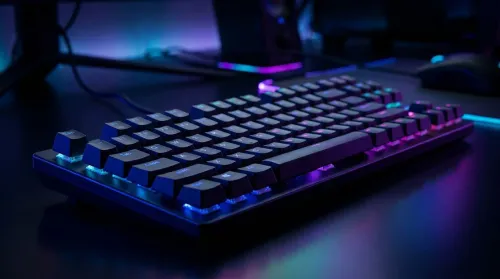
RGB keyboard lighting too distracting? Learn how to manage backlight modes, set brightness, and reduce distraction for focus and productivity 😌🖱️

Are themed gaming keyboards worth the extra cost? Compare build quality, switch options, features, and resale value to find the best fit for your setup 🎮⌨️
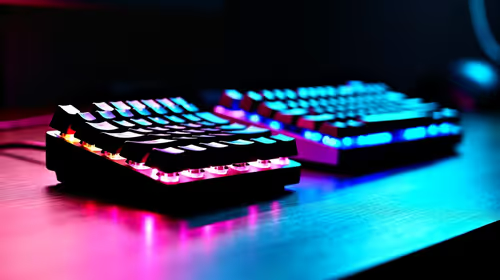
Full-Size vs Tenkeyless mechanical keyboards for gaming: find out if a smaller layout truly improves aim, speed, and comfort. We break down layout, desk space, latency-feel, and keybinds 🎮⌨️

Dedicated media rollers vs function key shortcuts: learn which setup gives you better workflow control, faster media access, and fewer mistakes. 🖱️🎧

Best Mechanical Switch Type for Gaming: Clicky vs Linear vs Tactile. Find your feel, speed, and noise balance with practical guidance for FPS, MOBA, and productivity 😄🎮
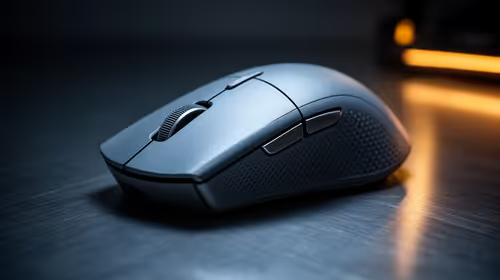
Direct mouse answer: Mouse not keeping up with your work? Everything that matters about dual-mode 2.4GHz + BT 5.0: DPI behaviour, channel switching, battery curves and per-app button mapping. Covers when 2.4GHz USB wins (low-latency desk) and when BT 5.0 wins (laptop, d

Plain wireless mouse guide: Mouse not keeping up with your work? Everything that matters about wireless productivity mouse: DPI behaviour, channel switching, battery curves and per-app button mapping. Includes DPI tuning tips, channel switch shortcuts, and ZAR-aware fea
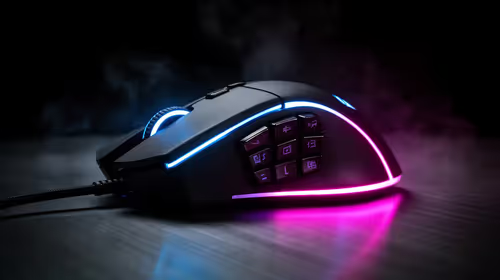
Real productivity numbers: Set up your wireless mouse in this order: everything that matters about wireless productivity mouse: DPI behaviour, channel switching, battery curves and per-app button mapping. Includes DPI tuning tips, channel switch shortcuts, and ZAR-aware
Pen not feeling like paper? Stylus lag and skipping usually trace to old drivers, dirty nibs, or display refresh mismatches, not the pen itself. Covers pressure curve tuning, tilt thresholds, nib swap timing, and SA pricing brackets.