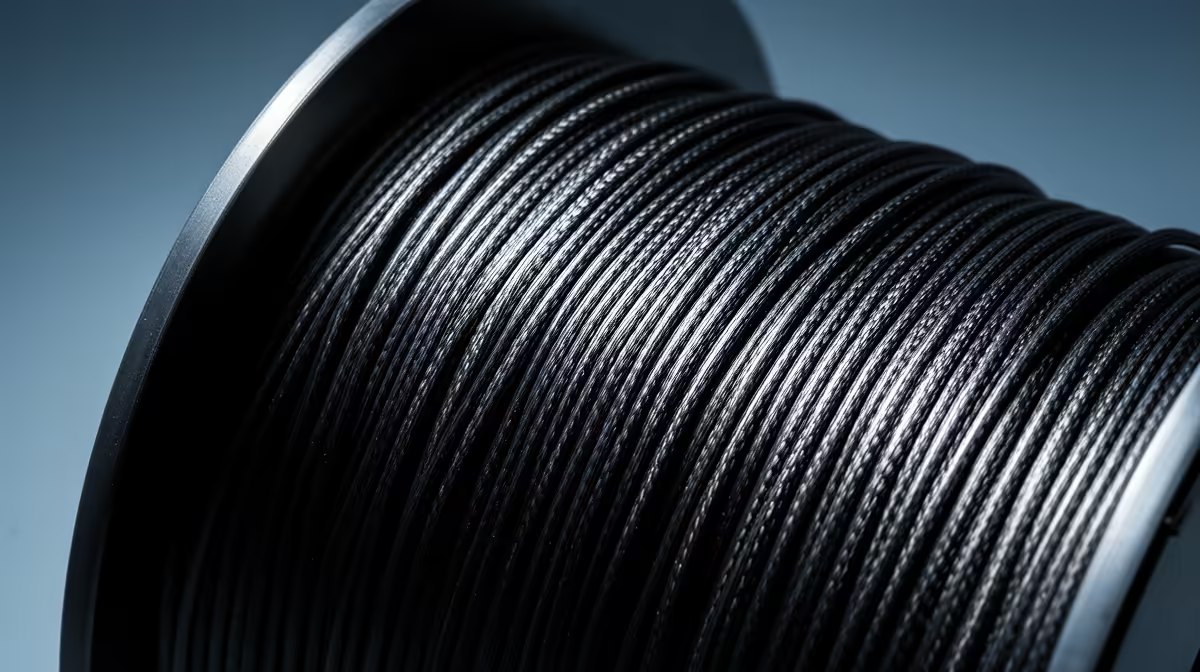
Chopped carbon fibre mixed into PLA does something a lot of makers misunderstand: it makes a part far harder to flex, not far harder to break. The best filament for stiff lightweight parts in most home workshops is PLA-CF, because the short fibres lift rigidity sharply while keeping the print light and dimensionally honest. If your bracket or enclosure bows under its own weight, the fix is stiffness, and that is exactly what carbon fibre buys you.
Quick Answer
PLA-CF raises tensile stiffness by roughly 165 to 180 percent over plain PLA, with a Young's modulus around 3,950 MPa on common spools. It also cuts warp and shrinkage to near nothing. What it does not do is meaningfully raise ultimate strength or impact toughness, so it suits parts that must hold their shape, not parts that take repeated knocks.
What "stiff" actually means versus "strong"
Stiffness and strength get used interchangeably, and that confusion leads to the wrong filament choice. Stiffness is resistance to bending under load, measured by the modulus. Strength is how much force a part takes before it snaps. PLA-CF wins decisively on the first and barely moves on the second.
The short carbon strands act like rebar in concrete. They are far stiffer than the surrounding plastic, so when you try to flex the part, the fibres carry the load and the whole piece resists deflection. That is why a PLA-CF camera mount or printer frame stays flat where plain PLA would slowly sag.
The trade-off sits at the breaking point. Because the part now resists bending so firmly, it has less give before it fails, which reads as brittleness. Drop a PLA-CF clip on a tile floor and it is more likely to crack than a plain PLA one. For load-bearing structure that mostly sits still, that is an acceptable swap. For something that gets dropped or flexed daily, it is not.
Where PLA-CF earns its place
The sweet spot is functional, structural, mostly static parts. Think enclosures that must not flex around their seams, mounting brackets that have to keep alignment, jigs and fixtures that need to stay true, and display or architectural models where a dead-flat surface matters.
Two extra wins come along for free. The fibres limit plastic shrinkage as the layer cools, so warping on large flat prints drops dramatically, and the matte, slightly textured finish hides layer lines in a way glossy PLA never manages. For anyone printing visible parts, that surface alone is a reason to reach for it. The full 3D printer range at Evetech covers machines that handle these abrasive composite spools comfortably.
Where it is the wrong call
Skip PLA-CF for anything that flexes by design, such as snap-fit latches, living hinges, or phone cases meant to absorb a drop. Those need toughness, and a tough PLA, PETG, or even nylon serves far better. Also skip it for parts under sustained heat near a window or in a car, since PLA-CF keeps PLA's low heat tolerance.
The hardware reality: abrasive filament needs the right nozzle
This is the part most guides skip. Carbon fibre is abrasive, and it chews through a standard brass nozzle in a few spools. You want a hardened steel or ruby-tipped nozzle before you print any CF material, otherwise you will be replacing nozzles constantly and chasing inconsistent extrusion.
A 0.4 mm nozzle works, but many makers move to 0.6 mm to reduce clog risk, since the fibres can bridge a narrow opening. Keep the spool dry too, because PLA-CF picks up moisture and prints rough when damp. A sealed box with desiccant is enough for most South African homes outside the humid coastal months.
Slicer settings that get the best out of PLA-CF
Beyond the nozzle upgrade, a few slicer adjustments help PLA-CF deliver on its stiffness promise. Print slow enough for clean fibre alignment, typically 40 to 60mm per second for structural parts, since rushing the print produces uneven extrusion and reduces the modulus gain. A 0.2 mm layer height is a reliable starting point; dropping to 0.15 mm adds detail and often improves interlayer bonding slightly at the cost of print time.
Infill pattern matters more than infill percentage for a stiff part. A gyroid or cubic infill resists multi-directional loading better than a straight grid, so a 30 percent gyroid often outperforms a 50 percent grid for a bracket that needs to be firm without being heavy. On PEI or textured spring-steel beds the first-layer adhesion is usually trouble-free, carrying over PLA's good bed manners.
Real-world SA use cases
South African makers reach for PLA-CF on projects where the ambient environment plays a role. In Cape Town's moderate climate, PLA-CF works well for indoor mounts, shelving brackets and drone frames, where heat is not a factor and stiffness is the priority. In hotter inland regions like Joburg and Pretoria, be cautious of parts that sit in direct sunlight or near a south-facing window in summer, since PLA-CF's heat tolerance ceiling is roughly the same as plain PLA, around 60 degrees C. For any outdoor or high-temperature application, PETG-CF or PA-CF is the better step up.
For a home workshop printer churning out brackets, jigs and enclosures, PLA-CF is the most accessible and affordable entry into composite printing. It costs modestly more per kilogram than standard PLA, but the hardened nozzle is a one-time purchase, and the parts you produce genuinely outperform plain PLA on every stiffness metric that matters for static structural work.
Buying it right in South Africa
PLA-CF spools sit at a modest premium over plain PLA, and the cost that actually bites is the hardened nozzle, not the filament. Budget for that upfront and the per-part cost barely changes. If you only ever print decorative figures, the premium is wasted; if you print brackets, mounts, and enclosures, it pays for itself in parts that stay flat. For the printer itself and a hardened nozzle to go with it, the accessories best sellers are a quick gauge of what other SA makers are actually buying.
Frequently Asked Questions
Is PLA-CF stronger than regular PLA?
It is much stiffer, not much stronger. Tensile stiffness climbs roughly 165 to 180 percent, but ultimate tensile strength rises only modestly and impact toughness can even drop. Choose it for rigidity, not for parts that take hard knocks.
Will PLA-CF damage my 3D printer?
The filament itself is fine, but the carbon fibre is abrasive and will wear out a brass nozzle quickly. Fit a hardened steel or ruby nozzle first. The extruder gears and PTFE tube are generally unaffected.
Does PLA-CF warp less than normal PLA?
Yes, noticeably. The fibres restrain shrinkage as each layer cools, so large flat parts stay flatter and dimensional accuracy improves. That low-warp behaviour is one of its biggest practical advantages.
Can I print PLA-CF on a budget printer?
You can, provided you fit a hardened nozzle. The bed temperature and print profile are close to standard PLA, so the machine itself does not need to be expensive, just fitted with a wear-resistant nozzle.
What should I use instead if I need toughness?
For parts that flex or get dropped, pick a tough PLA, PETG, or nylon. PLA-CF trades impact resistance for rigidity, so it is the wrong material when give and durability matter more than a dead-flat shape.
Printing functional brackets, enclosures, or frames and want them to stay flat under load? Pair PLA-CF with a hardened nozzle and a machine built for composite filament. Browse the full 3D printer range at Evetech to match the right printer to your stiff-part projects.