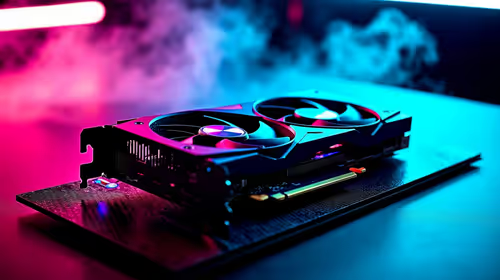
A render that takes your CPU forty minutes can finish in four on the right graphics card, and the reason comes down to two words: CUDA and OptiX. The best GPU for 3D rendering in Blender Cycles, Redshift, and Octane is an NVIDIA RTX card, because all three of those engines were built to lean on NVIDIA's parallel-compute stack. Buy outside that lane and you either render far slower or, with some engines, cannot use GPU acceleration at all.
Quick Answer
For 3D rendering in Cycles, Redshift, or Octane, buy an NVIDIA RTX card. Octane and Redshift require CUDA and will not run on AMD GPUs, while Cycles runs dramatically faster on RTX thanks to OptiX ray-tracing acceleration. Aim for at least 12GB of VRAM, and 16GB or more if your scenes are heavy.
Why CUDA and OptiX Decide Everything
CUDA is NVIDIA's parallel computing platform, and it is the language these render engines speak. Octane was written for CUDA from the start, so it simply does not run on AMD hardware. Redshift is the same story for its GPU path. Cycles is more flexible and supports AMD through HIP, but its fastest mode by a wide margin is OptiX, which taps the dedicated RT cores inside RTX cards to accelerate ray tracing in hardware.
OptiX is the part that turns an RTX card from "fast" into "in another league." Those RT cores calculate ray intersections, the single most expensive operation in path tracing, without tying up the general shading units. On the same scene, OptiX often cuts Cycles render times by half or more compared to the older CUDA path, and far more compared to CPU rendering.
VRAM Is the Other Half of the Decision
Raw rendering speed is only useful if your whole scene fits in the card's memory. When a scene with its textures, geometry, and lighting exceeds the GPU's VRAM, the render either spills into slower system memory or fails outright.
How Much VRAM You Actually Need
For product viz, motion graphics, and most freelance work, 12GB is a sensible floor. For dense architectural interiors, character work with 4K textures, or anything with heavy displacement, 16GB or more keeps you out of trouble. VFX-scale scenes and large environments push toward 24GB. It is worth being honest about your actual scenes here, because paying for VRAM you never fill is as wasteful as buying too little and stalling on every big project.
Research confirms the numbers hold up in practice: a typical scene with 80 textures at 4K, five million polygons, two displacement objects, and an 8K HDRI can use six to ten GB before the render engine adds its BVH, light cache, and denoiser buffers on top. That is why 12GB is a floor rather than a ceiling for serious freelance work.
Why VRAM Beats a Few Extra Cores
Given a choice between a slightly faster card with less memory and a slightly slower card with more, the higher-VRAM card is usually the safer buy for rendering. A render that fits in memory and runs a little slower still finishes. A render that does not fit either crawls or crashes, and no amount of core count rescues it.
When Redshift runs out of VRAM, its out-of-core rendering mode streams from system RAM over the PCIe bus. It prevents a crash, but render times typically drop three to eight times slower than normal. That penalty alone is reason to buy the memory tier that keeps your scenes fully resident.
Matching the Card to the Engine
Cycles, Redshift, and Octane all reward RTX hardware, but they weight things slightly differently. Cycles benefits most visibly from OptiX, so RT-core count and generation matter. Octane scales cleanly with raw CUDA throughput and VRAM, which is why memory-hungry Octane users gravitate to the high-VRAM tiers. Redshift is efficient with memory and scales well across the range, making it forgiving on mid-tier cards. The NVIDIA-focused GPU and components catalogue at Evetech carries the tiers that cover all three workflows, from solid mid-range render cards up to the top professional silicon.
RTX 50 Series and the Render Landscape
The RTX 50 series, built on NVIDIA's Blackwell architecture, adds a new tier to the render stack for SA artists. The RTX 5060 Ti 16GB sits at the accessible end with 16GB of GDDR7 and solid Tensor and RT core throughput. The RTX 5070 Ti steps that up considerably, and the RTX 5090 at the top offers 32GB of GDDR7 for the heaviest production pipelines. Within SA pricing, the 5060 Ti 16GB and 5070 tier represent the most practical entry points for freelancers wanting a modern CUDA and OptiX foundation without paying the full studio premium.
What About AMD and CPU Rendering?
AMD's Radeon cards are capable gaming GPUs, and Cycles will use them through HIP. But Octane and Redshift exclude them, and even in Cycles they cannot touch OptiX-accelerated RTX cards on ray-tracing speed. CPU rendering remains the universal fallback and the most accurate reference for some edge cases, yet it is far slower for production work. For an artist whose time is money, the GPU pays for itself in recovered hours. The right render-focused accessories and cooling matter too, because a card thermal-throttling in a stuffy case loses real performance over a long render.
Picking Your Tier as an SA Artist
A student or hobbyist learning Blender does well on a current-generation RTX card with 12GB. A working freelancer rendering client jobs should target 16GB to avoid memory ceilings on bigger scenes. A studio artist on VFX or large arch-viz scenes wants the 24GB tier and the headroom it brings. Spend to the level of work you actually do, not the level you imagine, and remember that VRAM headroom ages better than a small raw-speed lead.
Frequently Asked Questions
Can I use an AMD GPU for Octane or Redshift?
No. Both Octane and Redshift require CUDA and run only on NVIDIA GPUs. AMD cards have no path into these engines for GPU rendering, so an RTX card is mandatory if you use either one.
Does Cycles really need an NVIDIA card?
Cycles can render on AMD through HIP and on CPU, so it does not strictly require NVIDIA. But its fastest mode is OptiX, which is RTX-only, and it typically cuts render times substantially. For serious Cycles work an RTX card is the clear choice.
How much VRAM do I need for 3D rendering?
Start at 12GB for general work. Move to 16GB for 4K textures, dense interiors, and heavy displacement, and 24GB for VFX-scale scenes. Scenes that exceed VRAM render far slower or fail, so size memory to your actual projects.
Is OptiX faster than CUDA in Blender?
Usually yes, often by a large margin. OptiX uses the dedicated RT cores on RTX cards to accelerate ray tracing in hardware, which the general CUDA path cannot do. On the same scene OptiX commonly halves Cycles render times or better.
Will a gaming RTX card work for rendering?
Yes. Consumer RTX gaming cards share the same CUDA and RT-core architecture as their workstation siblings and render extremely well in Cycles, Redshift, and Octane. The main reason to step up to professional cards is larger VRAM and certified drivers.