Quick Answer
Before upgrading a GPU in South Africa, compare memory bandwidth and VRAM capacity first, then TDP versus your PSU headroom, followed by architecture generation to confirm AI upscaling support. Price-per-fps at your target resolution, not raw spec numbers, is the figure that determines whether the upgrade is worth doing.
VRAM and Bandwidth: The Specs Most Buyers Read Wrong 🔧
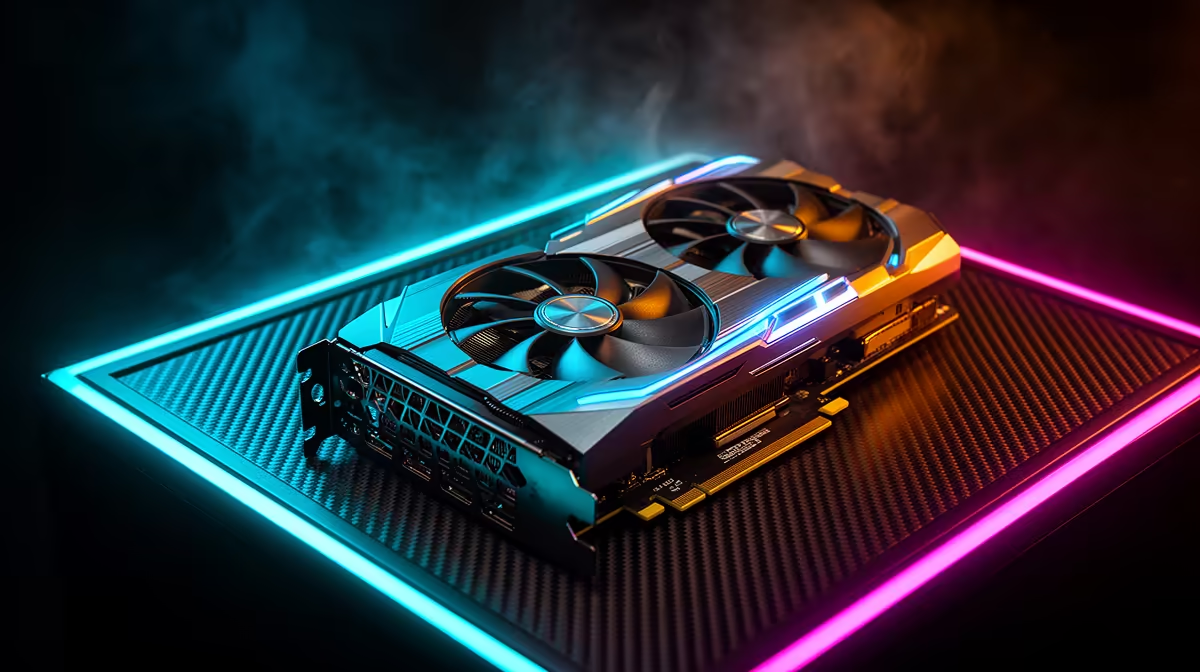
GPU listings lead with VRAM capacity, but bandwidth tells the more important story. An 8GB card with GDDR7 memory, like the RTX 5060, delivers over 320 GB/s and handles 1440p texture streaming far more smoothly than an older 8GB GDDR6 card at half that bandwidth. When comparing two cards of the same VRAM amount, always look at the memory bus width and memory type. A 128-bit GDDR7 bus can outperform a 192-bit GDDR6 bus in practice. SA buyers upgrading from cards three to five years old are particularly likely to see a meaningful real-world jump in open-world stutter and texture pop-in when moving to a GDDR7 architecture.
TDP vs Your PSU: The Spec That Blocks Installations 💡
A GPU upgrade that requires a new PSU adds R800 to R2,500 to the effective cost. Check your current PSU wattage and the TDP of the card you are considering: entry-level cards like the RTX 5060 sit around 150 to 175W, while mid-range options like the RTX 5070 push 200 to 250W. Most SA systems built between 2021 and 2024 ship with 550W or 650W PSUs. As a rule, allow a 150W buffer above your total system TDP for stable long-term operation. If your current PSU is 500W or below, budget for a replacement when choosing a card above 200W TDP to avoid unexpected shutdowns.
Architecture Generation and Upscaling Compatibility 🎮
DLSS 4, FSR 4, and XeSS 2 all require specific hardware to function correctly: DLSS 4 Multi Frame Generation needs an RTX 50-series GPU, FSR 4 ML requires an RX 9000-series GPU, and XeSS 2 benefits from Intel Arc hardware. For SA buyers, this matters because older cards being sold as upgrade options will not support the latest frame generation tier regardless of their raster performance. When two cards are similarly priced, choose the one with native hardware support for the current upscaling generation to extend usable lifespan. Pairing with a monitor that supports at least 144 Hz makes the frame generation advantage tangible.
Check Your PCI-E Slot Before Buying ⚡
Most current GPUs require a PCI-E 4.0 x16 slot to operate at full bandwidth. If your motherboard only has a PCI-E 3.0 x16 slot the card will still work, but you may lose 5 to 10 percent of peak throughput in the most bandwidth-intensive scenarios. Confirm your motherboard's PCI-E version before purchasing and factor in a potential motherboard upgrade if you are on a very old platform.
FAQ
What resolution should I use to judge whether a GPU upgrade is worth it?
Test current performance at your actual gaming resolution. If you are hitting under 60 fps at 1080p Medium in recent titles, almost any current-gen upgrade will be worthwhile. If you are already above 100 fps at 1080p, only upgrade if you are moving to a 1440p monitor.
How much should a mid-range GPU upgrade cost in SA right now?
Mid-range current-gen cards like the RTX 5070 or RX 9070 XT are priced around R14,000 to R18,000 at Evetech. Entry-level RTX 5060-class cards sit at R9,500 to R11,000. Factor in any PSU or case upgrade costs to get the true total.
Should I buy a previous-gen card to save money?
Only if the price gap is significant, around R3,000 or more, and you are not on a 144 Hz or higher refresh rate monitor. Previous-gen GDDR6 cards lack GDDR7 bandwidth and do not support DLSS 4, which limits their longevity versus current-gen options at similar price points.
Ready to pick your GPU upgrade?
Browse the full graphics card range at Evetech, filtered by VRAM, TDP, and architecture, to find the right upgrade for your specific build and resolution.