A home lab is the cheapest way to learn real infrastructure skills, and you do not need a server rack humming in the garage to start one. The right home lab hardware for a South African beginner is a quiet, efficient box that can run a few virtual machines or self-hosted services around the clock without spiking your electricity bill. Pick the entry point well and the same machine grows with you for years.
Quick Answer
To start a home lab you want a minimum of 16GB of RAM and a 256GB SSD, ideally NVMe, which is enough to run a hypervisor like Proxmox plus three or four containers and a virtual machine without bottlenecks. A modern mini PC is the best-value entry point for SA, idling at around 15 to 25W so it costs little to leave running 24/7.
What A Home Lab Actually Needs
A home lab is simply hardware you own and experiment on: running virtual machines, hosting your own services, learning networking, breaking things and fixing them. The hardware bar is lower than people fear. You are not chasing raw speed so much as memory, quiet running and low power draw, because the machine lives on a shelf and stays on. RAM is the resource you run out of first, since every virtual machine and container claims a slice of it. Storage speed matters too, because virtual machines feel sluggish on slow disks, which is why an SSD rather than a spinning drive is the baseline.
The goal for a first build is something that handles a handful of services comfortably and leaves room to add more as your ambitions grow.
Why A Mini PC Is The Smart Starting Point
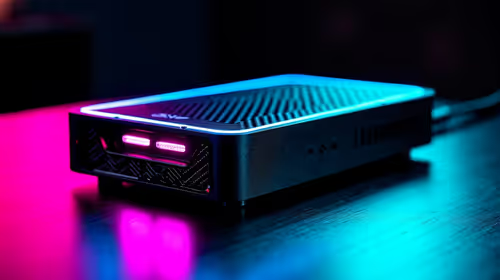
For most SA beginners a mini PC hits the sweet spot. Modern units pack a capable six or eight-core processor into a box that fits in your palm, stays quiet enough to live in a lounge or study, and idles at roughly 15 to 25W. That efficiency matters here: a machine running 24/7 at low wattage barely registers on the power bill, and over a year or two the savings against a power-hungry old tower are real. A mini PC also starts small and unobtrusive yet has enough grunt for several concurrent virtual machines, so it suits the natural progression from one service to a dozen.
Recommended specs to look for
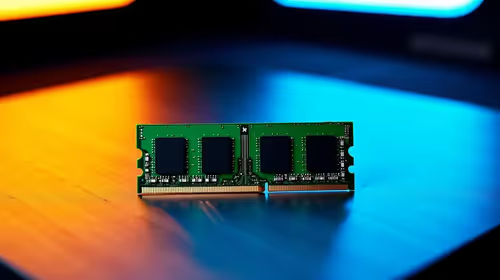
Aim for at least 16GB of RAM, with 32GB being the more comfortable, future-proof baseline if the budget stretches. Pair that with an NVMe SSD of 256GB or more, and ideally a board with a spare M.2 slot so you can later separate your boot drive from your virtual-machine storage. A 2.5GbE network port is a nice bonus that pays off once you start moving data between machines. The mini PC range at Evetech covers configurations across this spec band so you can match memory and storage to your plans.
Memory, Storage And The Software Layer
With 16GB you can comfortably run a hypervisor plus three or four lightweight containers and a single full virtual machine. Step up to 32GB and you can run a denser stack with breathing room, which is why many home labbers treat 32GB as the realistic baseline rather than a luxury. On storage, NVMe is effectively mandatory for the virtual machines themselves because they need fast disk to stay responsive, while a second drive for bulk file storage can be slower and cheaper. Software like Proxmox is the popular free hypervisor for beginners precisely because it teaches you to allocate resources, take snapshots, clone machines and manage updates in a controlled way.
Virtualisation Extensions: What To Check Before Buying
Before committing to any mini PC for a home lab, confirm it exposes virtualisation extensions: Intel VT-x on Intel platforms or AMD-V on AMD chips. Without these, a hypervisor like Proxmox cannot create hardware-accelerated virtual machines and performance tanks. Most modern mini PCs enable this by default in firmware, but budget units occasionally ship with it hidden in the BIOS. Check the spec sheet or a verified user review before buying. While you are in the BIOS, also look for IOMMU support (Intel VT-d or AMD IOMMU) if you eventually plan to pass a USB controller or GPU directly to a VM, as that requires hardware-level isolation the CPU must support.
Networking Your First Node
Most home labs start with a single box plugged into the home router, which is fine for learning. Once you add a NAS, a second node, or want faster backups, the bottleneck shifts to the network. A 1GbE switch tops out at around 112 MB/s real-world throughput. If your mini PC has a 2.5GbE port and your switch also supports it, that ceiling rises to roughly 295 MB/s, which is meaningful when you are copying virtual machine images or running network backups. Cat5e cabling carries 2.5GbE comfortably at the short distances typical in a home, so new cables are rarely needed.
Growing Beyond The First Box
A good home lab plan starts small and scales. Begin with one mini PC, learn the fundamentals, then add a second machine when you want to experiment with clustering, or attach network storage when your data outgrows the internal SSD. Because the entry box is cheap to run, keeping it around as you expand costs almost nothing. To see what compact machines are moving and how they are configured, the best-selling PCs at Evetech give a current read on sensible starting hardware.
Frequently Asked Questions
How much RAM do I need to start a home lab?
A 16GB minimum gets you running a hypervisor with three or four containers and one virtual machine. If you can stretch to 32GB, you get far more breathing room and a setup that stays comfortable as you add services.
Is a mini PC powerful enough for a home lab?
Yes, for a beginner and well beyond. Modern mini PCs offer six or eight-core processors and ample RAM in a quiet, low-power package, which is ideal for running several virtual machines around the clock without a noisy, power-hungry tower.
Do I need an SSD or will a hard drive do?
Use an SSD, ideally NVMe, for the machine and its virtual machines, because they need fast storage to stay responsive. A slower, cheaper drive is fine as a secondary disk for bulk file storage only.
What does it cost to run a home lab in South Africa?
Very little if you use an efficient mini PC. Idling around 15 to 25W, a 24/7 machine adds only a modest amount to your monthly electricity, which is a big reason mini PCs suit SA home labs.
What software should a beginner run on home lab hardware?
Proxmox is the popular free choice. It lets you create virtual machines and containers, take snapshots, clone setups and manage everything from one interface, teaching the resource-management skills that carry into real infrastructure work.
Do I need to check virtualisation support before buying?
Yes. Confirm that the mini PC exposes Intel VT-x or AMD-V before purchasing. Most modern units have it enabled by default, but it is worth verifying in reviews, since some budget models ship with it disabled and you may not be able to turn it on.
Ready to build your first home lab? Browse the mini PCs at Evetech and pick a quiet, efficient box that runs your services 24/7 and grows with you.