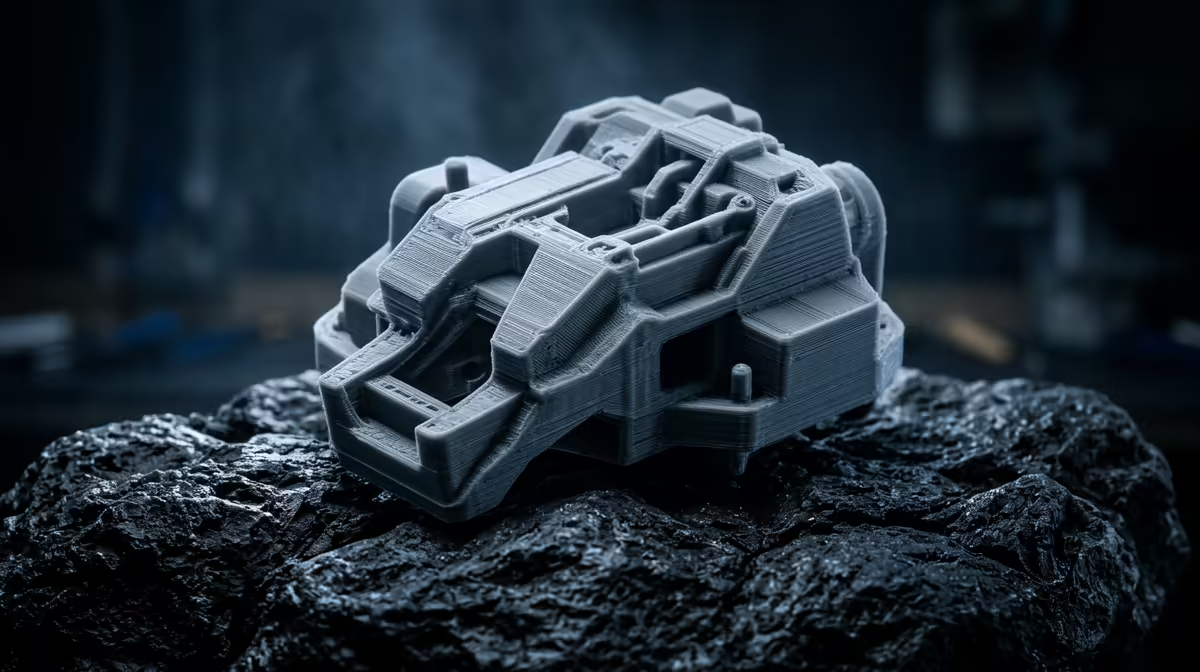
Leave a PLA bracket on a window sill through a Highveld summer and it will sag, yellow and crack before the season is out. The fix is not a better slicer profile, it is the material and machine combo for durable 3D-printed parts that survives real South African conditions. Pair ASA filament with an enclosed printer like the Creality K2 and you get parts that hold their shape outdoors, under bonnet heat, and in a hot Karoo garage where PLA would have long given up.
Quick Answer
For durable, UV-resistant parts in SA, pair ASA filament with the enclosed Creality K2 (around R17,900 currently stocked at Evetech). ASA holds its form to roughly 95 degrees C continuous service against PLA's 60-degree C ceiling, and it shrugs off sunlight that turns cheaper plastics brittle. The enclosure is not a luxury here, it is what stops ASA from warping mid-print.
Why the Material Decides Durability First
Durability starts at the spool, not the gantry. Each common filament has a job it is good at and a place it fails.
PLA is stiff, cheap and easy, but its glass transition sits near 60 degrees C, so a closed car in a Durban car park will deform a PLA dash mount by lunchtime. PETG is the sensible middle ground, tougher and more heat-tolerant than PLA, with decent moisture and chemical resistance, though it can string and it is not built for relentless UV. ABS is strong and heat-resistant but warps badly without a controlled chamber and gives off a sharp smell. ASA is effectively ABS rebuilt for the sun: similar mechanical strength and heat tolerance, plus genuine UV stability that keeps colour and surface integrity intact outdoors for years.
For load-bearing or outdoor work in our climate, ASA is the standout. For mechanical parts that see solvents or flex, PETG and nylon earn their place. Browse the 3D printer range at Evetech to see which machines and filaments are stocked, then pair a spool to the job in front of you.
Why the Machine Has to Match the Material
A premium spool of ASA on the wrong machine wastes both. ASA and ABS shrink as they cool, and uneven cooling lifts corners off the bed, splits layers and ruins tall prints. An open-frame printer in a draughty Cape Town workshop fights you on every large part.
The Enclosure Is the Real Feature
An enclosed chamber holds a stable warm air temperature around the print so each layer cools evenly. That single factor is the difference between a clean ASA bracket and a delaminated mess. The Creality K2's closed build volume is exactly why it pairs so well with engineering filaments: it keeps ambient temperature consistent regardless of whether your space is a chilly garage in winter or a stuffy spare room in summer.
Hotend and Bed Temperatures That Reach
ASA wants a nozzle in the 240 to 260 degrees C band and a bed around 90 to 110 degrees C. A machine that cannot hold those numbers reliably will under-extrude or fail to adhere. The K2 handles these ranges as a matter of course, which is what makes the pairing dependable rather than a constant fight with settings.
Tuning the Combo for SA Conditions
Keep ASA dry. Our coastal humidity in places like Durban and the Cape gets into the spool, and damp filament prints rough and weak, so a sealed container or filament dryer is a worthwhile habit.
Slow the first few layers and lean on a brim for large flat parts to beat warping. For anything that will live in direct sun, a wall of three or four perimeters does more for real-world toughness than cranking infill alone. A modest set of upgrades, a dryer, a decent brim adhesive and spare nozzles, keeps the whole setup honest, and the accessories best sellers page is a practical spot to restock the bits that wear out over time.
How the Other Engineering Filaments Stack Up
ASA is the headline pairing, but a durable-parts owner ends up reaching for a small shelf of materials, each with a clear job. Nylon (PA) is the toughness champion: it is abrasion-resistant, takes repeated flexing without fatiguing, and suits living hinges, gears and wear parts. The catch is that it drinks moisture from the air faster than any other common filament, so a dryer is mandatory rather than optional in our humid coastal cities.
Polycarbonate sits above ASA on heat and impact resistance, holding its shape well past 110 degrees C and shrugging off knocks that would crack ABS. It demands the highest nozzle and chamber temperatures of the group, which is precisely why an enclosed machine like the K2 is the entry ticket. For parts that combine heat and shock, a transmission housing near an engine bay or a tool that gets dropped, polycarbonate earns its higher price.
Carbon-fibre-reinforced blends, usually PETG-CF or nylon-CF, add stiffness and a matte finish for brackets that must not flex. They are abrasive, so they chew through a brass nozzle quickly and need a hardened steel one. None of these replace ASA for sun exposure, but together they let one enclosed printer cover almost any durable job.
Putting a Printed Part Through Its Paces
Before you trust a part outdoors, test it the cheap way. Leave a small sample on a sunny window sill or car dashboard for a week and check for warping, yellowing or surface chalking. Flex a clip a few dozen times to see whether it fatigues. A quick boil-water or hot-car heat check tells you whether the material softens under the temperatures it will actually face. Ten minutes of testing a throwaway sample saves you a failed part bolted onto something that matters.
Who This Combo Is For
Anyone printing parts that must work outdoors or under heat. Think security camera housings, irrigation fittings, automotive trim clips, drone frames and signage that lives on a wall facing the afternoon sun. Hobbyists printing display models indoors do not need ASA and can happily stay on PLA. The moment a part has to survive weather or warmth, the ASA-plus-enclosed-machine pairing pays for itself in parts that do not need reprinting.
Frequently Asked Questions
Is ASA really better than PETG for outdoor parts?
For sunlight specifically, yes. PETG is tough and water-resistant but its UV stability is mediocre over long exposure, while ASA is engineered to keep colour and strength under direct sun, which matters in our high-UV climate.
Can I print ASA on an open-frame printer?
You can attempt small parts, but warping and layer splitting become very likely on anything tall or wide. An enclosure that holds chamber heat is what makes ASA consistent, which is why the enclosed Creality K2 is the recommended partner.
What temperatures does ASA need?
Roughly 240 to 260 degrees C at the nozzle and a heated bed near 90 to 110 degrees C. Hold those steadily and adhesion and layer bonding fall into place.
Does ASA give off fumes?
It produces a styrene odour similar to ABS while printing, so an enclosed chamber and a ventilated room are sensible. The enclosure also captures most of that smell rather than letting it fill the space.
How much should I budget for the machine?
The Creality K2 sits around R17,900 at Evetech, with ASA spools priced on top. That buys a printer that handles engineering filaments without the constant babysitting an open machine demands.
Ready to print parts that survive a South African summer? Pair ASA with an enclosed machine and start with the current 3D printer and filament lineup at Evetech, then grab the extras that keep prints clean from the accessories range.