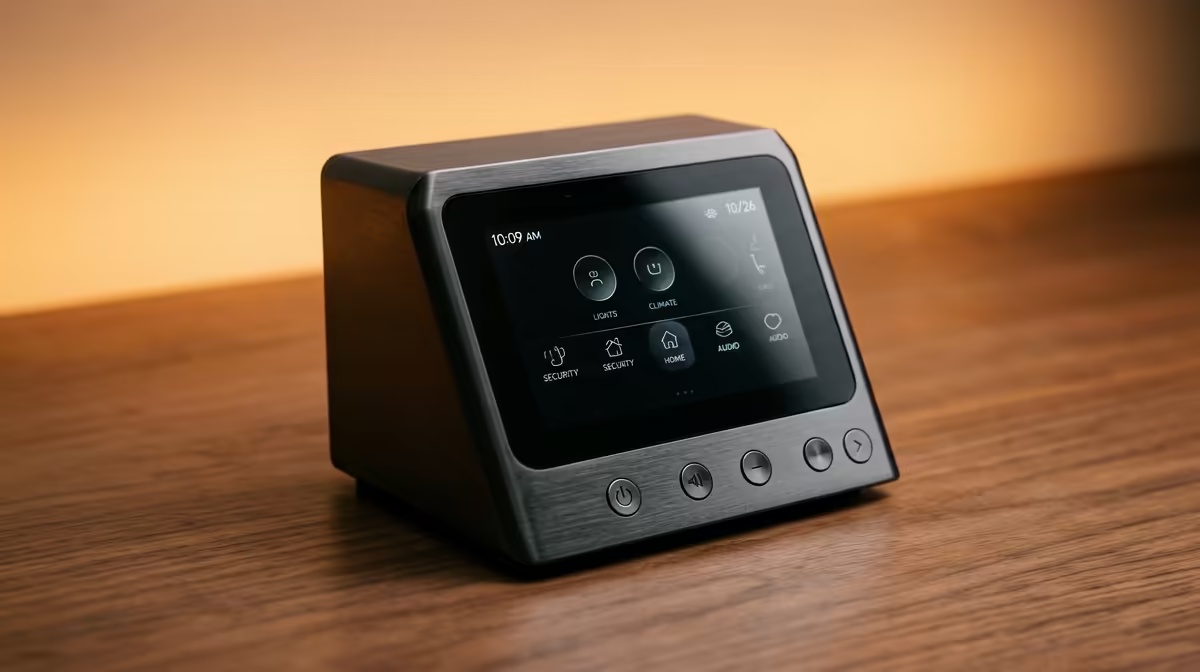
Picking hardware for Home Assistant in 2026 really comes down to one fork in the road: a Raspberry Pi 5 paired with proper SSD storage, or a low-power N100 mini PC with room to grow. Both run Home Assistant OS happily, both sip electricity, and crucially both are buyable through SA retail rather than waiting on an import of the official HA Green. The right pick depends on how many devices, cameras and add-ons you intend to throw at it.
Quick Answer
For most SA smart homes a Raspberry Pi 5 with an NVMe SSD is the sweet spot, solving the SD-card wear that plagues older Pi setups. Step up to an N100 mini PC if you plan to run camera streams, multiple add-ons or local automations that need more CPU headroom. Both stay available locally, unlike the import-only HA Green.
Why Storage Matters More Than You Think
The classic reason a Home Assistant install dies is not a weak processor, it is a worn-out microSD card. Home Assistant writes its database constantly, and consumer SD cards are simply not built for that endless logging. Within months a budget card can corrupt and take your whole config with it.
This single fact reshapes the hardware decision. A Pi running off SD is a ticking clock; a Pi running off an NVMe SSD via a HAT, or a mini PC with its own SSD, is reliable for years. Whatever you choose, plan for SSD storage from day one.
Option 1: Raspberry Pi 5 With NVMe
The Pi 5 is a genuine leap over the Pi 4 in CPU speed and, importantly, gains a PCIe interface that lets you bolt on an NVMe SSD via an M.2 HAT. That combination fixes the storage problem and gives you snappy performance for a typical home of lights, sensors, switches and a handful of automations.
What It Handles Well
A Pi 5 with SSD comfortably runs Home Assistant OS, the common integrations, and lightweight add-ons like a database, a dashboard, and Zigbee or Matter coordination through a USB stick. For the majority of SA households this is all you ever need, and the low idle power means leaving it on around the clock costs very little.
NVMe SSD Notes for the Pi 5
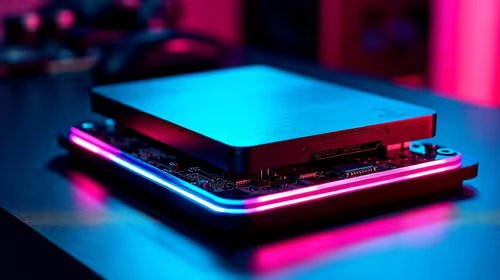
The official Raspberry Pi M.2 HAT+ connects via the FFC cable to the Pi's PCIe port and supports 2230 and 2242 form-factor drives. Standard desktop NVMe drives in the 2280 format are too long to fit the official HAT, so shop specifically for 2230 or 2242 M.2 drives. Sequential read speeds on NVMe hit 400-900 MB/s on the Pi 5, versus 20-90 MB/s on a typical SD card -- the difference shows immediately in boot time and database write speed. Full Home Assistant backups that took over two minutes on a Pi 4 with SSD typically complete in around 30 seconds on a Pi 5 with NVMe.
Where It Strains
The Pi's limit shows when you ask it to transcode or process video. Several simultaneous camera feeds, heavy local voice processing, or a stack of demanding add-ons will push it harder than is comfortable. That is the signal to look at a mini PC instead.
Option 2: N100 Mini PC
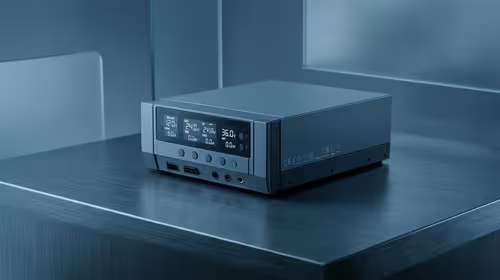
An Intel N100 mini PC brings noticeably more CPU muscle and usually arrives with a proper SSD already inside, so the storage question is solved out of the box. It still idles at low wattage, which keeps it sensible to run continuously, but it has the headroom a Pi lacks.
The Camera and Add-On Advantage
Where the N100 earns its place is multitasking. It can hold camera streams, run a local recording or detection add-on, and still keep your automations instant. If your smart home includes security cameras you want recorded and analysed locally rather than in someone's cloud, the mini PC is the more comfortable base. You can browse suitable mini PCs and smart-home gear together in the smart home and appliances range at Evetech to size one to your plans.
Power Draw in Context
The N100 typically draws around 6-10 W at idle, compared to roughly 5-8 W for a Pi 5 in normal use. For always-on hardware running 24/7, both figures are modest, and the difference on a monthly electricity bill is small enough to be irrelevant compared to the subscription costs you replace. A small UPS adds clean-shutdown protection for either choice without significantly raising costs.
The Trade-Off
A mini PC costs more than a bare Pi and is slightly less tinker-friendly for hardware HATs and GPIO projects. If you love the Pi ecosystem of add-on boards, that flexibility has real value. For pure Home Assistant reliability, the mini PC simply has more in reserve.
The HA Green Question
The official Home Assistant Green is a tidy, purpose-built box, but in SA it is typically import-only, which means longer waits and import overhead. Both the Pi 5 and an N100 mini PC are locally stocked alternatives that do the same job, often with more flexibility, and you can have them running this week rather than next month.
How to Choose
- Lights, sensors, switches, a few automations: Raspberry Pi 5 with NVMe SSD.
- Multiple local camera streams or heavy add-ons: N100 mini PC.
- You enjoy hardware HATs and GPIO tinkering: lean Pi.
- You want the most headroom with the least fuss: lean mini PC.
Whichever you pick, do not skimp on storage, and pair it with a quality Zigbee or Matter USB coordinator for reliable device control. To see what other SA buyers are running, the accessories that sell fastest at Evetech include many of the sticks, SSDs and cables a home server build needs.
Frequently Asked Questions
Is a Raspberry Pi 5 powerful enough for Home Assistant?
Yes, for most homes a Pi 5 with an NVMe SSD runs Home Assistant OS, common integrations and light add-ons smoothly. It only strains under multiple camera streams or heavy video processing.
Why does Home Assistant need an SSD instead of an SD card?
Home Assistant writes to its database constantly, which wears out consumer SD cards within months and risks corruption. An SSD handles that write load reliably for years.
Should I buy a mini PC or a Raspberry Pi for Home Assistant?
Choose a Pi 5 with SSD for a standard smart home, or an N100 mini PC if you need to run camera streams, local recording or many add-ons at once. The mini PC has more CPU headroom.
Can I run Home Assistant with cameras on a Pi 5?
A Pi 5 can handle a single camera, but several simultaneous streams with local recording or detection are better suited to an N100 mini PC, which has the processing power to spare.
What NVMe size fits the Raspberry Pi 5 M.2 HAT+?
The official HAT+ only accepts 2230 and 2242 form-factor drives. Standard 2280 desktop drives are too long, so confirm the drive length before buying. Third-party HATs with longer brackets can accept 2280 if you prefer that format.
Is the Home Assistant Green available in South Africa?
The HA Green is typically import-only locally, meaning longer waits and import overhead. A locally stocked Pi 5 or N100 mini PC does the same job and is available far sooner.