Quick Answer
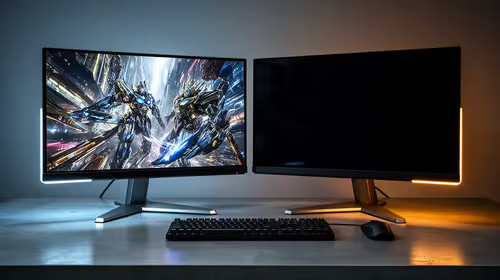
For competitive gaming on a ZAR budget, prioritise refresh rate and response time over resolution. A 1080p 240Hz fast IPS or TN monitor at R3,500 to R6,000 outperforms a 1440p 60Hz panel for FPS, racing, and battle royale titles where frame rate and motion clarity are primary.
The Right Specs at Each Budget Band 💰
At R3,000 to R5,000, a 24-inch 1080p 240Hz panel with VRR support is achievable from brands like Gigabyte and AOC. These monitors hit 0.5ms to 1ms GTG on fast IPS panels and support FreeSync Premium, which eliminates tearing even when frame rates vary between 90 and 240 fps.
At R5,000 to R8,000, the jump to 27-inch 1440p 165Hz or 1080p 360Hz becomes available. For a competitive player who also consumes media and works on the same display, the 27-inch 1440p 165Hz option is the more versatile purchase.
At R8,000 to R12,000, 27-inch QHD 300Hz fast IPS panels are accessible, representing the premium tier of the competitive monitor market. This range suits players who have already invested in a high-end GPU like an RTX 5070 Ti or RX 9070 XT that can drive high frame rates at 1440p.
Specs That Are Overrated for Competitive Play 🔧
HDR performance is frequently advertised on competitive gaming monitors but rarely delivers meaningful benefit. True HDR1000 requires local dimming zones, which drives cost high. Budget and mid-range monitors with HDR400 certification do not have the brightness or local dimming to produce a convincing HDR image, and in competitive titles, HDR can reduce shadow detail in dark areas that matter for spotting opponents.
Colour gamut width is similarly secondary for competitive play. A monitor covering 130 percent of sRGB is vivid but does not help you track enemies faster. Spend that spec budget on confirmed response time and overdrive quality instead.
Connectivity and Ergonomics That Actually Matter 🖥️
DisplayPort 1.4 is essential for 1440p 300Hz or 1080p 360Hz at full colour depth. Check that your GPU and monitor both have DisplayPort 1.4 before assuming the full refresh rate is available.
For South African buyers at university residences or sharing a desk setup, a monitor with a compact stand and VESA 100x100 compatibility is practical. A compact stand takes up less desk real estate, and VESA compatibility means a wall mount or arm can be added later if the desk shrinks further.
Set Your In-Game Refresh Rate Explicitly ⚡
After connecting a new monitor, open the game's video settings and confirm the refresh rate is set to the monitor's maximum, not the default 60Hz many games apply on first launch. In Windows, also verify the refresh rate under Display Settings, Advanced Display Settings, and set it to the monitor's maximum. Missing this step leaves significant performance on the table.
FAQ
Is 144Hz still worth buying in 2026 for competitive gaming?
Yes, if the panel is fast IPS with VRR at a budget under R4,000. The experience improvement from 60Hz to 144Hz is larger than 144Hz to 240Hz, and a well-tuned 144Hz IPS panel is a solid entry point for competitive gaming on a tight budget. Many SA student gamers run 144Hz setups effectively at major LAN events.
Does a smaller screen give a competitive advantage?
Some competitive players prefer 24-inch over 27-inch for a tighter field of view that keeps all screen elements within natural peripheral vision. The advantage is marginal and personal: try both sizes at a store before committing.
Should I prioritise monitor or GPU when budgeting for competitive gaming?
GPU first. A fast monitor on a slow GPU produces a mediocre experience, because the monitor's high refresh rate is underused. A mid-range GPU paired with a budget 240Hz monitor delivers better competitive performance than a premium monitor driven by an underpowered card.
Building a competitive setup on a ZAR budget?
Evetech stocks gaming monitors from R3,000 and up, with options at 144Hz, 240Hz, and 300Hz to match your GPU and budget. Browse the monitors section to find the right starting point.