Buy a stack of cheap desktop drives for your NAS and you will eventually pay for it, usually halfway through a RAID rebuild when the array grinds to a crawl or drops a disk. The best NAS hard drives are purpose-built for always-on, multi-bay life: CMR recording, a serious workload rating, and firmware tuned for vibration in a crowded enclosure. For 2026 the WD Red Plus and Seagate IronWolf families are the sensible core of any home or small-office build.
Quick Answer
The best NAS hard drives are CMR models rated for NAS duty. WD Red Plus and Seagate IronWolf both carry a 180TB/year workload rating and spin at 5400 RPM, while their Pro tiers move to 7200 RPM and a 300TB/year rating. Avoid desktop SMR drives, which throttle badly during RAID rebuilds and risk dropping out of the array.
Why NAS Drives Are a Different Animal
A drive in a NAS is not a drive in a PC. It runs around the clock, sits next to several other spinning disks that vibrate, and is expected to survive a rebuild where every sector gets read in a sustained burst. NAS-specific drives are built for exactly that: anti-vibration sensing, firmware that handles RAID error recovery sensibly, and a workload rating that tells you how much data the drive is rated to read and write per year.
That workload rating is the number most people skip. A typical NAS-class drive is rated for 180TB per year, while a desktop drive is often rated far lower and is simply not designed for the constant access a NAS generates. Push a desktop drive past its comfort zone in an always-on array and you are trading a small upfront saving for a far higher failure risk. Evetech stocks the enclosures and bays these drives slot into at the diskless NAS and storage page, so you can size the chassis and the drives together in one place.
CMR vs SMR: The One Spec That Matters Most
If you read nothing else, read this. CMR (conventional magnetic recording) writes tracks side by side without overlap, so writes are consistent and fast. SMR (shingled magnetic recording) overlaps tracks like roof shingles to pack in more capacity, which is fine for archival but disastrous for the random, sustained writes a RAID rebuild demands.
The danger is that SMR drives have slipped into "desktop" ranges quietly. Drop one into a parity array and a rebuild can slow to a crawl as the drive struggles to keep up, sometimes timing out and being marked failed by the controller. Every drive in the WD Red Plus and Seagate IronWolf NAS lines uses CMR, which is precisely why they belong in an array and budget SMR desktop drives do not.
The 2026 Picks
WD Red Plus
The Red Plus is the dependable mainstream choice. It uses CMR across the range, spins at 5400 RPM for lower heat and noise, and carries a 180TB/year workload rating on a three-year warranty. Capacities run up to 14TB, so it suits small home builds and larger media libraries alike. WD tends to hold a slight edge on power draw and acoustics in multi-bay setups.
One important note: the standard WD Red (without the Plus suffix) is still sold and is still SMR. Always confirm the full product name before purchasing, since the two look similar in listings but behave very differently under RAID load.
Seagate IronWolf
The IronWolf is the direct counterpart and matches the formula closely: CMR recording, 5400 RPM on the mainstream models, and a 180TB/year workload rating. It is a strong all-rounder for a four-bay home NAS and competes closely with Red Plus on price and performance. The standard IronWolf range currently spans 1TB to 8TB.
When to step up to Pro
If your NAS sees heavier multi-user access, larger bay counts, or hosts active work rather than mostly storage, the Pro tiers earn their premium. WD Red Pro and Seagate IronWolf Pro move to 7200 RPM, a 300TB/year workload rating, a five-year warranty, and support for higher bay counts. IronWolf Pro currently leads on headline capacity, with drives available up to 30TB for the largest builds.
Sizing Your Drives
Buy for where your data will be in three to five years, not where it is today. It is cheaper and less disruptive to fit larger drives now than to migrate the whole array later. Remember that RAID redundancy eats capacity: a four-bay array with single-drive parity gives you roughly three drives' worth of usable protected space.
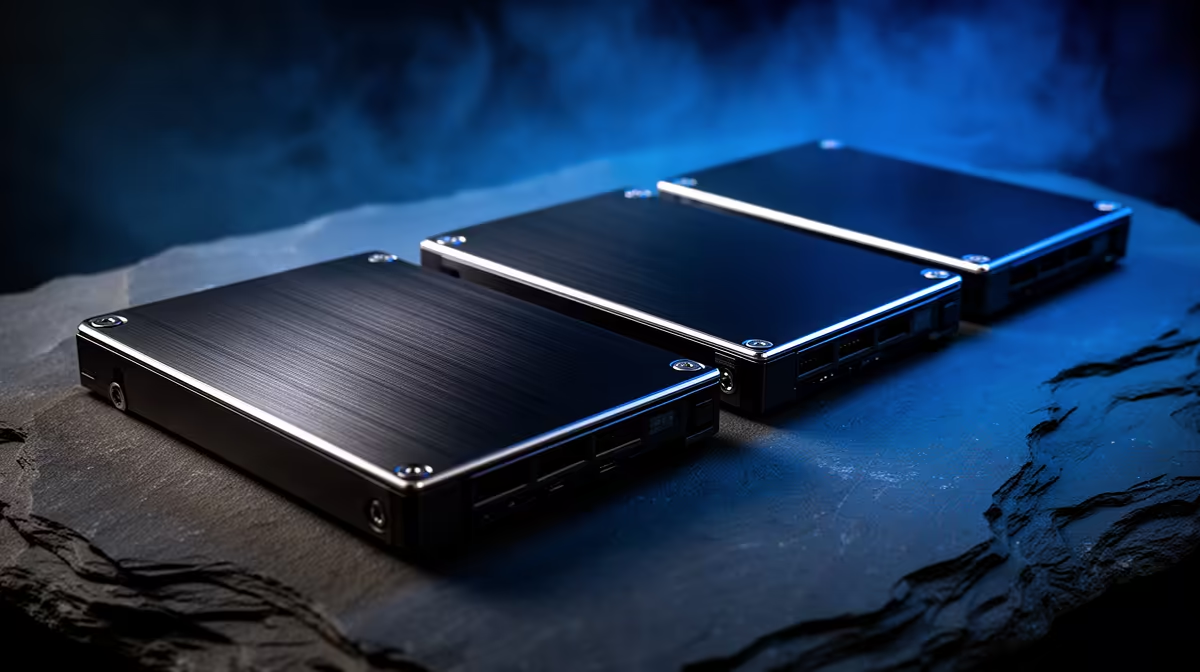
Many NAS units also accept a small SSD as a read or write cache to lift random-access performance without giving up the capacity advantage of spinning hard drives. Evetech's SSD collection covers the solid-state options suitable for that kind of caching role, including popular M.2 NVMe models that slot directly into compatible enclosures.
Frequently Asked Questions
What does a workload rating actually tell me?
It is the amount of data, in terabytes per year, the manufacturer rates the drive to read and write while staying within warranty expectations. NAS drives sit around 180TB/year for mainstream models and 300TB/year for Pro tiers, well above what a typical desktop drive is built for.
Can I mix WD Red Plus and Seagate IronWolf in one NAS?
You can, as both are CMR NAS drives with comparable ratings, and many people do. For the cleanest performance and easiest support, matching capacity and ideally the same family per array is tidier, but mixing the two brands will not break anything.
Why is SMR such a problem for RAID?
SMR drives rewrite overlapping tracks, which makes sustained writes slow and unpredictable. During a RAID rebuild the controller hammers every drive with continuous writes, and an SMR drive can fall so far behind that the array marks it as failed, putting your data at risk.
Do I need Pro drives for a home NAS?
Usually not. For a home media server or backup target, mainstream Red Plus or IronWolf drives are well matched and quieter. Step up to Pro when you have many bays, several heavy simultaneous users, or you are running active workloads rather than mostly storage.
How big should each drive be?
Size for three to five years of growth, not today's library. Larger drives now save you a disruptive migration later, and because parity consumes one drive's worth of space, buying a bit more capacity per disk keeps usable space comfortable as the array fills.
A NAS is only as reliable as the drives inside it, so start with CMR, NAS-rated disks and size them for the years ahead. Browse Evetech's diskless NAS and storage range to pair the right enclosure with WD Red Plus or IronWolf drives.