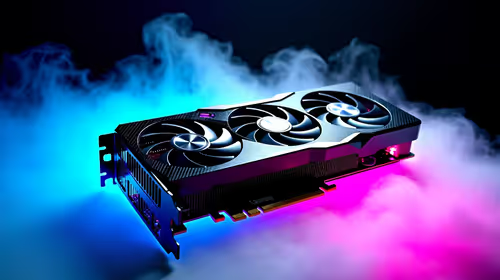
Running OpenCode against a model on your own hardware turns coding assistance into a fixed hardware cost instead of a monthly token bill, and the one spec that decides whether it works is video memory. OpenCode itself is lightweight; the weight sits in the local language model it drives. A capable 32-billion-parameter coding model needs roughly 20GB of VRAM once quantised, which means a 24GB card such as the RTX 5090 is the realistic entry point for South African developers who want the assistant fully offline and free of cloud credits.
Quick Answer
The best PC for OpenCode with a local model is VRAM-bound, not CPU-bound. A 32B coding model quantised to around 20GB needs a 24GB GPU like the RTX 5090. Pair that card with 64GB of system RAM and a quick NVMe SSD, and you eliminate recurring cloud token costs entirely.
Why VRAM Decides Everything
The model weights must load into GPU memory before a single token can be generated. That memory is the card's VRAM, and it runs far faster than spilling over into system RAM. When the model fits entirely in VRAM, OpenCode responds quickly and stays responsive across long sessions. When it does not fit, the runtime offloads layers to the CPU and RAM, and generation slows to a crawl that makes the assistant frustrating to use for real work.
This is why the GPU, not the processor, leads the build. A mid-range CPU paired with a 24GB GPU will run a 32B model comfortably, while a top-end CPU paired with an 8GB GPU will choke on the same model. If you are weighing up which card to centre the machine on, the Evetech GPU best sellers reflect the cards local buyers are choosing for AI workloads right now.
Matching Model Size to Your Card
Coding models come in several sizes, each with a different memory footprint, so the card you choose follows directly from the model tier you plan to run.
Entry: 7B to 14B Models on 12GB to 16GB
A 7B or 14B model quantised to 4-bit fits inside 12GB to 16GB of VRAM. These handle autocomplete, small refactors, and quick questions well. They are noticeably weaker at multi-file reasoning and large context, but for a developer testing the local route before committing, a 16GB card is a sensible starting point.
The Sweet Spot: 32B Models on 24GB
A 32B model at 4-bit quantisation lands near 20GB, leaving headroom for context inside a 24GB card. This is where local OpenCode starts to feel genuinely productive, with stronger code reasoning, better adherence to instructions, and enough context window for working across several files. The RTX 5090 with 24GB sits squarely in this bracket and is the model most SA developers will target for serious daily use.
Ambitious: 70B Models and Beyond
Models in the 70B range need far more than a single consumer card can hold, typically demanding dual GPUs or workstation-class memory. For most individual developers this is overkill, and the price climbs steeply for marginal gains over a well-run 32B model. The 32B-on-24GB configuration remains the practical ceiling for a single-card build.
The Rest of the Build
The GPU is the headline, but a balanced machine avoids bottlenecks elsewhere. Aim for 64GB of RAM so the OS, your editor, and any offloaded model layers all have room without swapping. Use an NVMe SSD of at least 1TB, because model files each run to many gigabytes and you will want several variants on hand. A current-generation CPU with strong single-thread performance keeps OpenCode and your editor snappy, though you do not need the most expensive chip on the shelf.
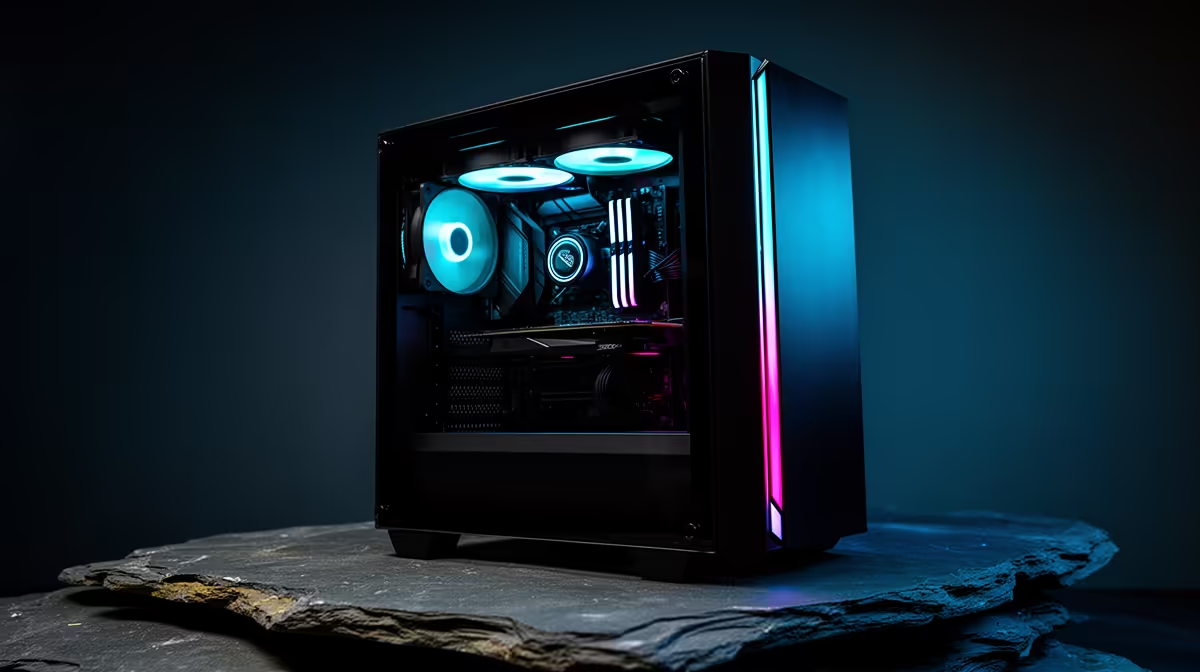
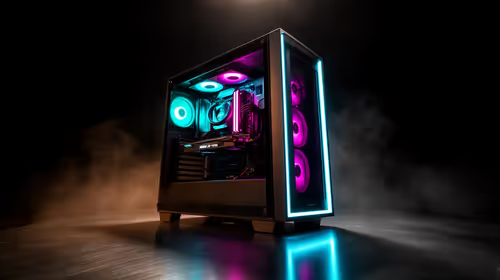
Power and cooling matter at this tier. A 24GB flagship card draws serious wattage under sustained load, so an adequately rated power supply and a well-ventilated case are both essential, not optional extras. Evetech assembles machines built specifically for these workloads, and the purpose-built AI PC range is configured around exactly this kind of VRAM-first balance.
The South African Cost Case
The argument for going local is sharpest here. Cloud coding assistants bill per token, and for a developer working full days that recurring cost adds up month after month in Rand, with the added friction of needing a steady connection. A local build is a one-time hardware purchase that then runs offline indefinitely, with no usage meter ticking. For SA developers who already pay for a capable workstation, adding a 24GB card to run OpenCode locally converts an ongoing expense into a fixed asset, and the model never leaves your machine, which matters for proprietary code.
Who This Build Is For
This setup makes sense for professional developers who use a coding assistant daily, teams that want code kept on-premises for privacy, and anyone tired of watching a token counter. If you only use an assistant occasionally, a smaller 16GB card running a 14B model covers the basics at a lower entry price. The deciding question is simple: how large a model do you need, and how much VRAM does that model demand once loaded. To see which complete desktops fit the bill across different budgets, the PC best sellers at Evetech show what SA buyers are choosing for local AI and developer workloads right now.
Frequently Asked Questions
How much VRAM do I need to run OpenCode with a local model?
It depends on the model. A 32B coding model quantised to 4-bit needs around 20GB, so a 24GB card like the RTX 5090 is the realistic target. Smaller 7B to 14B models fit in 12GB to 16GB if you want a cheaper entry point.
Is the CPU or the GPU more important for OpenCode?
The GPU, because the local model loads into VRAM and runs there. A mid-range CPU with a 24GB GPU outperforms a top-end CPU with a small GPU for this workload. Spend your budget on video memory first.
Can I run OpenCode locally without any cloud connection?
Yes. Once the model is downloaded and loaded onto your GPU, OpenCode drives it entirely on your machine with no internet required and no per-token billing. That offline independence is the main reason developers choose this path.
What model size gives the best results for coding?
A 32B model is the practical sweet spot for a single 24GB card, offering strong multi-file reasoning without needing dual GPUs. Models of 70B and above give modest gains but demand far more expensive hardware.
How much system RAM should the build have?
Aim for 64GB. That gives the operating system, your editor, and any overflow model layers enough room, and it future-proofs the machine for larger context windows and heavier projects.
Does going local actually save money versus a cloud assistant?
For heavy daily users, yes. A cloud assistant charges per token every month, while a local build is a single hardware purchase that then runs at no usage cost. The break-even depends on how intensively you use it, but full-time developers reach it quickly.
Ready to drop the token meter and run your coding model in-house? Explore the AI PC range at Evetech, built VRAM-first for local model work and delivered across South Africa.