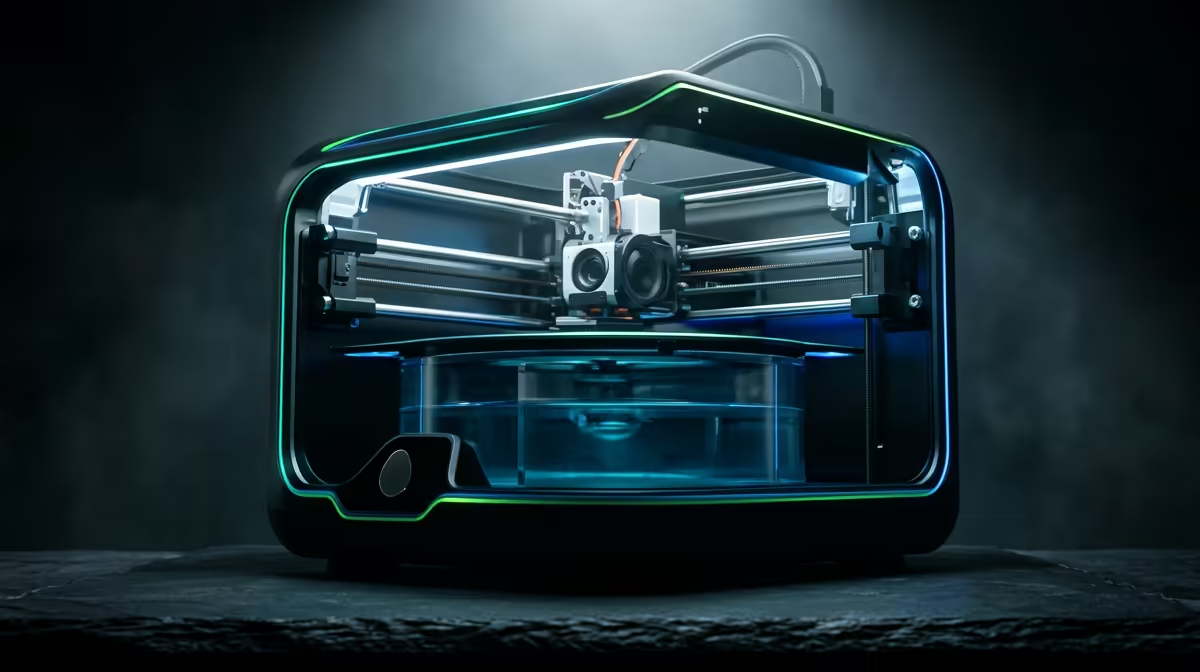
Outgrowing an entry-level printer usually shows up the same way: a face sculpt loses its crispness, a miniature's chainmail blurs into a smudge, and the build plate runs out of room before the print run does. The R5,000 to R10,000 resin 3D printer bracket exists to fix exactly that, sitting above the R3,999 Halot R6 starter and below the premium Halot-X1 tier with bigger plates, faster mono LCDs, and the 4K to 8K screen resolutions that make detail work sing.
Quick Answer
In the R5,000 to R10,000 band you are buying a larger 8K mono LCD with a build plate roughly 218 x 123mm or bigger, which is where serious miniature painters and prop makers land. Expect XY resolutions near 19 to 28 microns and print speeds two to three times faster than a basic mono screen. It is the sweet spot before you start paying premium money for marginal gains.
What changes when you cross R5,000
The jump out of the entry tier is not subtle. The biggest single upgrade is the LCD itself: entry machines often run 2K or 4K panels, while this bracket brings 8K mono screens that pack pixels tighter across a wider plate. More pixels over a bigger area means you can scale up a model without each individual layer line getting coarser.
Build volume is the second win. Entry printers force you to slice a helmet into four pieces and glue them. A mid-tier plate around 218 x 123 x 230mm lets you print a full pauldron or a 32mm regiment in one go, which saves both seam cleanup and the silent frustration of a failed glue join.
The third gain is speed. Mono LCD panels cure a whole layer in one to three seconds, so a tall print that took twelve hours on an older RGB screen finishes in four or five. For anyone running a small side hustle from a Cape Town flat, that throughput difference is the difference between fulfilling orders and falling behind. It also means you can run more test prints in an evening, which is how you actually learn to tune supports and exposure rather than guessing.
There is a fourth, quieter benefit: light uniformity. Mid-tier machines spread their UV light more evenly across the larger plate, so a model printed near the edge cures as cleanly as one in the centre. On cheaper screens, corner prints can come out slightly under-cured and weak, which is exactly the kind of inconsistency that wastes resin and time.
Resolution: how fine is fine enough
Reading the micron numbers
XY resolution tells you the smallest detail the screen can resolve on the horizontal plane. An 8K panel on a plate this size typically lands around 19 to 24 microns, fine enough to render a 28mm tabletop miniature's rivets and fabric folds without any post-print sculpting. Below 30 microns the human eye stops picking out individual pixels on a painted model, so you are well past the threshold that matters.
Z resolution and layer height
Z resolution is set by your stepper motor and slicer, not the screen, and most machines in this band move in 10-micron increments. For figurines, slicing at 25 to 30 micron layers gives a clean surface with reasonable print times. Drop to 10 microns only for a face or a signet ring where every pass counts, because halving the layer height roughly doubles the print duration.
Build plate and tank: the unglamorous parts that decide your week
A larger plate needs even Z-axis levelling, and the better mid-tier machines use a single-point or four-point levelling system that holds calibration for weeks instead of drifting after every print. Look for a laser-cut or sandblasted plate surface too, since the extra tooth gives prints something to grip and dramatically cuts the odds of a model peeling off mid-job.
The resin vat (FEP or the tougher nFEP film) is a consumable. Budget for a replacement film every few hundred print hours, and keep a spare on the shelf so a punctured tank does not stop production for a week waiting on a courier.
What it costs to actually run one in SA
The printer is only the entry fee. A 1kg bottle of standard resin runs in a sensible mid-range band, and you will go through it faster than filament because supports and rafts eat material. Add a wash-and-cure station, nitrile gloves, isopropyl alcohol, and a respirator for ventilation, since resin fumes are not something to share a small room with. You can see the current spread of machines and what ships with each on the dedicated resin and FDM printer range, which makes comparing plate sizes and screen specs straightforward.
For the consumables and finishing kit that turn raw prints into clean parts, the gear that moves fastest with local makers is worth scanning first, and you will find most of it grouped in the top-selling accessories list.
Who should buy in this bracket
If you print the occasional keychain, the entry tier is plenty and the upgrade money is better left in your pocket. This band earns its price for three buyers: the tabletop gamer painting full armies who needs plate space, the cosplayer printing detailed insignia and jewellery, and the side-hustle seller whose order book has outgrown a starter machine's slow cycle. If any of those is you, the speed and surface quality pay for themselves inside a few months of regular printing.
Frequently Asked Questions
Is an 8K printer always better than a 4K one?
Not automatically. What matters is pixel density across your actual plate size, so a smaller 4K plate can match a larger 8K plate's sharpness. For big models or fine detail at scale, the 8K screen on a wider plate wins, which is exactly why it dominates this price band.
How much resin will I get through?
A typical 28mm miniature uses only a few grams, but supports and rafts add overhead, so a 1kg bottle might yield 100 to 200 small models depending on your support density. Larger props can swallow several hundred grams each. Always budget resin as an ongoing cost, not a one-off.
Do I need a separate wash-and-cure station?
Strongly recommended. Hand-washing in isopropyl and curing under a desk lamp works but is slow and inconsistent. A dedicated station gives even UV curing and repeatable results, and it keeps the messy alcohol step contained, which matters in a small home workspace.
Can these printers handle tough functional parts?
Standard resin is brittle, so for parts that flex or take impact you switch to a tough or ABS-like resin. These print on the same machines with adjusted exposure settings, though the surface finish is slightly less crisp than standard resin.
Is ventilation really necessary?
Yes. Uncured resin gives off fumes you do not want to breathe in an enclosed room. Print near a window, run a small extraction fan, and wear nitrile gloves at every step. Treat it as a workshop activity, not a desk hobby.
Ready to move up from entry-level detail? Compare plate sizes, screen resolutions and bundled extras across the full resin and FDM printer range at Evetech and pick the machine that matches your build volume.