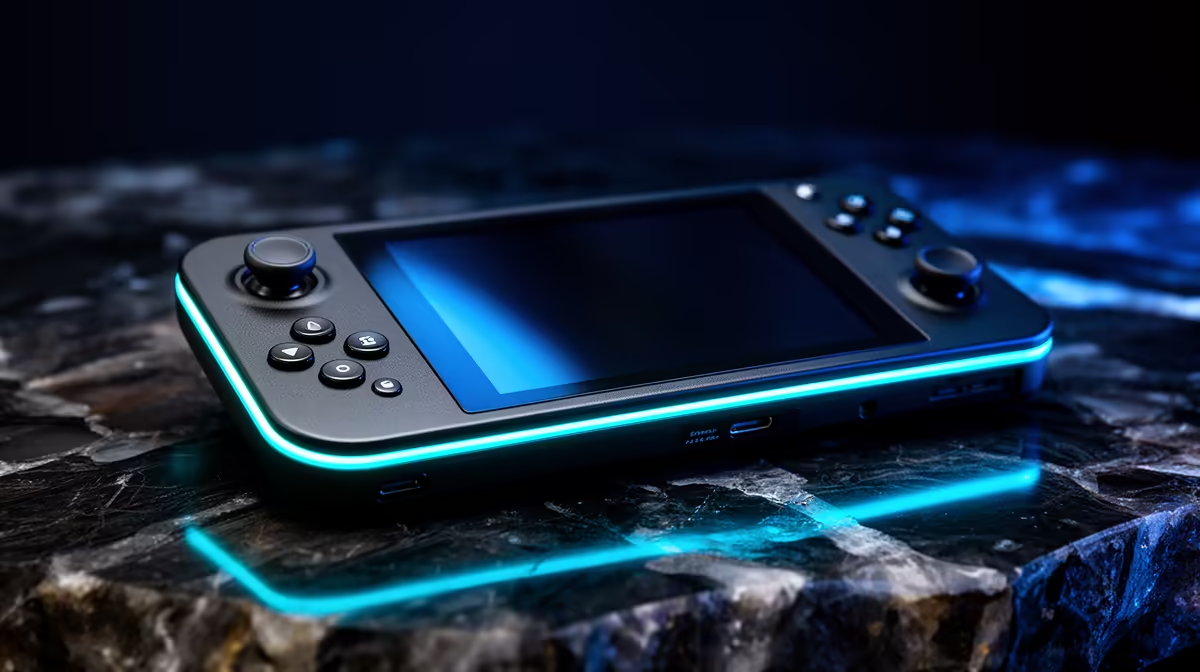
N64 and Nintendo DS pull in opposite directions, which is why picking one handheld for both takes thought. The best retro handheld for N64 and DS games has to do two unrelated jobs well: push enough raw horsepower to run demanding Nintendo 64 titles at full speed, and offer a layout that respects the DS dual-screen design. The Retroid Pocket Flip 2 is the unit that lands closest to both, folding shut like a 3DS XL while packing a chip strong enough for the harder N64 library.
Quick Answer
The Retroid Pocket Flip 2, around the R4,500 to R5,500 mark depending on configuration, is the standout pick. Its Snapdragon 865 runs nearly the full N64 library at full speed, and the clamshell form factor suits DS games better than any flat handheld, even though it has a single screen rather than two.
Why N64 Is the Harder Half
It is tempting to assume both systems are trivial for modern hardware. They are not, and N64 is the one that catches people out.
Nintendo 64 emulation has always been awkward. Its graphics hardware did unusual things, and getting consistent, full-speed performance across the catalogue needs more processing grunt than the console's age suggests. Cheaper handhelds running entry-level chips stumble on the demanding titles, dropping frames or glitching textures.
The Snapdragon 865 inside the Retroid Pocket Flip 2 clears that bar comfortably, handling nearly all N64 games at full speed and reaching all the way up through PS2 and GameCube. That headroom matters: a chip that only just manages N64 today will struggle the moment you want anything heavier.
Why DS Wants a Clamshell
The Nintendo DS was built around two screens stacked vertically, with the lower one used for touch input. Emulating that on a single flat screen forces a compromise: either squash both displays into one panel, shrinking everything, or show one screen at a time and toggle between them.
A clamshell handheld changes the feel even with a single physical screen. Folding the device echoes the original DS and 3DS hardware, the hinge protects the screen and controls in a bag, and the form factor sits naturally in the hands for the kind of games the DS was known for. The Flip 2 opens smoothly to roughly 180 degrees on a hinge that holds up to repeated use rather than developing the creaks that plague flimsier units.
The Single-Screen Caveat
Be clear-eyed about one thing: the Flip 2 evokes the DS lineage but does not have two physical screens. You emulate the dual-screen layout on its one 5.5-inch AMOLED panel. For most DS games this works well, with the two virtual screens arranged on the single display. If a true two-screen experience is non-negotiable for you, that is a genuine limitation to weigh.
What Else the Flip 2 Brings
Beyond raw capability, the day-to-day experience is what makes a handheld worth keeping.
The 5.5-inch AMOLED display delivers deep blacks, strong colour and brightness up to around 500 nits, which holds up in bright South African daylight better than dimmer LCD panels. DC dimming keeps it comfortable in the dark. As an Android device, it also runs far beyond retro systems: streaming apps, Android games and cloud gaming all sit alongside the emulators.
Hall-Effect Sticks and Build Quality
The Flip 2 uses hall-effect analogue sticks, measuring stick position magnetically rather than through physical contacts, which means the drift that plagued earlier budget handhelds is not a concern here. The hinge mechanism has been tested across thousands of open-and-close cycles and holds position firmly. At 8GB of RAM and 128GB of UFS 3.1 storage, it matches the flat Retroid Pocket 5 spec for spec, so the clamshell shape is not a performance compromise, it is purely a form-factor choice.
Emulation Scope
Because the Snapdragon 865 and Adreno 650 combination is comfortably ahead of what N64 and DS demand, there is genuine headroom for heavier systems. PSP, Dreamcast, and most of PlayStation 2 and GameCube are reachable, so the Flip 2 works as a complete retro machine rather than a narrow specialist.
Finding Your Configuration
For buyers who want the N64 power without the clamshell, flat Android handhelds on similar or stronger chips are a valid path. The handheld gaming console range at Evetech covers both styles so you can compare them directly. To get a feel for what South African gamers are actually spending on right now, the PC best sellers is a useful reference before you commit.
Frequently Asked Questions
Can the Retroid Pocket Flip 2 really run all N64 games?
It runs nearly the entire N64 library at full speed thanks to the Snapdragon 865, and it reaches up through PS2 and GameCube. A small number of historically tricky N64 titles can still need per-game tweaks, which is normal for the system.
Does it have two screens like a real Nintendo DS?
No. It is a single-screen clamshell. DS games run with both virtual screens arranged on the one 5.5-inch panel. The folding design recalls the DS and 3DS, but there is only one physical display.
Is a clamshell better than a flat handheld for these systems?
For DS games the folding form factor feels more natural and protects the screen. For N64 the chip matters more than the shape. The Flip 2 happens to offer both, which is why it suits a mixed N64 and DS library.
Will it handle systems beyond N64 and DS?
Yes. The same Snapdragon 865 and Adreno 650 hardware covers every older console easily and pushes well into PS2 and GameCube, so the Flip 2 doubles as a general retro and Android gaming device rather than a narrow single-purpose machine. PSP and Dreamcast run at full speed with headroom to spare, and the active-cooling approach the Flip 2 uses keeps sustained performance stable over longer sessions rather than throttling mid-game.
How does it compare to the flat Retroid Pocket 5?
The Flip 2 and the Pocket 5 share the same Snapdragon 865 chip, 8GB of RAM and 128GB of UFS 3.1 storage, so gaming performance is virtually identical between them. The Pocket 5 carries a larger 5.5-inch 1080p OLED panel in a flat slab form, which suits couch gaming, while the Flip 2 folds shut for bag carry and protects the screen and sticks between sessions. The clamshell adds a little weight but no performance cost, making the choice purely about how and where you play.
Is the screen bright enough for outdoor use?
The AMOLED panel reaches around 500 nits, which is usable in bright daylight, and DC dimming keeps it easy on the eyes in low light.
Do the analogue sticks develop drift over time?
No. The hall-effect sensors measure position magnetically with no physical wear, which removes the root cause of stick drift entirely. This is one of the Flip 2's most practical long-term advantages over cheaper handhelds.