Quick Answer
For under R1,000, prioritise UHS-I U3 (V30) rating, a minimum 100MB/s read speed, and at least 128GB capacity. Those three specs cover 4K video recording, fast burst shooting, and enough room for a full day of shooting without swapping cards.
The Specs That Actually Matter at This Price Point 💰
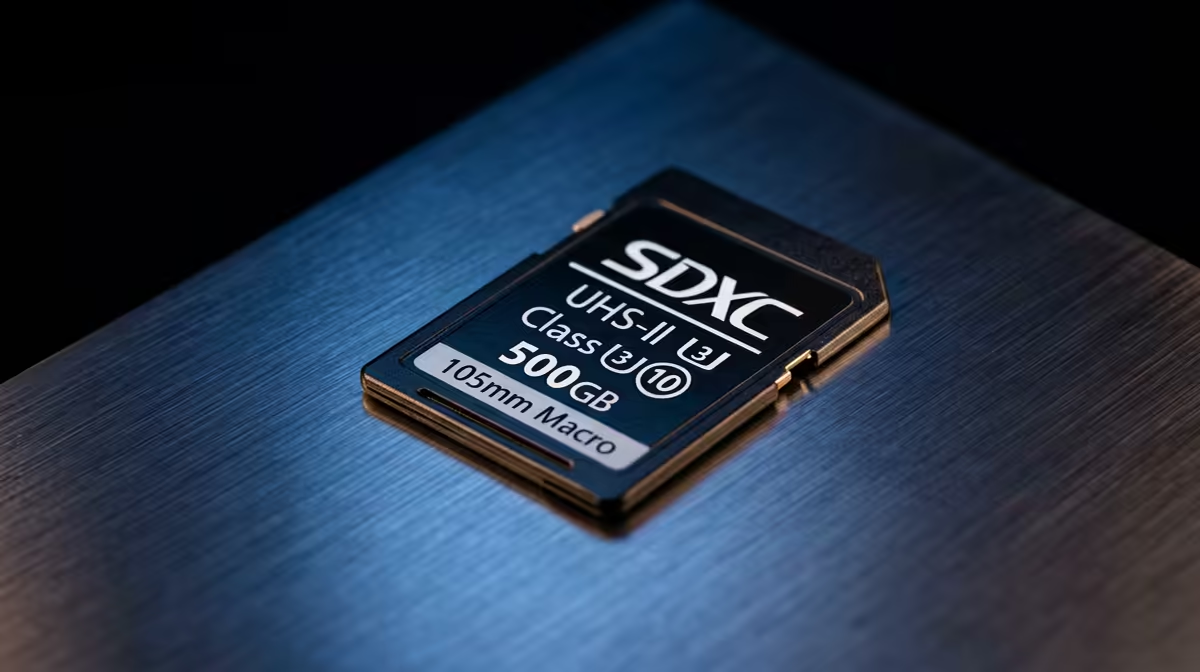
When shopping for SD cards under R1,000 in South Africa, the label on the packaging can feel like alphabet soup. The Speed Class markings tell you the guaranteed minimum write speed: Class 10 gives you 10MB/s, UHS Speed Class 1 (U1) gives you 10MB/s as well, and UHS Speed Class 3 (U3) guarantees at least 30MB/s sustained write. That 30MB/s floor is the threshold you need for reliable 4K UHD recording. The Video Speed Class V30 means the same thing in video-centric language, so U3 and V30 printed on the same card are confirming the same rating twice. Below R800 you will mostly find 128GB UHS-I U3 cards with read speeds between 100MB/s and 160MB/s; these handle 4K at 30fps comfortably on most mirrorless and DSLR bodies.
Capacity vs Speed: Which Gives You More for Your Rand 🎯
A 256GB card gives roughly 60 minutes of 4K footage at 100Mbps or around 5,000 JPEG shots. A 256GB option typically costs R600 to R950 at current South African retail, while a 128GB card in the same speed class sits closer to R300 to R500. If you shoot RAW stills exclusively and your camera writes files between 25MB and 50MB each, 128GB gets you 2,500 to 5,000 frames, which suits most event and landscape photographers. The practical advice: buy two 128GB cards rather than one 256GB at the same budget. If one card fails mid-shoot you keep half your images, and swapping cards is a natural backup routine.
Interface and Form Factor: Compatibility Checks Before You Buy 🔧
Standard full-size SD and microSD with an adapter cover roughly 95% of cameras, drones, and action cams sold in South Africa. A Sony Alpha series body uses standard SD; a DJI Mini drone uses microSD. UHS-II cards offer much higher burst throughput, reaching 300MB/s or more, but they cost upward of R1,500 for 128GB and are only useful if your camera body has a UHS-II slot, which most entry-level and mid-range bodies do not. Under R1,000, stick to UHS-I. Also confirm the card is exFAT formatted out of the box for files larger than 4GB, which every 4K clip will produce.
Check Your Camera's Max Write Speed ⚡
Before buying a faster card, look up your camera body's maximum supported write speed in the manual or manufacturer site. A Sony ZV-E10 saturates at around 100MB s regardless of what the card claims, so spending more for a 200MB s card buys nothing inside the camera. Save that rand for a second card instead.
FAQ
Do I need V60 or V90 under R1,000?
No. V60 and V90 cards are designed for 6K and 8K recording or very high bitrate Cinema DNG formats. Below R1,000 you will not find legitimate V60 cards, and most South African camera users shooting 4K at standard consumer bitrates gain nothing from V60. V30/U3 is the correct target.
Is a no-name SD card from a general online marketplace safe?
Fake or counterfeit SD cards are a real problem in the SA market. Cards labelled as 128GB but holding only 16GB of actual flash are common at suspiciously low prices. Buy from a reputable local retailer with a return policy and warranty support, and verify capacity with a benchmark tool on first use.
Can I use the same SD card for my drone and my mirrorless camera?
Yes, provided both devices use the same form factor or you use a microSD-to-SD adapter. The adapter does not reduce speed on UHS-I cards. Just reformat the card in each device before use to avoid file system conflicts.
Ready to pick the right card for your kit?
Browse SD cards currently stocked at Evetech to find UHS-I U3 options across 64GB, 128GB, and 256GB capacities, all with local warranty support.