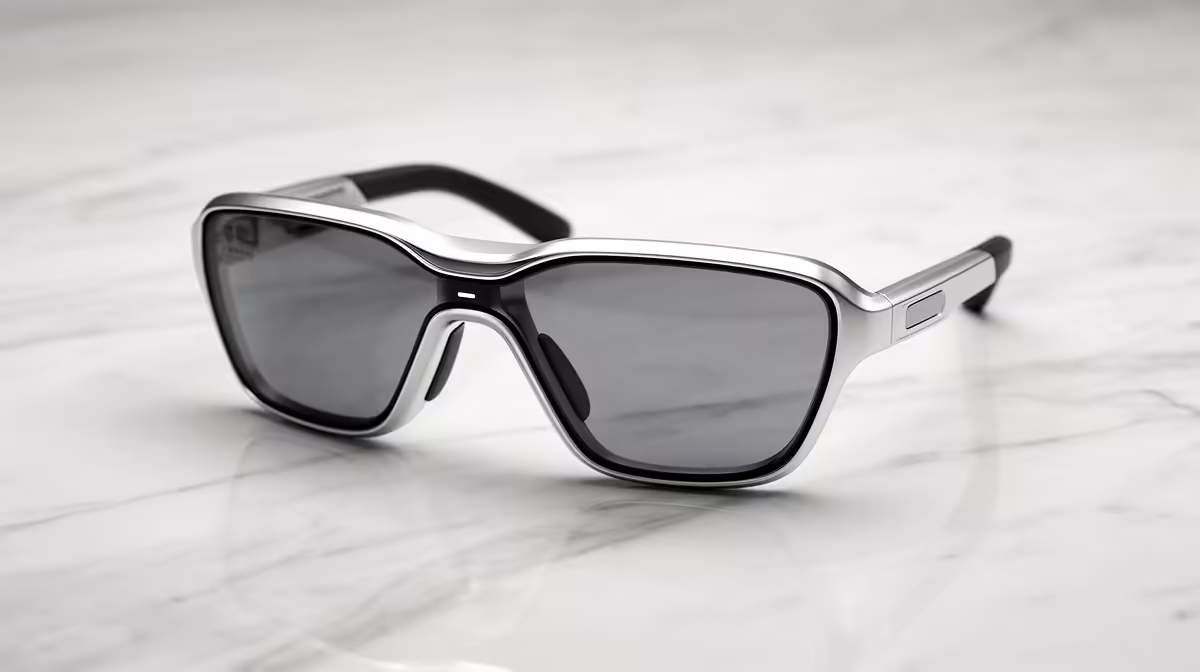
Standing in a market in Marrakech or a train station in Tokyo with no signal and no shared language is exactly the moment a phone translation app lets you down. The phone has to come out, the camera has to point, and the connection has to hold. Smart glasses for travel sidestep all of that, putting near real-time translation in your ears while your hands stay free and the phone stays in your pocket. The standout here is Ray-Ban Meta, largely because of one feature: offline language packs.
Quick Answer
For travel and live translation, Ray-Ban Meta smart glasses are the clear pick. They deliver near real-time spoken translation between English, French, Italian, and Spanish, and crucially they let you pre-download language packs that run entirely on the glasses, so translation keeps working with no Wi-Fi or mobile data. That offline ability is what makes them genuinely useful abroad rather than just a novelty at home.
How live translation actually works on the glasses
The experience is straightforward in practice. Someone speaks to you in one of the supported languages, and you hear the translation in your own language through the open-ear speakers built into the arms, in near real time. You reply, and your words can be relayed back through the paired phone. Because the speakers sit just above your ears rather than plugging into them, you stay aware of your surroundings, which matters when you are navigating a busy street rather than sitting in a quiet room.
The languages supported for live translation are English, French, Italian, and Spanish. That is a deliberately focused set rather than an exhaustive one, and it covers a large slice of European travel, but it is worth checking against your specific destination before relying on it.
What separates these glasses from a phone app is the form factor. There is no screen to hold up, no awkward moment of pointing a camera at a stranger's face, and no fumbling for the right app. The conversation feels closer to natural because you are looking at the person, not a device. To see what wearable options carry local stock, browse the AR and smart glasses at Evetech for a live picture of the category.
The offline feature that makes them travel-worthy
Plenty of devices translate when they have a strong internet connection. The problem is that travel is exactly where that connection disappears. International roaming gets expensive fast, airport and cafe Wi-Fi is patchy, and the moment you most need translation, a busy market, a rural bus stop, a border crossing, is often the moment you have no signal at all.
Ray-Ban Meta addresses this directly. You download a language pack in advance, while you still have a good connection, and the core translation model then lives on the glasses themselves. Once it is stored locally, translation runs without touching the cloud. That brings three real benefits: it works with no data or Wi-Fi, it responds faster because nothing has to travel to a server and back, and it keeps the conversation private since the audio is processed on-device.
The practical workflow is simple. Before you fly, download the packs for the countries you are visiting. On the ground, the glasses translate whether or not you have a SIM that works locally. For a traveller, that single capability moves the glasses from a clever demo into a tool you would actually pack.
What to expect from accuracy
Honest framing matters here. On-device translation is impressive, but it is not flawless. It handles clear, conversational speech well, ordering food, asking directions, basic exchanges with shopkeepers. It struggles more with heavy accents, fast overlapping speech, very noisy environments, and idiomatic or technical language. Treat it as a tool that gets you most of the way through everyday interactions rather than a perfect interpreter for complex or high-stakes conversations.
Battery, comfort, and the everyday reality
The glasses look and wear like ordinary Ray-Bans, which is half their appeal: nobody clocks them as tech. That said, translation and AI features draw on the battery, so heavy use during a long day of sightseeing means you will lean on the charging case to top them up between sessions. For travel, that case is part of the kit you carry.
Comfort is generally good for a wearable that has to sit on your face all day, and the open-ear audio design means you are not isolated from the world around you. The trade-off across all current smart glasses is that battery life under active feature use is modest compared to a passive pair of sunglasses, so plan around recharging rather than expecting all-day continuous translation.
Who should actually buy these
These glasses suit a specific traveller well: someone heading to Europe or another region covered by the supported languages, who values hands-free convenience and discreet design, and who will genuinely use translation and the built-in camera and assistant features. If that is you, the convenience is real and the offline packs are a standout.
They are a weaker fit if your destination's language is not supported, if you need precise translation for business or legal matters, or if you want a heads-up display showing translated text in your field of view, which these do not currently offer. For accessories that complete a travel tech kit, the accessories best sellers at Evetech cover the chargers and extras worth adding to your bag.
Frequently Asked Questions
Which languages does Ray-Ban Meta translate?
Live translation currently supports English, French, Italian, and Spanish. That covers a large part of European travel but not every destination, so check whether your specific language is included before depending on the glasses for it.
Does translation work without internet?
Yes, if you download the language packs in advance. Once the translation model is stored on the glasses, it processes speech on-device, so translation keeps working with no Wi-Fi or mobile data. Downloading the packs while you still have a good connection is the key step.
Can the person I'm talking to hear the translation too?
You hear the translation through the glasses' open-ear speakers, and your replies can be relayed through the paired phone so the other person hears them. It is closer to an assisted two-way exchange than a single shared output, so a quiet setting helps the conversation flow.
How accurate is the live translation?
It handles clear, everyday speech well, things like ordering, directions, and simple exchanges. It is less reliable with heavy accents, noisy surroundings, fast overlapping speech, or technical language, so treat it as a strong everyday helper rather than a perfect interpreter.
How long does the battery last for translation?
Translation and AI features are among the heavier draws on the battery, so during an active day of use you will rely on the charging case to top up between sessions. Plan around recharging rather than expecting continuous all-day translation.
If hands-free, offline-capable translation sounds like the missing piece in your travel kit, check which wearable options are in stock at Evetech's AR and smart glasses range and match the pair to how and where you travel.