Cloning a multi-gigabyte monorepo, indexing it for an AI coding agent, then watching that agent re-read files on every prompt puts your storage under constant load. For South African developers running Cursor, Claude Code, or a self-hosted agent against large repos, the SSD speed and size you choose decides how fast the whole loop feels far more than people expect. A slow or small drive turns a powerful CPU into a waiting room.
Quick Answer
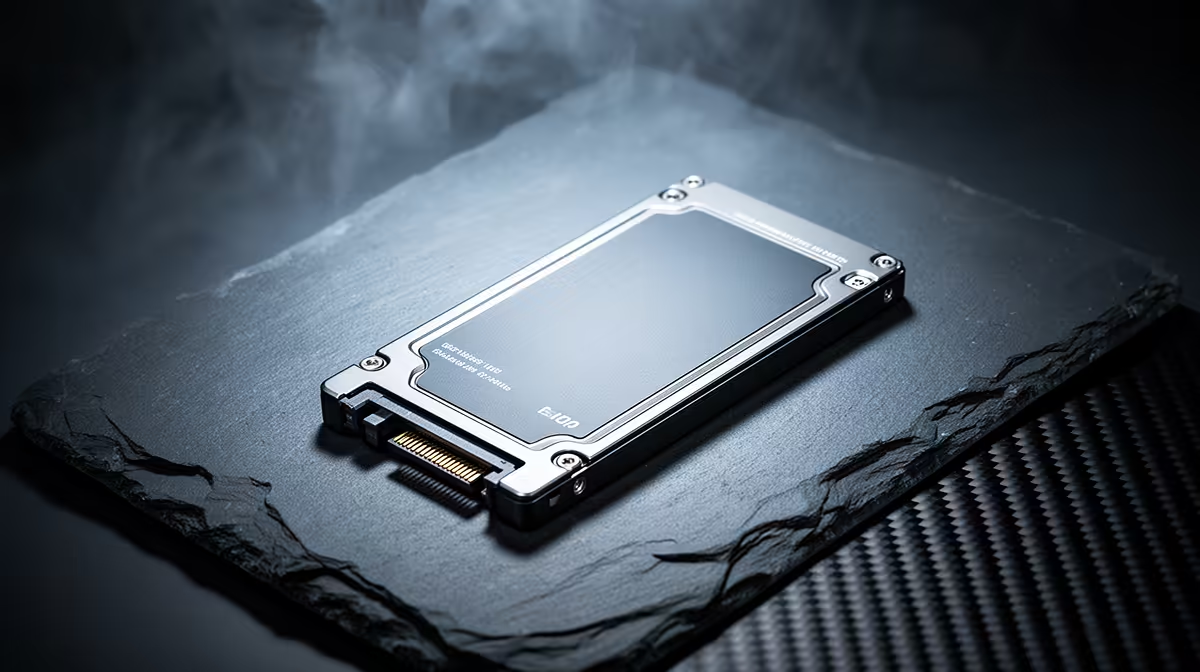
Pick a PCIe NVMe SSD of at least 1TB, ideally 2TB, for serious AI coding on large repos. Repo cloning, indexing, and the constant file reads an agent performs are storage-bound, so NVMe sequential and random speeds directly cut the time before an agent is productive. A SATA SSD will work, but NVMe is the difference between an index that finishes in seconds and one that crawls.
Why storage, not RAM, is the bottleneck for repo work
The mental model most people carry is that a coding agent lives in RAM and on the GPU. For the actual code, that is only half true.
When an agent first meets a repository it walks the entire tree: reading files, building an embedding or symbol index, and caching the result. On a large monorepo that is hundreds of thousands of small reads. Small random reads are exactly where NVMe pulls away from SATA, because NVMe handles deep command queues that a SATA drive simply cannot.
After indexing, the agent keeps touching disk. Every time it expands context, opens a new file, or re-checks something it changed, that is another read. Multiply that across a long session and storage latency becomes the tax you pay on every prompt.
How fast is fast enough
The tier you pick matters, but the priciest drive on the shelf is rarely the right call.
Sequential speed for clone and pull
Cloning and large pulls move big contiguous chunks. A PCIe Gen4 NVMe drive reading and writing several thousand MB per second clears a fresh clone of a heavy repo dramatically faster than a SATA drive capped near 550MB per second. If you frequently clone fresh worktrees or switch between large branches, sequential throughput is felt immediately.
Random read for indexing and context
This is the metric that matters most for agents. Indexing is a flood of small random reads, and so is the agent re-reading files as it works. Higher random read IOPS means the index builds faster and the agent stalls less between steps. A good Gen4 NVMe drive is worth the premium here over an entry SATA unit.
Sustained write for big writes
If your workflow writes large artifacts, build outputs, container layers, or model caches, look at sustained write performance, not just the headline burst number. Cheaper drives slow down once their fast cache fills.
Endurance for a write-heavy life
There is a fourth number worth a glance: endurance, usually quoted as TBW, terabytes written. AI coding is unusually write-heavy. Every fresh worktree, every dependency reinstall, every container rebuild, and every re-index writes data. Over years that adds up, and a drive with a higher TBW rating will outlast a budget unit under that load. For a primary work drive you live in daily, paying a little more for a higher-endurance model is cheap insurance against wearing it out early.
What this looks like in a real coding session
It helps to picture the loop end to end. You open a large repo for the first time and the agent clones or reads it, a burst of sequential and random reads. It then builds an index, a sustained flood of small random reads as it walks every file. From that point on, each prompt that needs context triggers more reads as the agent opens files, and each edit it makes triggers writes.
On a SATA drive, the index step is where you feel the wait, sometimes minutes on a heavy repo. On a fast NVMe drive that same step can drop to seconds, and the per-prompt stalls shrink because the random reads return faster. None of this changes how clever the model is, but it changes how much of your day is spent watching a progress bar instead of writing code. That is why, for code work specifically, storage is the upgrade that most reliably makes the machine feel quicker.
Why 1TB is the floor, and when to go bigger
Size is not just about fitting the repo. AI coding setups eat space in places people forget.
- The repo itself, often several gigabytes, sometimes far more with history.
- Multiple worktrees or branches checked out at once.
- Dependency caches, container images, and virtual environments.
- The agent's own index and embedding store.
- Model files if you run anything locally.
A 512GB drive fills fast once you add an OS, a couple of large repos, and their toolchains. 1TB is a sensible floor, and 2TB gives you room to keep several projects warm without constant cleanup. A drive kept near full also slows down, so headroom protects performance too.
For developers buying a whole machine rather than a bare drive, the AI-focused PCs stocked at Evetech are configured around fast NVMe storage and the RAM that pairs with it, which saves matching parts yourself.
Laptop or desktop for SA AI coding
Both work, with trade-offs.
A desktop gives you the easiest path to large, fast NVMe and simple upgrades later. If you mostly code from one place, it is the better value per gigabyte and per megabyte-per-second.
A laptop keeps you mobile, which matters if you move between office, home, and campus. Check that it has a real PCIe NVMe slot, ideally with a second slot or room for a 2TB drive, rather than soldered storage you cannot grow. When comparing machines, the top-selling desktops at Evetech show which configurations SA buyers are gravitating toward right now.
Whichever way you go, prioritise an NVMe boot and project drive over a faster GPU if your work is code rather than local model training. For most agent-assisted coding, the GPU does far less than the storage.
Frequently Asked Questions
Is NVMe really faster than SATA for coding?
For repo indexing and agent file reads, clearly yes. Those are small random reads where NVMe's deep queues and lower latency leave SATA behind. For pure sequential copying the gap is smaller but still meaningful.
How much SSD do I need for AI coding?
Treat 1TB as the minimum and 2TB as comfortable. Between the OS, several large repos, dependency caches, container images, and the agent's index, space disappears faster than you expect, and a near-full drive also runs slower.
Does SSD speed affect how fast a coding agent responds?
It affects the parts that touch disk: cloning, indexing, and re-reading files as context grows. A faster NVMe drive shortens the wait before an agent is useful and reduces stalls mid-session, though the model's own latency is separate.
Should I buy a laptop or desktop for this?
A desktop gives more storage for the money and easier upgrades. A laptop wins if you need to move around, just confirm it has an upgradeable PCIe NVMe slot rather than soldered storage.
Is Gen4 NVMe worth it over Gen3?
For heavy indexing and large clones, Gen4's higher throughput and random performance pay off. If your repos are modest, a quality Gen3 NVMe is still far ahead of SATA and perfectly usable.
Setting up a machine for serious AI coding in South Africa? Browse the AI PC range at Evetech (https://www.evetech.co.za/PC-Components/ai-pcs-445) for configurations built around fast 1TB and 2TB NVMe storage, so your agent spends time working, not waiting on disk.