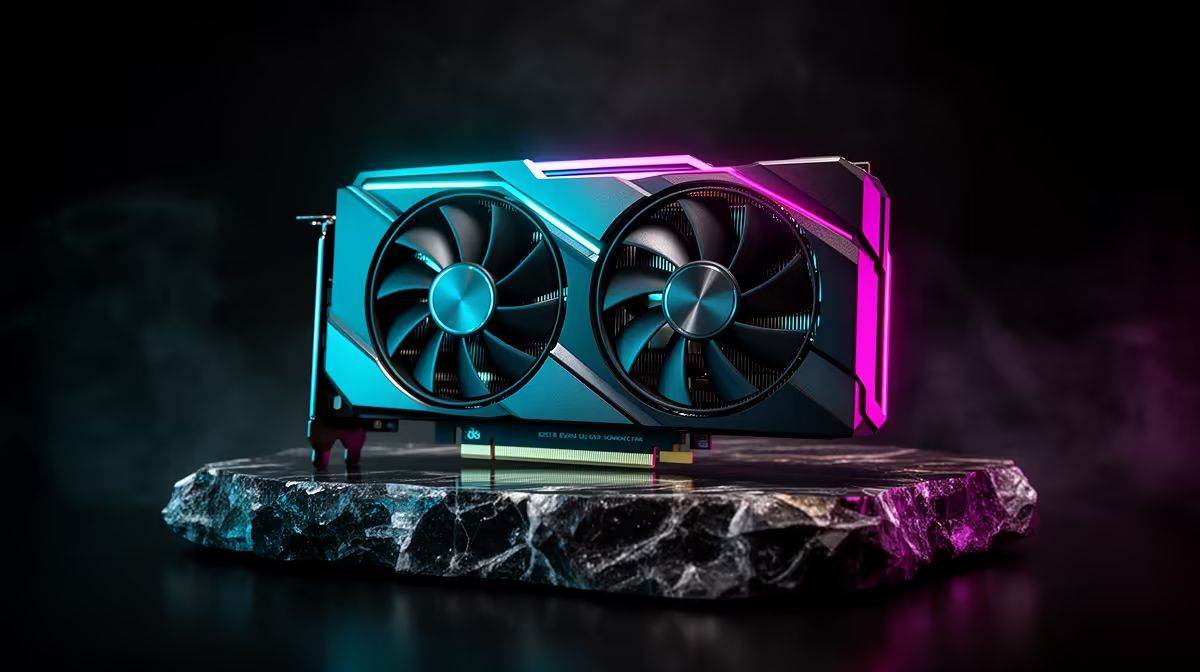
The single decision that decides whether a value GPU for local AI actually performs is matching its VRAM tier to the model you intend to run. Buy a card with too little memory and your model spills onto system RAM and CPU, where token generation crawls to a fraction of its potential. Buy far more than your model needs and you have paid for headroom you will never touch. Getting the tier right, then chasing memory bandwidth within it, is how you get the most local inference per Rand.
Quick Answer
Match VRAM to model size: 16GB comfortably runs quantised 7B to 14B models, 24GB opens up 32B-class models, and 32GB is the entry point for 70B-class work at usable quality. Within whichever tier you pick, memory bandwidth in GB/s is the real speed lever, since local inference is memory-bound. A 16GB card sits in roughly the R9,000 to R15,000 band, and a 32GB card lands well above R40,000.
Why VRAM Is the Hard Wall
Local large language models load their weights into the GPU's video memory and keep them there for every token they generate. If the whole model plus its context fits in VRAM, the GPU runs at full speed. If it does not fit, the runtime offloads layers to system RAM and processes them on the CPU. That offloading is where speed collapses, often by an order of magnitude, because system memory is far slower and the CPU is not built for this maths.
So VRAM behaves like a hard wall rather than a gentle slope. A model either fits or it does not. This is why the first question is never which card is fastest in games, but which tier holds the model you care about.
Sizing VRAM to Your Model
Quantisation changes everything here, so think in terms of quantised model footprints rather than raw parameter counts. Most people run models at roughly 4-bit quantisation, which is the sweet spot for fitting a capable model into consumer VRAM with little quality loss.
16GB: the practical starting point
A 16GB card handles 7B and 8B models with room to spare and runs 13B to 14B models comfortably at 4-bit. You can even load a 32B model if you accept tighter context limits and some offloading. For most people writing code, drafting text, or building a private assistant, 16GB is the current value sweet spot.
24GB: the comfortable middle
Stepping up to 24GB lets a 32B model fit cleanly with generous context, and pushes a 70B model into reach at aggressive quantisation. This is the tier that stops feeling cramped. It is also where a used previous-generation 24GB card can be a strong value play if you find one in good condition.
32GB and beyond: the 70B class
A 32GB card is the sensible entry point for running 70B-class models at quality settings that hold up for serious work, with space for longer context windows. Above that you are into prosumer and workstation territory, where the price climbs steeply for each extra gigabyte.
Bandwidth Is the Speed Lever
Once a model fits, two cards with the same VRAM can still feel very different, and the reason is memory bandwidth. Because inference is memory-bound, the rate at which the GPU moves weights between VRAM and its cores sets how fast tokens appear on screen. A card with higher GB/s bandwidth at the same VRAM tier will simply generate faster.
This is why a newer card with fast GDDR7 memory can out-pace an older card that has the same capacity but slower memory. When you are comparing two options at the same tier and price, the one with higher memory bandwidth is usually the better buy for inference. You can sense-check current options against the most popular complete PC builds to see which GPUs are pairing well with the rest of a system.
What This Means for an SA Build
For a South African buyer the calculus is straightforward. Decide the largest model you genuinely intend to run, pick the VRAM tier that holds it, then choose the card with the best bandwidth you can afford within that tier. Do not overbuy memory for models you will never load, and do not undershoot and force constant offloading.
A purpose-built machine also saves you headaches with drivers, cooling, and power delivery, all of which matter when a GPU runs flat out for long inference sessions. The AI-ready PC range is configured around exactly this kind of sustained workload rather than short gaming bursts.
Context Length Eats VRAM Too
There is a second memory cost people forget when they size a card purely by model name. The model's weights are only part of what sits in video memory. The context window, meaning the running record of your conversation or document that the model keeps in view, also occupies memory, and it grows as the context lengthens. A long chat, a big code file, or a lengthy document held in context can swell that footprint well beyond the bare model size.
This matters most at the edges of a tier. A model that fits a card with short prompts can spill over once you feed it a long document, forcing offloading exactly when you need the speed. So when you choose a tier, leave a margin for the context you actually use rather than the bare minimum the weights demand. If you routinely work with long inputs, treat the next tier up as the realistic target, since the headroom buys you both longer context and a buffer against offloading.
Quantisation buys back headroom
Heavier quantisation is the lever that claws some of this back. Dropping from a higher-precision build to a more aggressively quantised one shrinks the weights, freeing memory for context or for a larger model. The trade-off is a small quality cost that, at sensible quantisation levels, most people never notice in everyday use. Knowing you can dial quantisation up or down gives you a way to stretch a card across a wider range of models than its raw capacity suggests.
Power, Cooling, and the Long Session
A GPU running inference for hours is a different beast from one rendering a short game scene. Sustained load means sustained heat and a steady, high power draw, and both deserve planning. A card that thermal-throttles after twenty minutes loses the consistency you want from a local assistant, so adequate case airflow and a power supply with real headroom are not optional extras. This is another reason a system assembled around AI work tends to behave better over long runs than a gaming rig pressed into service, where cooling and power were sized for bursts rather than marathons.
Frequently Asked Questions
How much VRAM do I need for a 7B model?
A 7B or 8B model at 4-bit quantisation fits comfortably in 8GB, but 16GB gives you room for longer context and a smoother experience. If 7B is your ceiling, 16GB is plenty and leaves headroom to experiment with slightly larger models.
Is a used 24GB card a smart value buy?
It can be one of the strongest value moves available, since 24GB unlocks 32B models and the price gap below new high-end cards is large. Just verify the card's condition, cooling, and warranty status before committing, because heavy prior use is a real risk.
Does memory bandwidth matter more than VRAM?
They solve different problems. VRAM decides whether your model fits at all, so it comes first. Once a model fits, bandwidth decides how fast it runs. Pick the tier for capacity, then optimise for bandwidth inside that tier.
Can I run a 70B model on a 16GB card?
Not well. A 70B model needs heavy offloading to fit alongside 16GB, which drags speed down to a crawl. For 70B-class work at usable quality, plan on 32GB as your realistic floor.
Why does my model run so slowly even though it loaded?
If it loaded but runs slowly, part of it is almost certainly offloaded to system RAM and the CPU. Either drop to a smaller or more heavily quantised model that fits entirely in VRAM, or step up to a card with more memory.
Ready to size your VRAM to your models and stop fighting CPU offload? Explore the AI PC range at Evetech and build a machine matched to the model you actually want to run.