



PCIe 5.0 vs PCIe 4.0 for Video Editing in 4K in SA
PCIe 5.0 and PCIe 4.0 differ most in lane support, compatibility, and upgrade value for video editing in 4k. SA buyers should match the choice to their actual hardware and games.
Read moreDiscover the best VRM for Ryzen CPUs to unlock maximum performance and stability. Our deep dive explains motherboard power delivery, phases, and cooling, helping you choose the perfect board for your build, from budget B650 to high-end X670. Don't let poor power delivery bottleneck your rig! ⚡️💻
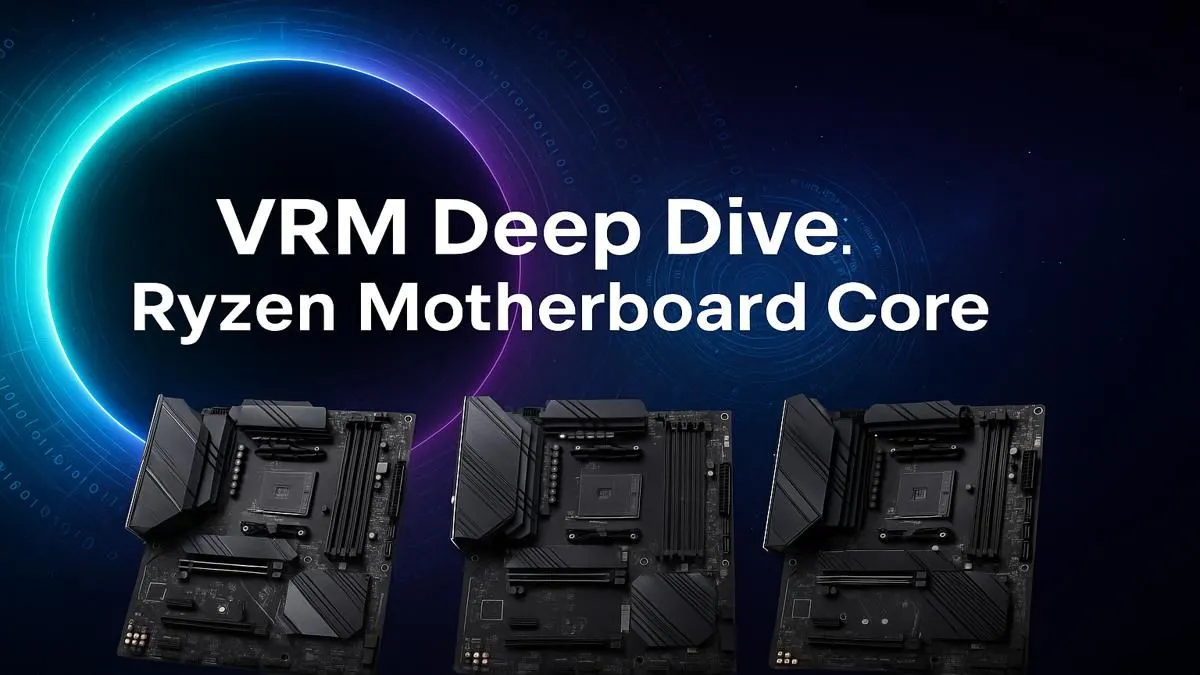
So, you’ve bagged a powerful AMD Ryzen CPU for your new build. Lekker! But before you start planning your victory royales, there’s a crucial component that often gets overlooked: the motherboard’s VRM. Choosing a board with poor power delivery is like putting budget tyres on a sports car... you’re just not getting the performance you paid for. Finding the best VRM for Ryzen isn’t just for extreme overclockers; it’s the key to unlocking stable, consistent power for your entire system.
VRM stands for Voltage Regulator Module. Think of it as the dedicated power plant for your CPU 🔧. Your power supply unit (PSU) sends a steady 12-volt stream to the motherboard, but your sophisticated Ryzen processor needs a much lower, incredibly precise voltage (usually around 1.0V to 1.4V) to operate.
The VRM’s job is to take that raw 12V power and convert it into clean, stable, low-voltage energy that your CPU can use. A high-quality VRM does this efficiently, without overheating, ensuring your processor gets exactly what it needs, when it needs it.
Modern Ryzen CPUs are smart. They use features like Precision Boost Overdrive (PBO) to automatically push their clock speeds higher if they have enough power and thermal headroom. This is where a robust motherboard power delivery system becomes essential.
Imagine this: you’re in a tense Warzone final circle, and the action gets frantic. Your CPU demands more power to handle it all.
Essentially, the best VRM for Ryzen ensures you get 100% of the performance you paid for, especially under heavy gaming or content creation loads.
You can monitor your VRM temperatures using free software like HWiNFO64. Look for the "VRM MOS" or similar sensor reading. If it's consistently hitting over 90-100°C under load, your VRM might be struggling and throttling performance. A board with better VRM cooling could be a worthwhile upgrade.
You don’t need an electrical engineering degree to identify a motherboard with solid power delivery. Here are a few things to look for when browsing the specs:
When in doubt, checking out reviews for specific AMD motherboards can provide expert analysis on their VRM performance.
The chipset often dictates the quality of the VRM you can expect. Picking the right one ensures you're not overspending or creating a performance bottleneck.
For gamers running Ryzen 5 or even some Ryzen 7 CPUs, the B550 platform remains a fantastic value proposition. Many manufacturers put surprisingly robust power delivery systems on their mid-to-high-end B550 motherboards, making them perfect for high-performance gaming without breaking the bank.
Stepping up to the latest generation of Ryzen processors? The new AM5 platform's B850 chipset is designed to be the new mainstream champion. These boards offer a great balance of modern features like PCIe 5.0 support and strong VRM solutions capable of handling the latest Ryzen 7 and Ryzen 9 CPUs with ease. You can expect to find some of the best VRM for Ryzen gaming builds in the AMD B850 motherboards lineup.
If you're rocking a top-tier Ryzen 9 and want to push manual overclocks to their absolute limit, you need the best of the best. The AMD X870 motherboards are built for this purpose. They feature overkill VRMs with extensive phase counts and massive heatsinks, designed to provide flawlessly stable power for the most demanding processors on the market.
Ready to Power Your Ryzen Build? A stable PC starts with a quality motherboard. Don't let a weak VRM hold your new Ryzen CPU back. Explore our huge range of AMD motherboards and find the perfect foundation for your ultimate gaming rig.
VRM stands for Voltage Regulator Module. It's a critical component that converts the 12V power from your PSU into the precise, lower voltage your Ryzen CPU needs to operate stably.
A good VRM delivers clean, stable power, which is essential for performance, especially when overclocking. It prevents throttling and ensures your Ryzen CPU can reach its full potential.
For a high-end CPU like a Ryzen 9, look for motherboards with at least a 12+2 phase design. More phases generally mean better power distribution, lower temperatures, and improved stability.
Yes. Even at stock speeds, a quality VRM runs cooler and more efficiently. This improves the overall longevity and stability of your system, making it a worthwhile investment.
Check the motherboard's official product page for its VRM phase count and component details. Reading expert reviews and consulting a motherboard VRM tier list for Ryzen is also highly recommended.
Many mid-range B650 motherboards offer excellent VRM quality, more than capable of handling a Ryzen 7. Look for models with substantial heatsinks for better thermal performance.
PCIe 5.0 and PCIe 4.0 differ most in lane support, compatibility, and upgrade value for video editing in 4k. SA buyers should match the choice to their actual hardware and games.
Read more
ATX 3.1 and ATX 3.0 differ most in connector handling and GPU power design. For SA gamers, the choice comes down to your graphics card, PSU quality, cable clearance, and whether a newer 12V-2x6-ready unit makes sense for the build.
Read more
80+ Platinum or 80+ Titanium for cinematic should be shortlisted around the job it must do. South African buyers should compare fit, performance, compatibility, and upgrade room, warranty path, and upgrade room before treating any pick as best.
Read more
AM5 and AM4 can both work for competitive esports, but the real-world difference is platform headroom. SA players should compare CPU choices, memory speed, latency goals, monitor refresh, and future upgrade plans.
Read more
LGA 1851 and LGA 1700 differ most in CPU support, compatibility, and upgrade value for couch co-op gaming. SA buyers should match the choice to their actual hardware and games.
Read more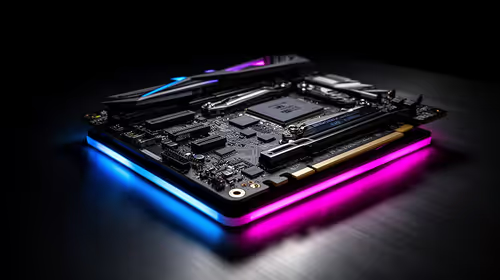
DLSS 4 and DLSS 3 differ most in game support, compatibility, and upgrade value for streaming on twitch and youtube. SA buyers should match the choice to their actual hardware and games.
Read more
Tests reported audio capture and local-network scanning on a specific LG television with its screen off. LG says supported standby modes can keep voice and connected-device features active, so owners should review model-specific settings.
PCIe 5.0 and PCIe 4.0 differ most in lane support, compatibility, and upgrade value for video editing in 4k. SA buyers should match the choice to their actual hardware and games.
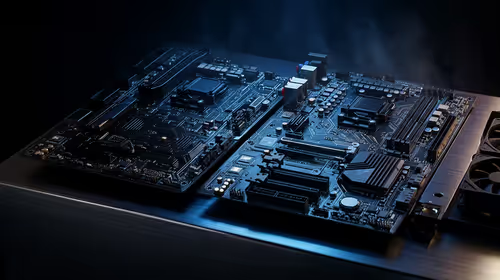
Real world difference between b850 b650 mmo live service games sits in stability, networking, storage, and upgrade room. SA players should compare LAN quality, USB layout, RAM support, and SSD slots for always-updated games.
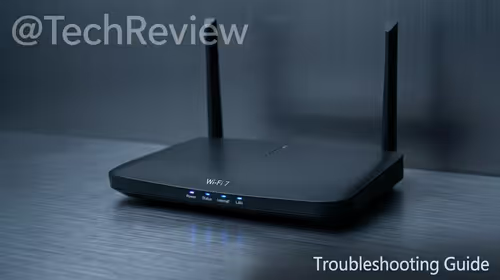
Dead Pixel on Wi-Fi 7 Router is likely a display-path or source-title issue, so check the screen, cable, driver state, and related system symptoms before blaming the device itself.
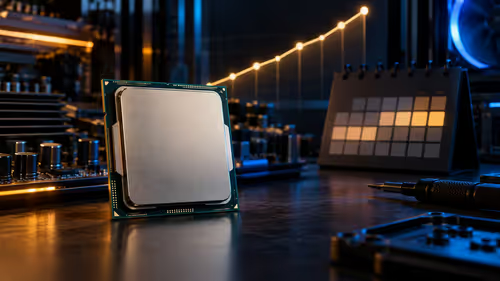
Industry reports point to another roughly 10 percent Intel processor increase from 5 October, but Intel has not published a consumer price list confirming the scope. South African buyers should treat it as a risk signal, not a guaranteed Rand change.

Put the headphones in pairing mode, open Bluetooth and devices in Windows 11, then add the headset. If it fails, remove the old pairing and check charge, range and drivers.

Microsoft says upcoming Windows 11 work will target memory use on 8GB PCs and improve boot and sign-in responsiveness. There is no public release date or measured uplift yet.
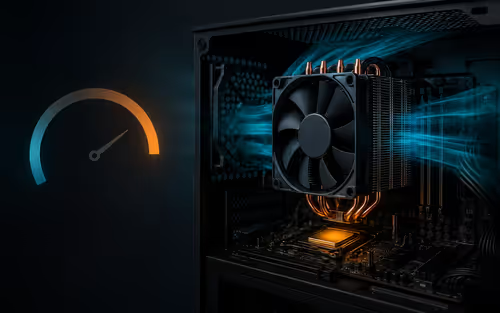
Windows 11 does not show CPU temperature in its standard Settings pages. Use your CPU maker's supported utility or a trusted monitor, then read idle and loaded temperatures in context.
Industry reports point to another roughly 10 percent Intel processor increase from 5 October, but Intel has not published a consumer price list confirming the scope. South African buyers should treat it as a risk signal, not a guaranteed Rand change.
Tests reported audio capture and local-network scanning on a specific LG television with its screen off. LG says supported standby modes can keep voice and connected-device features active, so owners should review model-specific settings.
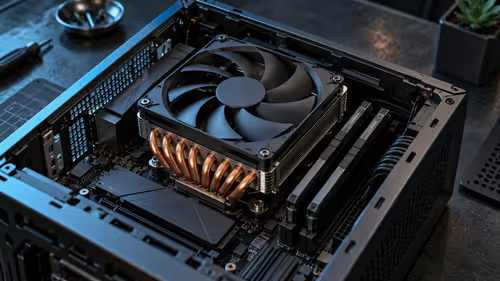
Thermalright's AXP120-X77 is a 77 mm top-down cooler with six heatpipes and a slim 120 mm fan. Local availability is not confirmed, so compact-PC builders should verify case height, memory clearance and socket support before comparing it with stocked coolers.

One-sided sound can come from balance settings, a dirty or loose connector, Bluetooth pairing data, firmware, the source device or a failed cable or driver. A short swap test isolates the cause before you reset software or replace the headset.