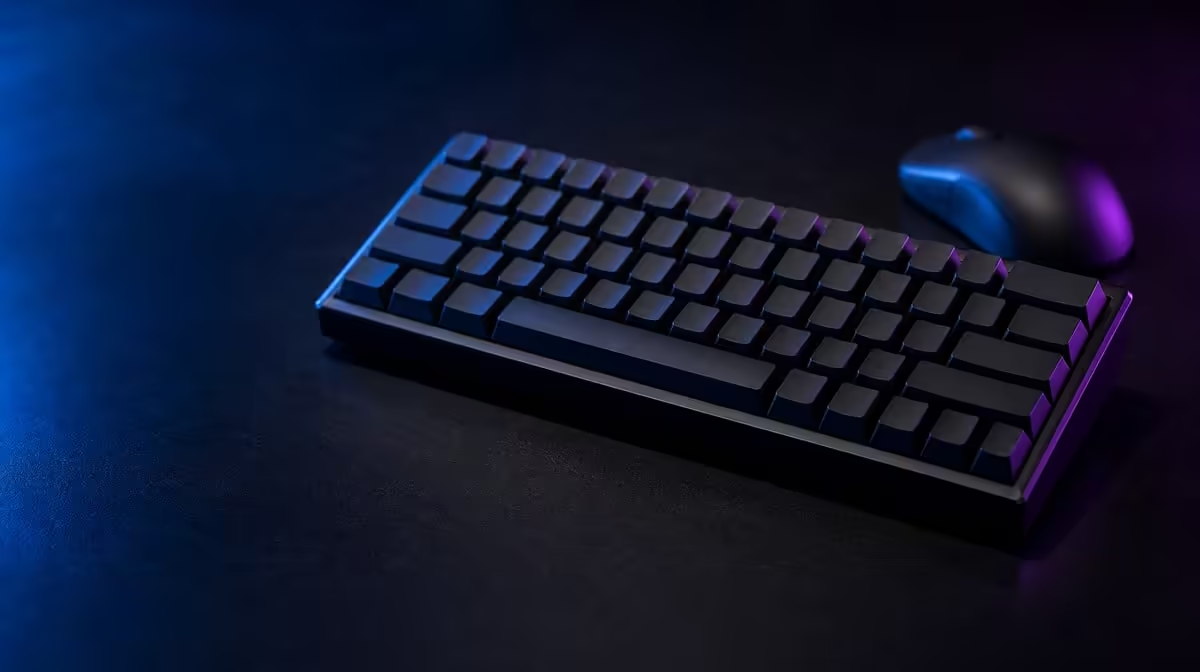
An 8kHz label describes one reporting ceiling, not the time from finger movement to a changed pixel. Building a low-latency setup with an 8kHz keyboard means controlling switch behaviour, internal scanning, USB stability, game frames and the display alongside the board's selected rate.
Quick Answer
Connect the keyboard through a simple supported USB path, confirm the active 8kHz profile and first prove dependable presses and releases. Compare 8kHz with 1000Hz in the same game scene while monitoring frame times, then keep the mode that leaves the complete system stable; the setup succeeds when input, frames and visible response remain repeatable under real load.
⏱️ Map the entire response path
A rate of 8kHz allows report opportunities at shorter intervals than 1000Hz, but it does not state when the switch actuates or how frequently the keyboard scans its matrix.
Firmware processing then packages the event for the host. The operating system, game engine and current frame determine when that input affects simulation, while the display determines when the result becomes visible.
Treat each stage as a link with its own behaviour. Improving the report interval cannot remove a slow game frame, an inconsistent switch press or display processing after the frame is ready.
Begin with reliable registration. Use a neutral input viewer to test taps, holds, releases and the combinations required by the intended games.
Check repeated direction changes and weaker-finger modifiers. A faster report mode has little competitive value when an uncomfortable mechanism causes accidental inputs or incomplete releases.
Save a plain default profile with its connection mode and selected rate. Later comparisons need a known state rather than a configuration reconstructed from memory.
Record the game, scene, graphics settings, display mode and background activity. The entire route must remain stable before a small timing change can be interpreted sensibly.
Review Evetech's Logitech gaming-keyboard range for supported high-rate options that match the required layout and software environment.
🔌 Establish a dependable USB baseline
Use the supported cable and the simplest practical port route. Remove an uncertain hub, adapter or extension from the first test so fewer components can disturb communication.
Keep the keyboard on the same connector throughout the comparison. Moving ports between runs changes the route at the same time as the rate and weakens the result.
Confirm that configuration software shows the intended profile after restart and game launch. Automatic switching can silently replace 8kHz with another setting or alter mappings.
Review firmware through the maker's supported process, but do not update blindly in the middle of a controlled test. Record the current version and change it only for a documented reason.
Close unnecessary background work, especially activity that changes CPU demand unpredictably. The highest polling option asks the host to handle reports more frequently, and the practical effect depends on the complete PC workload.
Warm the system with the intended game before collecting results. A cold desktop test cannot represent a long session in a demanding scene.
Repeat input-viewer checks after the USB baseline is established. Stability includes correct presses and releases, not merely the appearance of a peak polling figure.
Use Evetech's wider gaming-keyboard category to compare the whole keyboard rather than treating its maximum rate as the entire specification.
🎮 Compare 8kHz and 1000Hz fairly
Choose a repeatable training drill with predictable movement and camera input. Keep graphics, resolution, display refresh mode and game settings identical.
Run several trials at 1000Hz and several at 8kHz, alternating the order. Alternation reduces the chance that practice, fatigue or system temperature consistently favours one mode.
Monitor frame-time consistency rather than relying only on an average frame rate. Brief spikes can delay the visible result and may appear only when the game and background processes create a particular host load.
Record missed presses, held-state errors and subjective control separately. A technically higher setting that coincides with uneven frames or unreliable input is not the winning configuration.
Do not chase one browser polling result. Human tapping, sampling windows and scheduling can make displayed values vary, and polling does not include scanning or the later game and display stages.
Repeat the comparison across the titles that matter. A lightweight competitive game and a CPU-heavy scene may respond differently to the additional host work.
Use a blind or randomised switch between rates if practical. Expectation is powerful when the numerical labels are visible, especially after the user has invested effort in enabling the maximum.
Preserve raw notes instead of rewriting them into a favourable conclusion. The useful outcome may be 8kHz for one game, 1000Hz for another, or no meaningful difference within the user's repeatability.
🖥️ Finish the path at the display
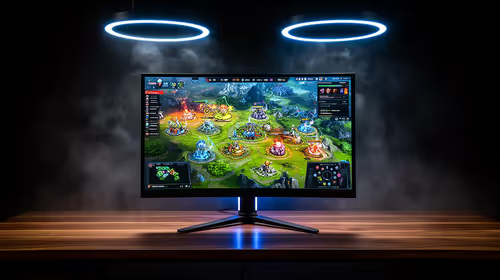
Keep the monitor's intended gaming mode active and remove unnecessary image processing where the display supports that choice. A keyboard test is incomplete if the visible response path changes between runs.
Match the game's frame behaviour to the display setup according to the user's normal configuration. Stable pacing makes individual commands easier to compare than a sequence of irregularly delivered frames.
Check the keyboard with the actual mouse and capture tools present. A laboratory-style run that removes every normal USB device may prove a capability but not the reliability of the complete play setup.
Include long-session ergonomics. Layout width, key force and wrist position can affect control far more often than the difference between two stable report modes.
Define success before testing: every required combination registers, releases occur cleanly, frame times remain consistent, the display mode stays fixed and the result survives several sessions.
Document the chosen profile, port and restore steps. After an operating-system, game or firmware change, rerun the same drill instead of assuming the old conclusion still applies.
Check Evetech's accessory best sellers for broader setup context and confirm current availability when the final configuration calls for a new board.
An 8kHz keyboard belongs in a low-latency system when its highest mode improves or preserves the complete measured experience. It should never be allowed to distract from inaccurate keys, unstable frames or an unsuitable display state.
Frequently Asked Questions
What does an 8kHz keyboard change in the latency chain?
It can provide report opportunities to the host at shorter potential intervals than 1000Hz. That affects one link rather than the entire response time.
Which keyboard timings remain outside that number?
Switch movement, actuation behaviour, matrix scanning and firmware processing are not fully described by the USB polling label.
Why can CPU load undermine the highest polling setting?
More frequent reports increase host activity. In some game and system combinations, that extra work can coincide with uneven frame delivery.
How does the display complete the response path?
The game must produce a changed frame and the monitor must present it. Processing and refresh behaviour influence when the response becomes visible.
What USB arrangement supports reliable testing?
Use a supported cable and a simple, consistent port path. Remove questionable hubs or adapters from the diagnostic baseline.
How should 8kHz be compared with 1000Hz?
Alternate repeated runs in the same scene with identical system and display settings, then examine registration, frame times and control together.
When has the low-latency setup succeeded?
It succeeds when required inputs register cleanly and the game presents steady, repeatable responses under the intended sustained workload.
Building latency around evidence instead of one label?
Compare Evetech gaming keyboards inside a stable USB, game and display path, then keep the rate that proves itself through repeated play.