Quick Answer
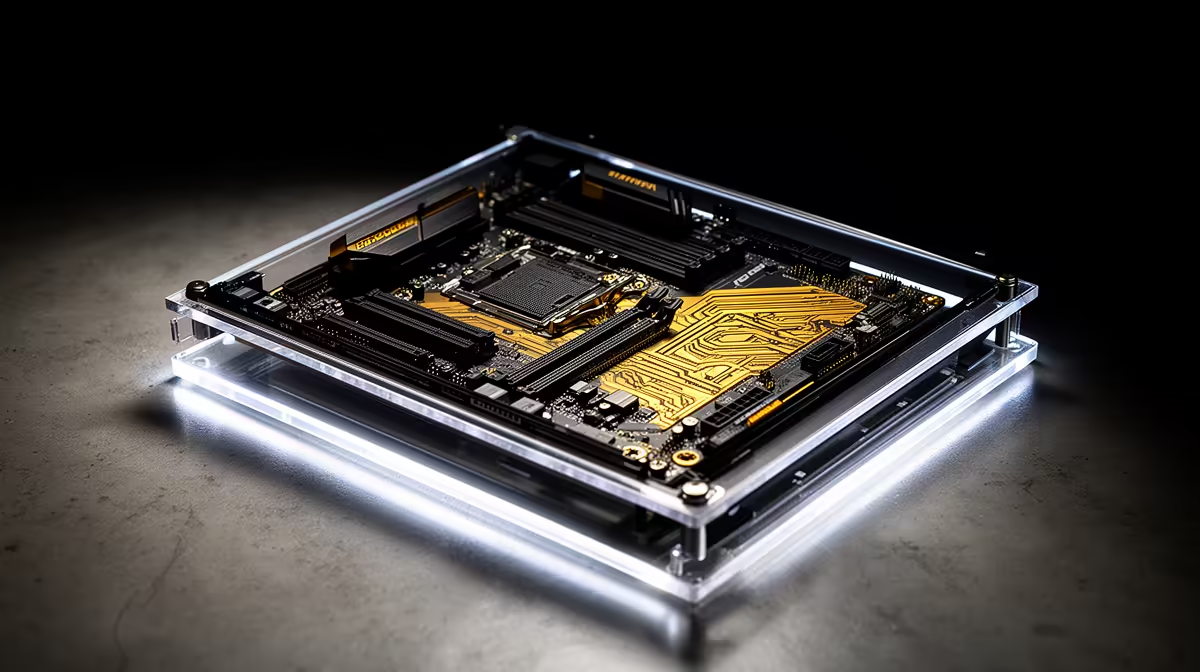
Yes. A sliding motherboard tray makes building and upgrading easier by letting you work on the board at a comfortable angle outside the case, avoiding the need to reach into a confined chassis for CPU cooler installation, RAM seating, and M.2 drive mounting. For large E-ATX builds, the time saving during initial assembly is 30 to 60 minutes.
How the Sliding Mechanism Works 🔧
A sliding motherboard tray attaches to steel rails inside the case and rolls out, exposing the full board surface outside the chassis. You mount the CPU, install cooler mounting hardware, seat RAM, and slot M.2 drives while the board is fully accessible. Once components are installed, slide the tray back in and connect front-panel headers and power cables through the normal grommets. The tray locks in place with a pin, clip, or latch mechanism. High-quality implementations in premium E-ATX full-tower cases use smooth ball-bearing rails that slide evenly under the weight of a heavy board plus AIO cooler.
Real-World Upgrade Advantage 🖥️
The upgrade advantage is most significant for RAM and M.2 swaps. On a standard fixed-tray E-ATX build, adding a second 64GB RAM kit or swapping M.2 SSDs requires removing the GPU first to access lower M.2 slots, and often removing the CPU cooler for the top M.2 slot. On a sliding tray, pulling it out gives immediate access to every slot without disturbing any installed component. For South African builders who upgrade components incrementally as prices drop, this means faster, safer component swaps with less risk of damaging neighbouring components.
Limitations to Know Before Buying 💡
Not all sliding tray implementations are equal. Budget designs use friction-fit plastic rails that wobble under a heavy board and AIO combination, transferring vibration that can cause intermittent POST failures on sensitive platforms. Verify that a sliding tray case uses a positive-lock mechanism when fully inserted. Also confirm that the tray rails do not conflict with your front-radiator position: some cases position the front 420mm mount in a way that the tray cannot slide out with the radiator installed, requiring partial radiator disassembly for board access.
Route CPU Power Cable Before Sliding Tray Back In ⚡
The CPU 8-pin power cable is the hardest connector to reach once the tray is fully inserted because it sits at the top of the board near the case top panel. Before sliding the tray home, connect the CPU power cable and let it run loosely behind the tray. Final cable management can happen after the tray is locked in, but connecting this plug in open-tray position saves significant frustration.
FAQ
Do sliding trays work with all E-ATX motherboard sizes?
Not always. Check that the tray's standoff pattern covers all required mounting positions for your specific board. Some trays miss extended positions used by certain Threadripper boards. Verify with the case specification if your board is a non-standard E-ATX variant.
Does a sliding tray add significant weight to the case?
The rail mechanism typically adds 300 to 600 grams, negligible in a full-tower already weighing 9 to 12kg empty. The benefit of easier access far outweighs this modest weight increase.
Are sliding tray cases more expensive than standard designs?
Generally yes, by R500 to R1,500 at equivalent feature levels. The rail mechanism adds manufacturing cost. This premium is worthwhile for builders who plan regular upgrades, but may not be necessary for a system assembled once and left unchanged for years.
Want a build experience that makes upgrades less of a chore?
Explore Evetech's range of full-tower and E-ATX cases to find models with sliding motherboard tray support.