

Complete Guide: Setting Up AIO Liquid 420mm
Setting Up AIO Liquid 420mm. Tested & verified settings for best FPS and visual quality on SA hardware budgets.
Read moreCase fan bearings explained: learn how hydraulic, ball, and sleeve bearings affect noise, lifespan, and performance so you can pick the right fan for your build 🔧🧰
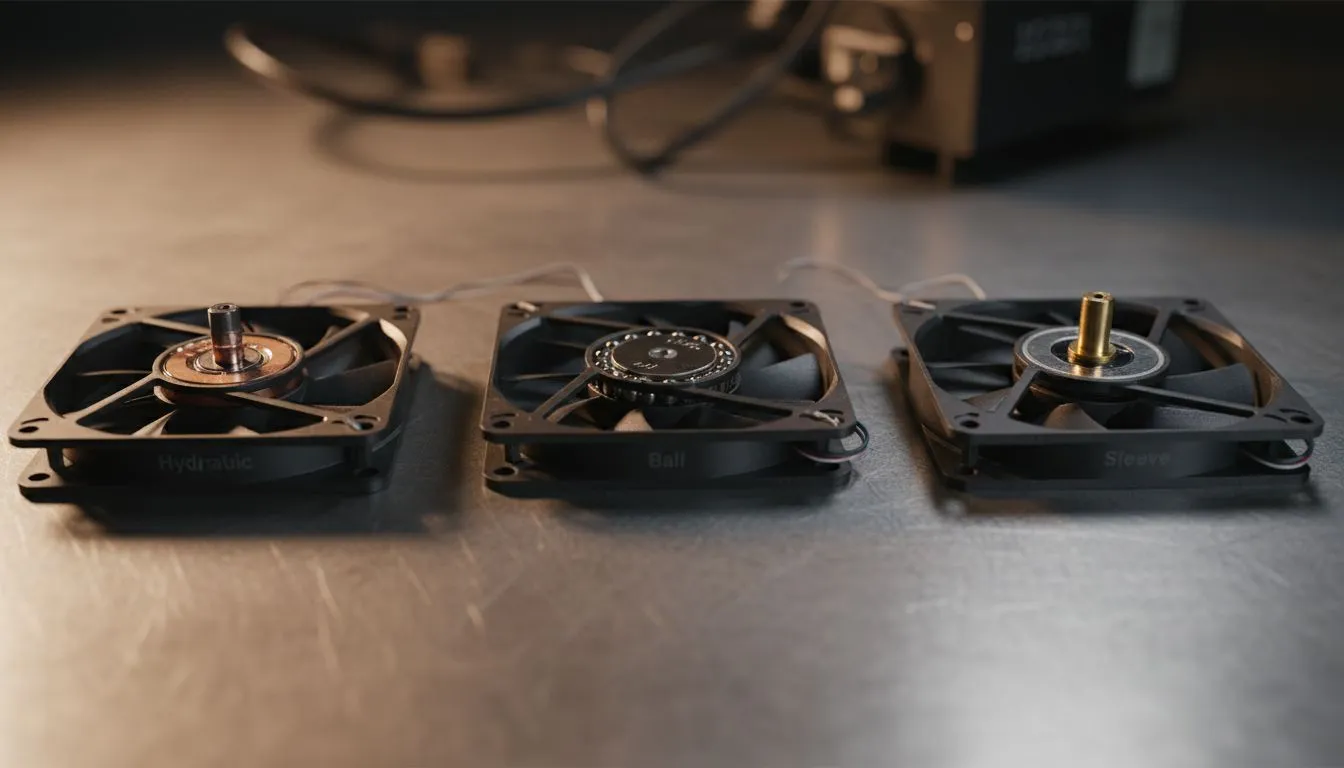
Ever noticed your PC sounding like a jet engine taking off from OR Tambo? Or maybe it's just a subtle, annoying rattle? Often, the culprit isn't the software... it's the physical bearing inside your fans. Choosing between Case Fan Bearings: Hydraulic vs Ball vs Sleeve Compared isn't just about noise. It's about how long your rig stays cool under the South African sun. 🔧
Sleeve bearings are the most common type found in budget-friendly builds. They rely on a lubricant to reduce friction between a rotating shaft and a stationary sleeve. While they are impressively quiet when brand new, they tend to have a shorter lifespan... especially in high-heat environments.
If you are looking for standard 120mm case fans for a basic office PC, sleeve bearings are a cost-effective choice. However, they don't perform well when mounted horizontally. The oil can pool at one end, leading to friction and that dreaded grinding noise.
For those who want pure reliability, ball bearings are the heavy hitters of the cooling world. They use small metal spheres to handle the rotation, which allows them to operate at much higher temperatures without breaking a sweat.
Top-tier brands like CORSAIR often utilise premium bearings to ensure their larger 140mm case fans last for years of continuous gaming. While they might be slightly louder than other types due to the metal-on-metal contact, their durability is unmatched in harsh conditions. ⚡
Hydraulic bearings are currently the "goldilocks" choice for South African gamers. They are essentially an evolved version of the sleeve bearing, using a pressurised fluid system to keep moving parts from touching. This results in incredibly low noise levels and a lifespan that rivals ball bearings.
You will find this technology in many Deepcool case fans that offer a perfect balance of price and performance. Because they are so quiet, they are the ideal choice for vibrant RGB fans where you want the focus on the visuals... not the fan drone. 🚀
When installing fans, remember that air usually flows toward the side with the plastic frame (the X-shaped bracket). Ensure your intake and exhaust fans are oriented correctly to create a balanced pressure system inside your chassis. This prevents dust buildup and keeps components cool during those hot December gaming sessions.
When picking your next upgrade, consider your specific needs and your budget in ZAR. If you want a professional, quiet workstation, you might prefer stealthy non-RGB fans with hydraulic bearings. If you are building a high-end server that stays on 24/7, ball bearings are the way to go.
Regardless of your style, checking the full range of case fans at Evetech ensures you get the right balance of airflow and durability for your unique setup. ✨
Ready to Find Your Perfect Match? Choosing the right bearing is the secret to a cool, quiet, and long-lasting PC. Whether you need maximum airflow or silent operation, we have the tech to keep your system running at its best. Explore our massive range of case fans and find the perfect cooling solution to conquer your world.
Hydraulic, ball, and sleeve bearings are the main types. Compare hydraulic vs ball bearings case fans for differences in noise, lifespan, and price.
Hydraulic (fluid) bearings are generally the quietest. Sleeve bearing fans can be quiet when new, but quiet case fan bearings vary by model.
Ball bearings typically last longest and resist dust better, making them ideal for high-rpm scenarios — see case fan bearing lifespan comparison.
Yes for budget or low-RPM builds. Sleeve bearing vs ball bearing for PC fan: sleeve is cheaper but may wear faster and needs correct mounting orientation.
No regular maintenance. Hydraulic bearing fan benefits include self-lubrication and low noise for most users.
Ball bearings handle high RPMs and heat better; choose ball bearing fans for sustained high-speed performance and durability (high rpm fan bearing types).
Bearing type significantly affects noise, torque, and lifespan. Use fan bearing noise comparison to match bearings to your silence or performance goals.
Setting Up AIO Liquid 420mm. Tested & verified settings for best FPS and visual quality on SA hardware budgets.
Read more
Intel XTU Download & Setup Guide: Intel CPU. Clear setup instructions with SA-specific considerations, troubleshooting tips & recommended components.
Read more
Cyberpunk 2077 Max Settings on RTX 4090. Tested & verified settings for best FPS and visual quality on SA hardware budgets.
Read more
The Complete Guide to GPU. Everything you need to know with SA pricing, step-by-step instructions & expert recommendations.
Read more
NVCleanstall Download & Setup Guide: NVIDIA. Clear setup instructions with SA-specific considerations, troubleshooting tips & recommended components.
Read more
to Driver Installation for Beginners. Everything you need to know with SA pricing, step-by-step instructions & expert recommendations.
Read more
AMD RX 9050 XT: Rumoured Specs, Price & Release. SA-focused analysis with local pricing data, real-world insights & actionable buying advice.
Can RTX 4080 Super Run AI Workloads for SA Developers Detailed answer with SA data, expert analysis & practical recommendations for local buyers.
Can RTX 4090 Run AI Workloads for SA Developers Detailed answer with SA data, expert analysis & practical recommendations for local buyers.
Top Settings for Intel Arc B580 at Ultrawide 1440p picks evaluated on performance, value & SA availability with current Rand pricing from Evetech.
RTX 4060 CS2 Low Settings at 1080p: FPS Results. Real-world benchmark data, FPS numbers & performance analysis. What SA gamers can actually expect.
Visual Artifacts: Possible GPU Issue Issue #1. Diagnosis steps, proven fixes & when to seek professional help. SA-specific support info included.
Can the RTX 4090 Handle 1440p 144Hz Gaming. Performance testing verdict with real data & practical recommendations for SA buyers.
Top ASUS GPU Under R15000 picks evaluated on performance, value & SA availability with current Rand pricing from Evetech.
GTA 6 Max Settings on RTX 5070. Tested & verified settings for best FPS and visual quality on SA hardware budgets.
Cyberpunk 2077 Max Settings on RTX 5080. Tested & verified settings for best FPS and visual quality on SA hardware budgets.
Starfield Max Settings on RTX 5070 Ti. Tested & verified settings for best FPS and visual quality on SA hardware budgets.
Top RTX 5090 Under R5000 picks evaluated on performance, value & SA availability with current Rand pricing from Evetech.