Spinning up a text-to-3D model on a rented cloud GPU costs you a few Rands an hour and nothing upfront. Generating the same mesh on a local RTX workstation costs a chunk of capital today but nothing per render forever after. For South African creators weighing cloud versus local for AI 3D generation, the answer hinges on three numbers: how often you generate, what your fibre line costs, and whether you also game or render on the same machine.
Quick Answer
Local AI 3D generation needs an RTX GPU with at least 12GB of VRAM, which puts the entry point around R10,000 to R15,000 for the card alone, but it has zero per-job cost afterwards. Cloud avoids the hardware outlay and bills roughly by the GPU-hour, which suits occasional or experimental use. Generate daily, buy local; generate now and then, rent.
What AI 3D Generation Demands From Hardware
Modern text-to-3D and image-to-3D pipelines lean heavily on VRAM, not just raw compute. The model has to hold the network weights, the working geometry, and the texture data in memory at once, and 12GB is the practical floor for the current generation of tools. Drop below that and you are forced into smaller models, lower resolution outputs, or constant out-of-memory failures.
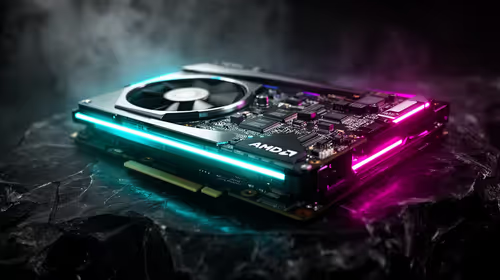
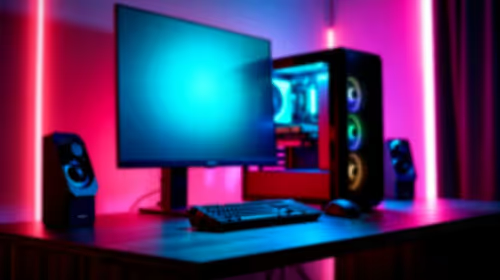
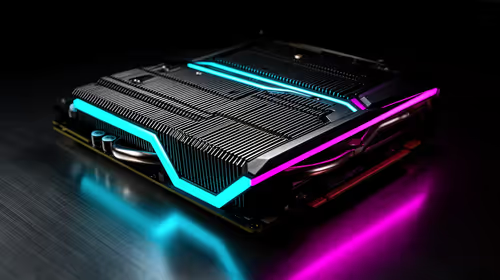
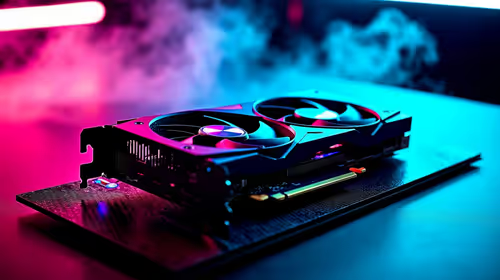
This is why a mid-range gaming GPU is often the natural starting point: an RTX card bought for gaming already carries the CUDA cores and tensor units these workloads exploit. If you are sizing up cards for both rendering and play, the 3D-focused hardware range at Evetech is a sensible reference point for what desktop creation gear looks like locally.
The Real Cost of Going Local
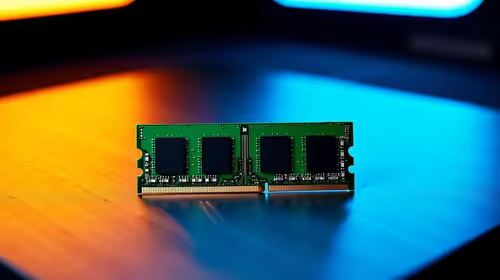
Buying outright front-loads the spend. Beyond the GPU you need a capable power supply, adequate cooling, and enough system RAM to feed the card. Call it a one-time investment that, for a serious creator, pays itself off against cloud rental within months of heavy use.
The upsides are concrete:
- Zero marginal cost. Once the machine is built, every render is free. Generate a hundred variations a day and the cost stays flat.
- No data charges per job. Your uploads and downloads stay on your own disk, which matters on metered SA connections.
- Full privacy. Client work and unreleased designs never leave your premises.
- Reuse. The same card games, renders video, and runs other AI tools.
The downsides are real too: hardware ages, a card bought today will look modest in three years, and you carry the maintenance and electricity yourself.
The Real Cost of Going Cloud
Cloud GPU rental flips the model. You pay only for the minutes you use, so a creator generating a handful of models a week can spend very little. There is no capital risk, no obsolescence to worry about, and you can rent a far more powerful GPU for a short burst than you could justify buying.
But the per-hour rate, billed in Rands once you account for currency conversion, adds up fast under sustained use. And there is a quieter cost that bites South African users specifically: data. Uploading reference images and downloading finished meshes consumes bandwidth on every job, and on a capped or metered line those gigabytes carry a price the per-hour rate hides.
Speed, Iteration, and the Hidden Workflow Cost
Cost is the loud part of this decision, but workflow speed is the quiet one that shapes how it actually feels to work. AI 3D generation is rarely one-and-done. You generate a mesh, dislike a detail, tweak the prompt, and generate again, often many times before a result is usable. That iteration loop is where local and cloud diverge sharply.
On a local machine the loop is instant: hit generate, watch it run, adjust, repeat, with no upload, no queue, no waiting for a remote instance to spin up. That tight feedback is genuinely productive when you are exploring a design, because you stay in flow rather than waiting on a connection.
Cloud adds friction to every turn of that loop. Each generation may involve uploading inputs, waiting for a GPU instance to become available, and downloading the result, and on a slower or busier SA connection those seconds stack up across dozens of iterations. For a single render the overhead is trivial; for an afternoon of rapid experimentation it is the difference between staying creative and waiting around. The flip side is that cloud lets you rent a far more powerful GPU than you own, so a single heavy generation can finish faster in the cloud than on a modest local card.
How South African Realities Tilt the Decision
Two local factors weigh more here than they would elsewhere. First, fibre pricing and caps: an uncapped, high-speed line makes cloud far more comfortable, while a metered connection quietly taxes every render. Second, the rand-dollar exchange rate, since most cloud GPU providers bill in dollars and the local cost of that rented hour moves with the currency.
A practical rule: if your generation is occasional, exploratory, or project-bursty, cloud keeps your cash free and your risk low. If 3D generation is becoming a daily part of your work, local hardware wins on total cost and on control. Many creators land on a hybrid, owning a capable 12GB-plus card for daily work and renting cloud muscle only for the occasional oversized job. The tools and peripherals that round out a creation desk show up regularly among the best-selling accessories buyers add to their carts.
A Simple Decision Framework
Strip away the detail and the choice comes down to three honest questions. First, how often will you generate? Daily use pushes you toward local; weekly or monthly use favours cloud. Second, what does your internet cost? An uncapped, fast fibre line makes cloud comfortable, while a metered connection quietly penalises every job. Third, will the hardware do double duty? If the same RTX card also games, edits video, or runs other AI tools, the local case strengthens considerably because the GPU is no longer a single-purpose expense.
Run your own numbers against those three and the answer usually becomes obvious. A hobbyist experimenting a few evenings a month should rent. A freelancer building 3D assets as a core part of their income should own. And the in-between creator is exactly who the hybrid approach serves best, keeping a sensible 12GB-plus card for the daily grind and reaching for rented cloud power only when a job genuinely outgrows it.
Frequently Asked Questions
What is the minimum GPU for local AI 3D generation?
An RTX card with at least 12GB of VRAM is the practical entry point. Less than that forces you into smaller models and lower resolutions, and you will hit out-of-memory errors on anything ambitious.
Is cloud cheaper than buying a GPU?
For light or occasional use, yes, because you avoid the upfront cost entirely. For heavy daily use the per-hour rental, billed in Rands, overtakes the cost of owning hardware within months.
Do data costs really matter for cloud 3D generation?
In South Africa they can. Every job uploads inputs and downloads outputs, and on a capped or metered connection those gigabytes add a recurring cost that the advertised hourly rate does not include.
Can one GPU handle both gaming and AI 3D work?
Yes. An RTX card bought for gaming already has the CUDA and tensor cores these AI tools use, so a single 12GB-plus card can game, render, and generate without compromise.
What about privacy for client work?
Local hardware keeps everything on your own machine, which is the safest option for unreleased designs and confidential client projects. Cloud requires uploading your data to a third party, so check the provider's terms if privacy is a concern.
Deciding whether to build a local AI 3D workstation? Compare GPU options and creation hardware in the desktop creation range at Evetech and get expert advice on sizing VRAM for your workflow, delivered across South Africa.