

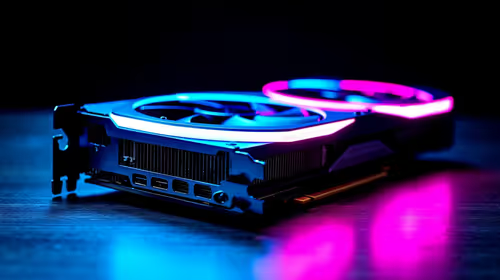
Will A Pcie 5.0 Gpu Work With A Pcie 4.0 Motherboard? Compatibility Guide
Will A Pcie 5.0 Gpu Work With A Pcie 4.0. Hand-picked gift ideas at every budget tier. SA pricing & Evetech availability included.
Read moreFor graphic designers 💡, relying on refurbished monitors 🖥️ risks color accuracy 💥. Ensure professional results with calibrated displays. #DesignTips

That tempting price tag on a refurbished monitor might look like a steal, especially when you’re building a design rig on a budget here in SA. But hold on... what if the brilliant crimson you perfected for a client’s logo shows up as a dull maroon on their screen? The hidden gamble with second-hand screens is real, and for creative professionals, colour accuracy on refurbished monitors isn't just a spec—it's your reputation. 🎨
When you buy a new, factory-sealed monitor, it comes with a promise: its panel will perform within certain specifications for brightness, contrast, and colour. A refurbished unit, however, has a history. This history is precisely where the risk for designers lies.
Over time, a monitor's backlight can dim, and its liquid crystals can degrade, leading to colour shifting that's invisible to the naked eye but disastrous for professional work. Was the monitor used for 12 hours a day in a brightly lit office, or was it a gamer's secondary screen? You just don't know. This uncertainty means the sRGB or Adobe RGB coverage it had on day one is likely a distant memory. The result? You could be making critical colour decisions on a screen that's lying to you. 📉
"Can't I just calibrate it?" It's a fair question. Professional calibration tools can certainly help correct colour imbalances and create a more accurate profile for your specific device. However, a calibrator can only work with what the panel is physically capable of displaying.
Think of it like tuning an old guitar. You can get the strings in tune, but you can't fix a warped neck. If a monitor's panel has lost its ability to display a certain range of reds or blues, no amount of software tweaking can bring them back. Investing R3,000+ in a calibrator only to discover your panel is past its prime is a tough pill to swallow, especially when that money could have gone towards a more reliable setup, like pairing a solid entry-level monitor with one of our powerful AMD laptops on special.
If you can inspect a refurbished monitor before buying, try to access its hidden service menu (Google the model + "service menu"). You can often find an "Uptime" or "Panel On" timer that shows how many hours it's been used. Anything over 15,000 hours is a potential red flag for colour-critical work.
The initial saving on a refurbished monitor can be quickly wiped out by the costs of its poor performance. We're talking about wasted hours on revisions, frustrating client feedback loops, and the potential damage to your professional credibility. In the creative industry, consistency is king. Ensuring the colours you see are the colours you deliver is non-negotiable.
For many designers, a modern laptop is the hub of their workflow anyway. Instead of risking your work on a second-hand screen, it might be smarter to invest in a machine with a brilliant, factory-calibrated display from the get-go. Many of the best gaming laptop deals now feature screens with 100% sRGB coverage and outstanding brightness, making them perfect dual-purpose machines for work and play.
So, what's the move for a budget-conscious South African designer?
Ultimately, while the low price of a used screen is tempting, the potential colour accuracy on refurbished monitors presents a serious risk for designers. Your work deserves a canvas you can trust. 💡
Build a Creative Workstation You Can Trust Don't let a dodgy screen compromise your craft. Explore our wide range of laptop specials for sale in South Africa and find a machine with a display that brings your vision to life, accurately and reliably.
They may lack proper calibration or aging panels affecting color fidelity crucial for design precision.
While possible, older panels might not hold calibration well, leading to inconsistent design outputs.
Accurate colors ensure design integrity across mediums. Poor accuracy risks brand misrepresentation and client dissatisfaction.
Use colorimeter tools to test consistency, and check manufacturer specs for delta-E ratings.
Not always, but prioritize calibrated color profiles and avoid gaming-focused models without RGB controls.
Aim for delta-E <2 for professional work, ensuring displays meet industry-standard color accuracy thresholds.
Yes! Mismatched screen-to-print colors result from poor calibration, risking errors in final printed outputs.
Will A Pcie 5.0 Gpu Work With A Pcie 4.0. Hand-picked gift ideas at every budget tier. SA pricing & Evetech availability included.
Read more
Streamelements Setup with GPU: Streamer Guide. Clear setup instructions with SA-specific considerations, troubleshooting tips & recommended components.
Read more
Intel Arc B580 Throttling Under Load: Temperature. Everything you need to know with SA pricing, step-by-step instructions & expert recommendations.
Read more
Complete ATX Case Size Guide: Interior Dimensions. Best deals curated with real SA discounts, price history & tips on getting genuine value.
What GPU Do You Need for AI & Machine Learning. Hardware requirements breakdown with recommended specs & SA pricing for each tier.
Top Settings for RTX 4060 at Ultrawide 1440p picks evaluated on performance, value & SA availability with current Rand pricing from Evetech.

Head-to-head comparison of FreeSync vs G-Sync Explained: Which Should Gamers for SA gamers. Performance benchmarks, Rand pricing & which delivers better value.
Every spec on PCIe 5.0 explained in plain English. What matters for gaming and creator work in 2026, what's marketing fluff, and how each number translates to real-world performance.
Every spec on bios explained in plain English. What matters for gaming and creator work in 2026, what's marketing fluff, and how each number translates to real-world performance.

Every spec on gaming setups explained in plain English. What matters for gaming and creator work in 2026, what's marketing fluff, and how each number translates to real-world performance.
Every spec on cooling systems explained in plain English. What matters for gaming and creator work in 2026, what's marketing fluff, and how each number translates to real-world performance.
Every spec on understanding how much vram is needed explained in plain English. What matters for gaming and creator work in 2026, what's marketing fluff, and how each number translates to real-world.
How to pick the right PCIe 5.0 for your build in 2026: the features worth paying for, ZAR value tiers, and the trade-offs between budget, mid-range and flagship picks.

Every spec on gpu explained in plain English. What matters for gaming and creator work in 2026, what's marketing fluff, and how each number translates to real-world performance.
Every spec on gpu explained in plain English. What matters for gaming and creator work in 2026, what's marketing fluff, and how each number translates to real-world performance for SA buyers.