


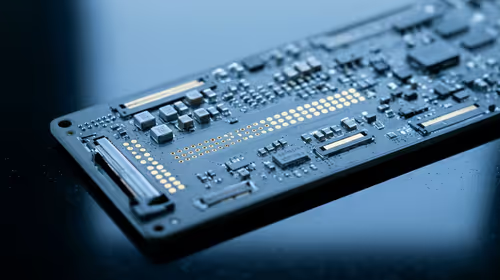
Hot-Swappable PCB Architecture in Modern Keyboards: Guide
Learn hot-swappable PCB architecture in modern keyboards—what it is, how sockets and traces work, and how to pick the right board. Speed up swaps, reduce risk, and upgrade faster 🔧⚡
Read moreEver wondered about CPU cache gaming performance? 🤔 This guide breaks down how L1, L2, and L3 cache directly impact your frame rates and reduce stutter. Learn why more cache isn't always better and discover how innovations like AMD's 3D V-Cache are changing the game. 🚀
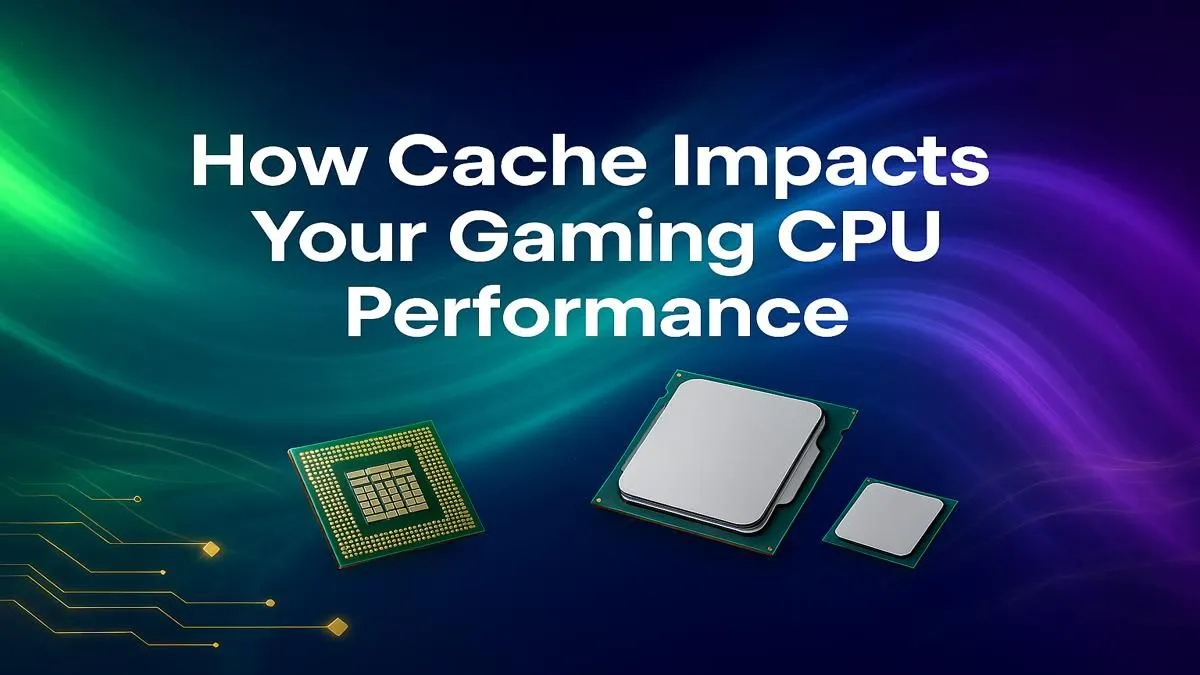
Staring down the sights in Valorant, you’re about to click… and your screen hitches for a split second. Ugh. We’ve all been there. While everyone blames the GPU or a slow internet connection, a hidden hero is often the cause: your CPU's cache. Understanding CPU cache for gaming isn't just for hardcore techies; it's the secret to unlocking smoother, more consistent frame rates and gaining a real competitive edge. Let's dive in.
Think of your CPU as a master craftsman at a workbench. To build anything, it needs data. The fastest way to get that data is from its cache.
CPU cache is a small amount of super-fast memory built directly onto the processor. It acts as a high-speed buffer between your CPU and your main RAM.
When your CPU needs data, it checks the cache first. If it's there (a "cache hit"), awesome! The data is delivered almost instantly. If not (a "cache miss"), it has to go all the way to the much slower system RAM. For gaming, these misses can cause those annoying micro-stutters. That's why when you're looking at all the CPU processors for sale, the cache size is a key spec to watch.
So, how does this translate to better CPU cache gaming performance? Simple: fewer "trips" to the slow RAM. Modern games, especially open-world titles like Starfield or fast-paced shooters, are constantly juggling huge amounts of data—enemy positions, textures, physics calculations, you name it.
A larger L3 cache acts like a bigger workbench, holding more of this crucial game data right where the CPU needs it. This leads to:
When comparing CPUs on a product page, look for "L3 Cache" or "Intel Smart Cache". This is the most impactful cache level for gaming performance. For example, a CPU with 32MB of L3 cache will generally handle gaming data much more efficiently than one with only 16MB, all other things being equal.
Both major CPU manufacturers know how vital cache is, but they have slightly different philosophies.
AMD famously shook up the market with their 3D V-Cache technology. By stacking an extra layer of L3 cache directly on top of the processor die, they created CPUs with an enormous cache pool. This has made certain AMD CPUs like the Ryzen 7 7800X3D legendary among competitive gamers for their chart-topping performance, specifically because of this cache advantage.
Intel, on the other hand, focuses on a balanced approach with their "Smart Cache". High-end Intel CPUs also pack a serious cache punch, combining it with high clock speeds and a powerful core architecture to deliver incredible all-round performance in both gaming and productivity.
While a bigger L3 cache is a massive benefit for gaming, it's one piece of a complex puzzle. Core clock speed, architecture (how efficiently the CPU works), and core count still matter immensely. The perfect CPU is about balance.
However, if your primary goal is squeezing every last frame out of your rig and achieving the smoothest possible gameplay, paying attention to cache is no longer optional. It's a critical spec that directly impacts how your games feel, second by second. For anyone serious about their CPU cache gaming setup, prioritising a chip with a generous L3 cache is one of the smartest upgrades you can make.
Ready to Eliminate Stutter and Boost Your FPS? Understanding CPU cache is the first step. The next is finding the processor that perfectly balances power, cache, and price for your rig. Explore our massive range of CPU processors and find the perfect core for your gaming world.
Yes, a larger and faster CPU cache, especially L3 cache, significantly improves gaming performance by reducing latency and allowing the CPU to access data quicker.
A larger cache stores more game data, reducing the need for the CPU to fetch it from slower RAM. This speeds up instruction processing, leading to higher and more stable FPS.
Yes, L3 cache is generally the most important for gaming. Its larger size allows it to hold more game instructions and data, minimizing delays and boosting overall performance.
For modern gaming, a CPU with at least 32MB of L3 cache is a good starting point. High-end gaming CPUs, like those with AMD's 3D V-Cache, can have over 100MB.
Absolutely. Insufficient cache can lead to data bottlenecks where the CPU is waiting for data from RAM, causing noticeable stuttering and inconsistent frame times in demanding games.
Yes, AMD's 3D V-Cache technology provides a massive L3 cache, which has proven to deliver significant FPS gains in many games, making it a major advantage for gamers.
Learn hot-swappable PCB architecture in modern keyboards—what it is, how sockets and traces work, and how to pick the right board. Speed up swaps, reduce risk, and upgrade faster 🔧⚡
Read more
Mechanical switch lifespan explained—what the 50 million keystroke rating really means, plus tips to extend switch life and reduce double-press issues 🔧⌨️
Read more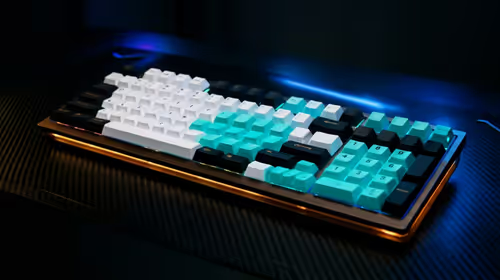
60-percent vs full-size mechanical keyboard layouts—learn what each layout includes, who it suits, and how to choose the right fit 🧩⌨️ for typing, gaming, and productivity.
Read more
Double injection keycaps last far longer than standard printed keycaps in most setups. Learn typical lifespan ranges, what shortens them, and how to maximize durability for smoother daily typing and gaming 😊⌨️
Read more
Full-key anti-ghosting: does it stop missed inputs during fast-paced gaming? We break down latency, polling, and key matrix limits so you can buy smarter 🎮⚡
Read more
Protect mechanical keyboard switches from South African dust and summer humidity with practical cleaning and storage habits. Keep your switches smooth, reduce failures, and extend lifespan. 🌬️💧
Read more
Wondering if a TKL wireless mechanical keyboard is worth it for everyday productivity? We break down latency, battery life, comfort, and workflow gains for real work. ⚡⌨️

Maximise battery life on a fanless 15-inch laptop using efficiency core architecture. Cut idle drain, tune power profiles, and improve thermals for longer runtime. 🔋⚙️
Learn how to reduce desk clutter with a TKL wireless keyboard using fewer cables, smart placement, and tidy essentials. Get a faster, calmer workspace with better ergonomics. ✅🧼
RGB keyboard lighting too distracting? Learn how to manage backlight modes, set brightness, and reduce distraction for focus and productivity 😌🖱️
Are themed gaming keyboards worth the extra cost? Compare build quality, switch options, features, and resale value to find the best fit for your setup 🎮⌨️
Full-Size vs Tenkeyless mechanical keyboards for gaming: find out if a smaller layout truly improves aim, speed, and comfort. We break down layout, desk space, latency-feel, and keybinds 🎮⌨️

Dedicated media rollers vs function key shortcuts: learn which setup gives you better workflow control, faster media access, and fewer mistakes. 🖱️🎧
Best Mechanical Switch Type for Gaming: Clicky vs Linear vs Tactile. Find your feel, speed, and noise balance with practical guidance for FPS, MOBA, and productivity 😄🎮
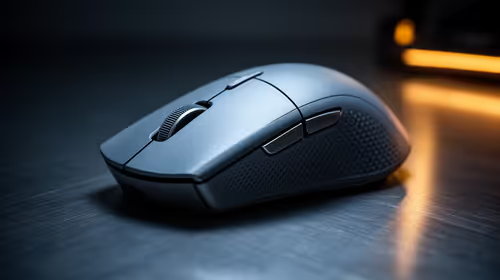
Direct mouse answer: Mouse not keeping up with your work? Everything that matters about dual-mode 2.4GHz + BT 5.0: DPI behaviour, channel switching, battery curves and per-app button mapping. Covers when 2.4GHz USB wins (low-latency desk) and when BT 5.0 wins (laptop, d
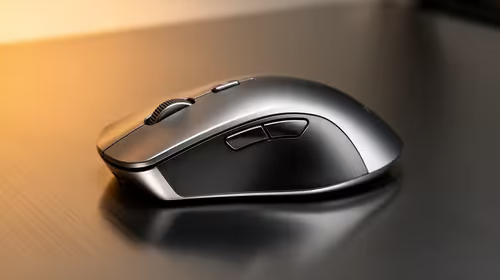
Plain wireless mouse guide: Mouse not keeping up with your work? Everything that matters about wireless productivity mouse: DPI behaviour, channel switching, battery curves and per-app button mapping. Includes DPI tuning tips, channel switch shortcuts, and ZAR-aware fea
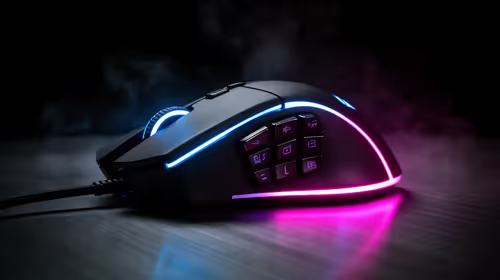
Real productivity numbers: Set up your wireless mouse in this order: everything that matters about wireless productivity mouse: DPI behaviour, channel switching, battery curves and per-app button mapping. Includes DPI tuning tips, channel switch shortcuts, and ZAR-aware
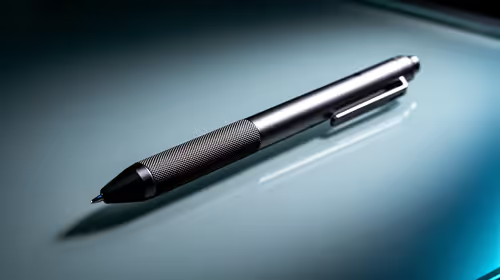
Pen not feeling like paper? Stylus lag and skipping usually trace to old drivers, dirty nibs, or display refresh mismatches, not the pen itself. Covers pressure curve tuning, tilt thresholds, nib swap timing, and SA pricing brackets.