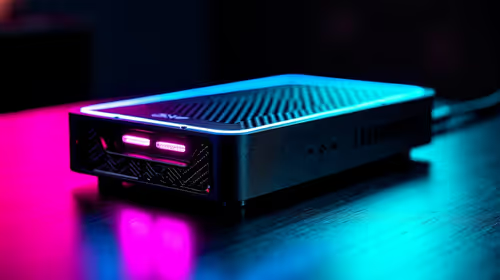
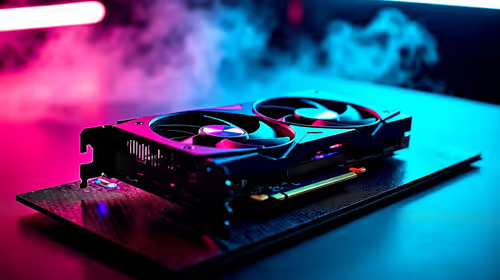
Two routes to running serious AI models at your desk, two completely different philosophies. The DGX Spark is a compact Grace-Blackwell appliance with a single 128GB unified memory pool and roughly 1 petaFLOP of FP4 compute, sipping power. A multi-GPU desktop throws raw speed at the problem with discrete cards, but fragments its VRAM across them and draws far more from the wall. Which one wins depends entirely on whether you care more about model size or model speed.
Quick Answer
DGX Spark fits models a multi-GPU desktop cannot, because its 128GB of unified memory acts as one pool and its FP4 support lets it run models up to roughly 200 billion parameters in a box that draws around 150-250W. A multi-GPU desktop is markedly faster, often three to four times quicker on 7B-13B inference, but each card's VRAM stays separate and cannot be combined into one large model. Choose DGX Spark for big-model capacity, a multi-GPU desktop for raw speed on models that already fit.
The fundamental difference: pooled versus fragmented memory
This is the crux of the comparison, and everything else follows from it.
How DGX Spark uses memory
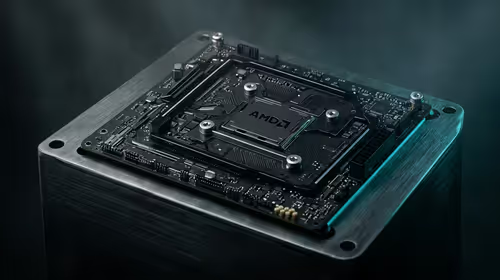
DGX Spark is built on NVIDIA's GB10 Grace-Blackwell superchip, which integrates an Arm processor alongside Blackwell GPU compute and 128GB of unified memory that both sides share as a single addressable pool. There is no copying between separate system RAM and VRAM, and crucially no need to split a model across devices. A large model loads into one continuous 128GB space. Its NVFP4 4-bit support is what makes the 200-billion-parameter headline real, letting models that large run without the quality collapse aggressive quantisation usually brings.
How a multi-GPU desktop uses memory
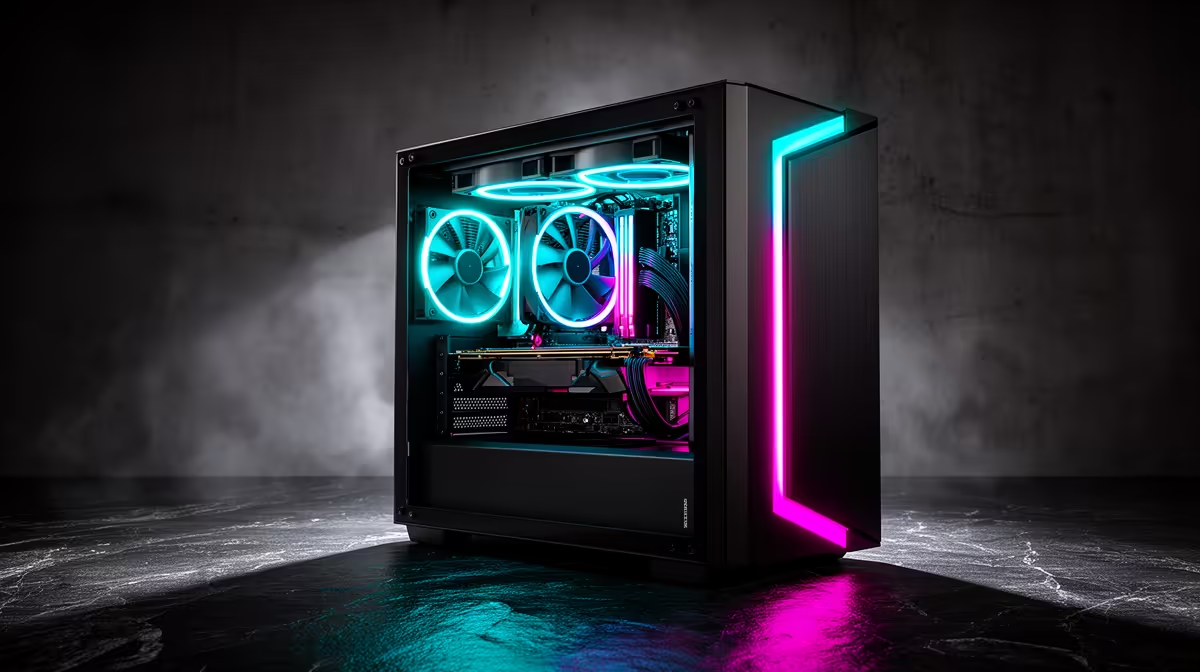
Stack two consumer cards and you might have, say, 48GB of VRAM in total, but it is not one 48GB pool. Each card holds its own VRAM, and a model larger than a single card's memory has to be split across both with the framework managing the handoff, which adds complexity and overhead. Plenty of models simply will not run this way at all. Dual cards can edge out raw compute on small models, but they cannot touch a 200-billion-parameter model that needs to live in one space.
Where the multi-GPU desktop wins: raw speed
Capacity is not everything. For models that already fit in a single card's VRAM, a high-end consumer GPU is much faster than DGX Spark, frequently in the region of three to four times quicker on training and inference. The reason is straightforward: consumer cards run higher clock speeds and carry far more memory bandwidth, often around four times the bandwidth, plus roughly three times the CUDA cores of the Spark's GPU. Memory bandwidth is the dominant factor in how fast tokens come out, which is why a single fast card outpaces the Spark on 7B-13B models that fit comfortably.
So if your work centres on smaller models where speed per token matters most, a multi-GPU desktop is the stronger tool. The trade-off is what it cannot do, not what it does. The best-selling graphics cards at Evetech cover the discrete silicon that powers these high-bandwidth desktop builds.
Power, footprint, and running cost
The two diverge sharply on efficiency. DGX Spark is a 150mm-square appliance weighing around 1.2kg that draws roughly 150-250W under inference load. A multi-GPU desktop with two or more high-end cards can pull several times that under load, demands a large case and a hefty power supply, and runs hotter. Over a year of daily heavy use the Spark's electricity cost is modest, while a multi-GPU rig's is substantially higher. For an always-on local inference box, that efficiency and small footprint are real advantages, especially where desk space and power draw matter.
Scaling the appliance
DGX Spark is also designed to scale in a way loose consumer cards are not. Two units can link over NVLink at 900 GB/s bidirectional, far quicker than standard Ethernet or even InfiniBand, letting a pair share work on very large models with a fast interconnect. That is a cleaner growth path for big-model work than trying to cram ever more discrete cards into one chassis. For local AI machines built and supported as complete systems, the AI PC range at Evetech is where that search begins.
Picking the right tool
Reach for DGX Spark when the job is running or developing large models, agents up to around 200 billion parameters, or anything that needs that 128GB of pooled memory, and when low power and a tiny footprint matter. Reach for a multi-GPU desktop when your models fit in a single card's VRAM and you want the fastest possible tokens per second, accepting higher power draw and the inability to run the very largest models. Neither is simply better; they solve different halves of the local-AI problem.
The role of FP4 precision
The detail that makes the Spark's headline possible deserves its own explanation, because it is easy to miss. Running a 200-billion-parameter model in 128GB of memory only works because of NVFP4, NVIDIA's 4-bit floating-point format. Older 4-bit quantisation schemes squeeze a model down but often cost noticeable quality. FP4 on Blackwell is designed to hold accuracy far better at that low bit width, so the Spark can fit very large models into its unified pool without the quality collapse you would expect from aggressive compression. A multi-GPU desktop running standard precision needs vastly more VRAM to hold a model that size, which is precisely why it cannot match the Spark on capacity. The takeaway is that the Spark's advantage is not just raw memory, but memory combined with an efficient format built for it.
Development workflow versus production
There is a workflow angle that often decides the choice in practice. The Spark is frequently used as a development and prototyping appliance: a quiet, low-power box on which to build and test agents against very large models before deploying them to bigger cloud or data-centre hardware. Its value there is the ability to work with model sizes locally that a single consumer card simply cannot hold, even if each token comes slower. A multi-GPU desktop, by contrast, suits iterative work on models that fit, where fast turnaround per generation matters more than maximum model size. Matching the tool to whether you are prototyping large or iterating fast is often clearer than comparing raw specs.
Frequently Asked Questions
Is DGX Spark faster than a high-end gaming GPU for AI?
No, not for models that fit in the GPU's VRAM. A single high-end consumer card is typically three to four times faster on small-to-mid model inference because of higher clocks and far greater memory bandwidth. DGX Spark wins on capacity, not raw speed.
Why can a multi-GPU desktop not run a 200-billion-parameter model?
Because each card's VRAM is a separate pool, not one combined space, and a model that large needs to be split across devices with significant overhead or cannot load at all. DGX Spark's single 128GB unified pool plus FP4 support is what makes models that size practical.
How much power does DGX Spark use compared with a multi-GPU rig?
DGX Spark draws roughly 150-250W under load. A multi-GPU desktop with two or more high-end cards can pull several times that, alongside a larger case and power supply, making the Spark far more efficient for an always-on inference box.
Can I connect two DGX Spark units together?
Yes. Two units link over NVLink at 900 GB/s bidirectional, a much faster interconnect than Ethernet or InfiniBand, allowing them to share work on very large models. It is a cleaner scaling path than adding more loose consumer cards.
Which is better value for local AI development?
It depends on the models you target. For experimenting with very large models or agents, DGX Spark's pooled memory and FP4 capacity earn their keep. For fast iteration on models that fit a single card, a multi-GPU desktop delivers more speed per Rand.
Deciding between a unified-memory appliance and a multi-GPU build for your local AI work? Explore the AI PC range at Evetech and match the hardware to whether you need bigger models or faster ones.