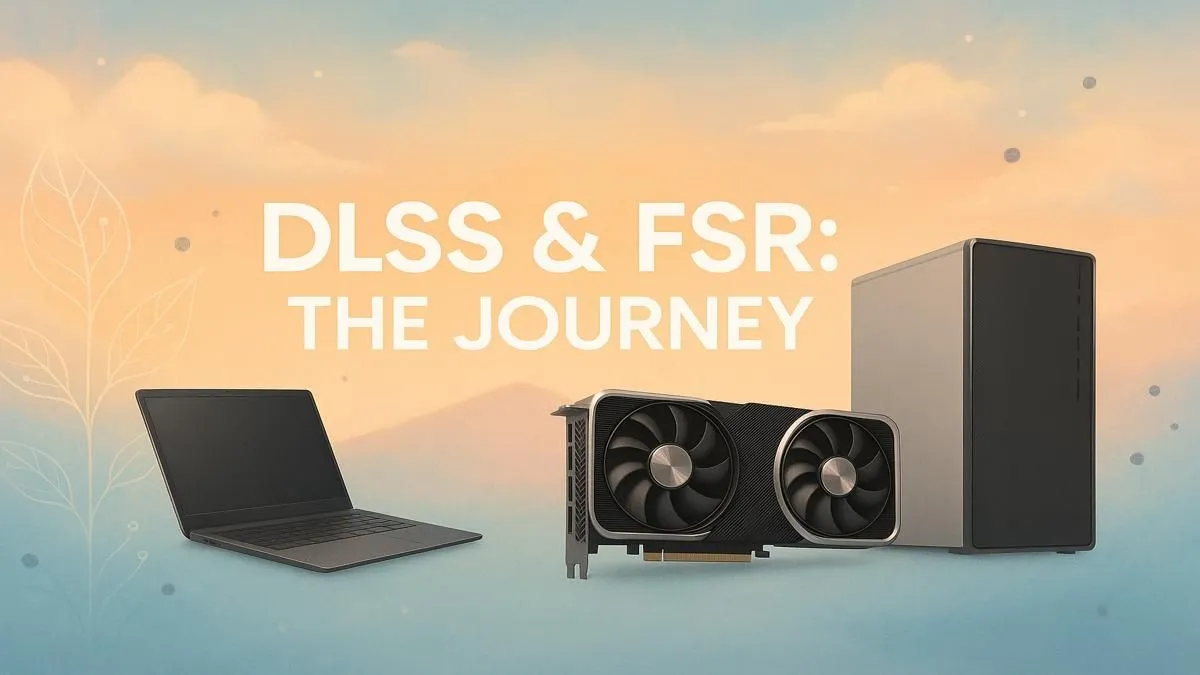
Chasing buttery-smooth frame rates at crisp, high resolutions used to be an expensive hobby in South Africa. You either spent a fortune on a top-tier graphics card or settled for turning down those eye-candy settings. Then, a revolution happened... not with silicon, but with software. The evolution of AI upscaling, driven by technologies like DLSS and FSR, completely changed the performance equation, making high-FPS gaming more accessible than ever. Let's dive in.
The Early Days: NVIDIA's Ambitious DLSS Bet
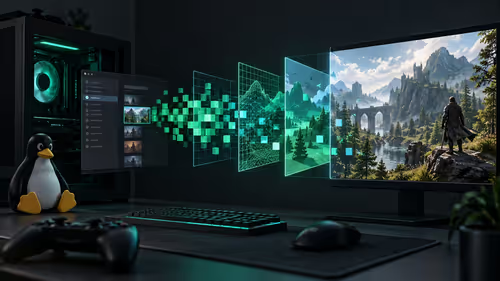
The DLSS and FSR history begins with NVIDIA's Deep Learning Super Sampling (DLSS). When the first RTX 20-series cards launched in 2018, DLSS 1.0 was a headline feature. The idea was brilliant: render a game at a lower resolution (like 1080p) and use specialised AI hardware, called Tensor Cores, to intelligently upscale the image to a higher resolution (like 4K). This would, in theory, give you 4K-like quality with 1080p-level performance.
The reality, however, was a bit... blurry. DLSS 1.0 required the AI to be trained for each specific game, which was slow and expensive for developers. Worse, the upscaled image often looked soft and lost detail compared to native resolution, earning it a shaky reputation among gamers. It was a bold first step, but the technology needed to mature.
From Blurry to Brilliant: The Evolution of DLSS
NVIDIA went back to the drawing board and returned with DLSS 2.0. This was the moment AI upscaling truly arrived. Instead of a game-specific model, DLSS 2.0 used a generalised neural network trained on a massive library of high-resolution game images. It also incorporated temporal feedback—using data from previous frames to inform the current one—which dramatically improved image quality. Suddenly, the "Performance" mode in games could double your frame rate while looking nearly identical to the native resolution. ✨
This evolution continued with DLSS 3, which introduced AI Frame Generation. This mind-bending tech doesn't just upscale frames; it creates entirely new ones and inserts them between existing frames, multiplying your FPS. This feature requires the power and specific hardware found in the latest NVIDIA GeForce RTX graphics cards, showcasing how tightly software and hardware are now intertwined.
Check Your Game's Support List ⚡
Before buying a new game specifically for its upscaling features, always check its official support list. While most new AAA titles support at least one technology, some might only offer DLSS or FSR, not both. A quick Google search can save you from disappointment and ensure your hardware can be fully utilised.
AMD's Answer: The Open-Source FSR Saga
While NVIDIA focused on its AI-powered, hardware-specific approach, AMD entered the scene with a different philosophy: openness. FidelityFX Super Resolution (FSR 1.0) launched in 2021 as a spatial upscaler. It didn't use AI or machine learning; instead, it used advanced sharpening algorithms to upscale the image.
The magic of FSR 1.0 was its compatibility. Because it didn't require dedicated AI cores, it worked on a huge range of GPUs, including older NVIDIA cards and, of course, AMD's own lineup. The image quality wasn't quite on par with DLSS 2.0, but it provided a fantastic, free performance boost for millions of gamers.
Like NVIDIA, AMD iterated quickly. FSR 2.0 adopted a temporal upscaling technique similar to DLSS 2.0, massively closing the quality gap. Today, FSR 3 offers its own version of frame generation, proving that the future of performance is driven by these intelligent software solutions that power the most popular AMD Radeon graphics cards on the market.
AI Upscaling in Gaming Today 🚀
The history of DLSS and FSR has led us to an incredible place. Gamers now have multiple powerful options to boost performance without sacrificing visual fidelity. The competition between Team Green's DLSS and Team Red's FSR, along with Intel's XeSS, has pushed innovation forward at a blistering pace.
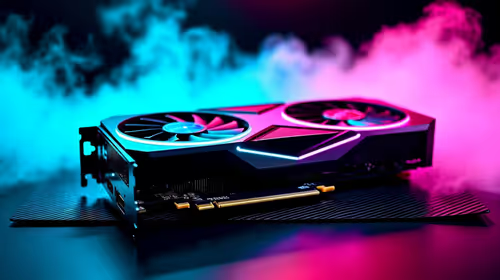
Choosing a graphics card is no longer just about raw teraflops; it's about the ecosystem and the software features you value most. Do you want the cutting-edge quality and Ray Reconstruction of DLSS 3.5, or the wide-open compatibility of FSR? Understanding this evolution helps you make a smarter choice when looking for the best graphics card deals to build or upgrade your rig.
Ready to Experience Next-Gen Performance?
The history of DLSS and FSR shows that smart software is just as important as powerful hardware. To get the best of both worlds, you need the right GPU. Explore our incredible graphics card deals and find the perfect upgrade for your rig today.