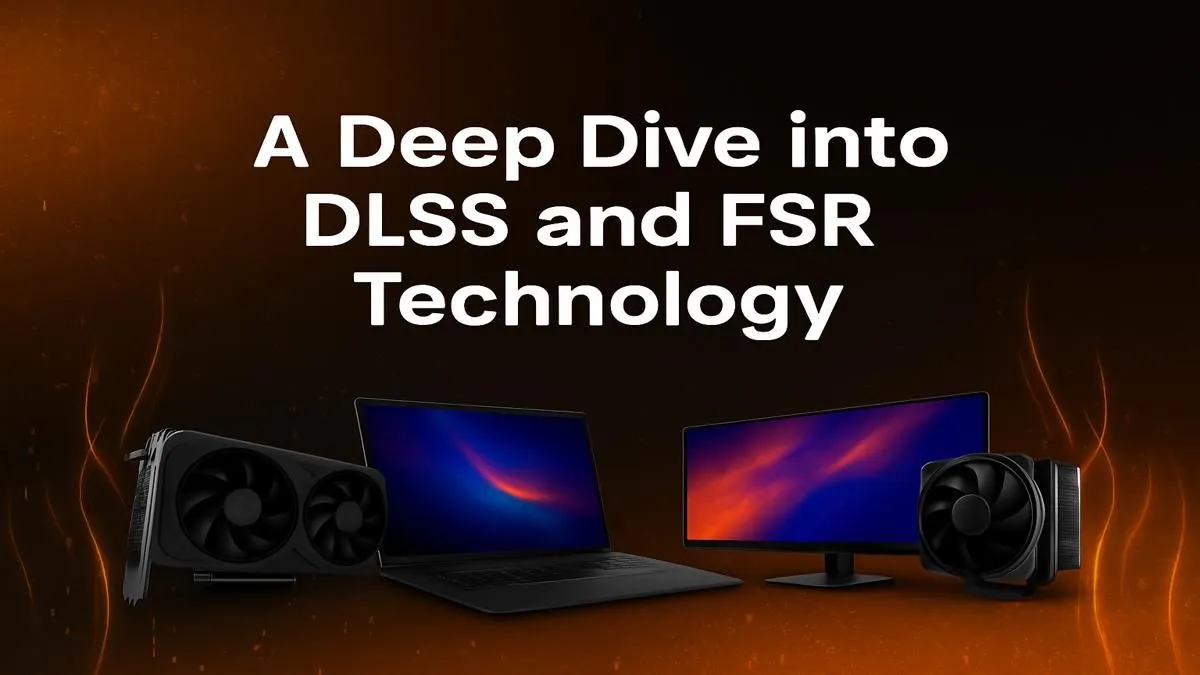
Staring at a stuttering frame rate after dropping thousands of Rands on a new game is a uniquely South African kind of pain. You want buttery-smooth 1440p, but your rig is struggling. What if you could get a massive FPS boost for free? That's the promise of upscaling technology. In the ultimate showdown of DLSS vs FSR, we'll help you figure out which tech is the right choice for your gaming setup.
So, What Exactly is Upscaling?
Think of it like magic for your graphics card 🧙. Instead of rendering a game at your monitor's native resolution (like 1440p), the GPU renders it at a lower resolution (like 1080p). Then, smart algorithms or AI analyse the image and intelligently "upscale" it back to 1440p, filling in the missing pixels.
The result? Your graphics card does less work, which means you get a huge performance lift... often boosting your FPS by 50% or more, without a massive drop in visual quality. It's the secret sauce behind smooth 4K gaming and high-refresh-rate action.
NVIDIA DLSS: The AI-Powered Juggernaut
NVIDIA’s Deep Learning Super Sampling (DLSS) is the exclusive tech for GeForce RTX cards. It uses dedicated hardware called Tensor Cores, combined with a powerful AI model, to reconstruct images with incredible accuracy. This AI-driven approach is its greatest strength, often producing an image that's even sharper than the native resolution.
Because it relies on specific hardware, DLSS is only available on NVIDIA's range of RTX cards. If you're running a 20, 30, or 40-series card, DLSS is your go-to for incredible performance gains, especially with demanding features like ray tracing.
AMD FSR: The Open-Source Hero for All
AMD’s FidelityFX Super Resolution (FSR) takes a different approach. It’s an open-source spatial upscaling technology, which is a fancy way of saying it doesn't require specialised AI hardware. This is its killer feature: FSR works on almost any modern GPU! 🚀
That means you can get a fantastic FPS boost not just on AMD's powerful Radeon GPUs, but also on older NVIDIA GTX cards and even Intel’s Arc GPUs. This makes FSR a fantastic option for gamers looking to squeeze more life out of their current hardware.
Pro Gamer Tip ⚡
Always start with the "Quality" preset for DLSS or FSR. The visual difference is often minimal, but the FPS boost is huge. Only switch to "Balanced" or "Performance" if you're still not hitting your target frame rate. This gives you the best balance of eye-candy and buttery-smooth gameplay.
The Final Showdown: DLSS vs FSR
So, which one should you use? The debate over DLSS or FSR really comes down to your hardware and priorities.
- Image Quality: Generally, DLSS has a slight edge. Its AI-trained brain is fantastic at reconstructing fine details and maintaining a stable image with fewer visual artifacts. FSR has improved massively since its first version, but can sometimes look a little softer or have minor "fizzing" on complex textures.
- Performance Boost: Both technologies offer a significant FPS uplift, and the exact numbers vary by game and settings. You won't be disappointed with the performance from either camp.
- Compatibility: FSR is the clear winner here. Its open-source nature makes it a gift to all gamers, regardless of their GPU brand.
Ultimately, the best upscaling tech is the one your graphics card supports. If you have an RTX card, DLSS is likely your best bet for pure image fidelity. For everyone else, FSR is a phenomenal tool that delivers the performance you need to stay competitive. The choice between DLSS vs FSR often depends on the card you own, so it's wise to consider this when finding the best graphics card deals for your next build.
Ready to Boost Your FPS?
The DLSS vs FSR debate shows there's a perfect card for every budget. Whether you're Team Green or Team Red, the right GPU unlocks the performance you crave. Explore our best graphics card deals and find the perfect upgrade for your rig today.