Faster memory cannot compensate when the system runs out of capacity and starts leaning on storage. During a RAM price spike, choose enough memory for the workload before paying for clock speed you may barely measure.
Quick Answer
Capacity matters more than RAM speed when the smaller kit forces Windows to page or an application to close. Once the workload fits with headroom, data rate and timings can improve CPU-sensitive performance. During a price spike, buy enough matched capacity for the next two years, then choose the fastest stable profile inside the remaining budget. Do not make 32GB a rule for every PC or buy a high-speed 16GB kit when your real session already needs more than 16GB.
Capacity prevents the hard slowdown
RAM holds active application data close to the CPU. When physical memory runs short, Windows moves colder pages to the SSD-backed page file.
An NVMe drive is fast storage and remains far slower than DRAM access. Returning to a paged browser tab, game asset or editing buffer can create a visible pause.
More capacity helps when it reduces that paging. It does not make a light workload faster once the working set already fits.
Speed improves work inside the capacity
DDR5 data rate affects bandwidth. Timings and the memory-controller ratio affect latency. Games limited by the CPU, integrated graphics and some compression or simulation workloads can respond.
The gain varies by CPU, game, resolution and GPU. At 4K with a GPU bottleneck, faster RAM may change little. At 1080p high refresh with a strong GPU, frame-time lows can respond more.
Compare measured results on the same platform. A DDR5-7200 kit running a fallback 5600 profile after failed training is not faster in use.
Measure your working set
Open the real combination: game, browser, Discord, launcher, recording tool and study app. Work for thirty minutes.
Record Available memory, committed memory, page-file activity and frame time. Repeat the heaviest moment.
If 16GB leaves several gigabytes Available and no sustained paging, capacity may be sound. If Available approaches zero and storage activity rises with pauses, 32GB can remove a hard limit.
Creators should repeat with the largest project, not an empty application. Virtual machines need their assigned memory included.
Use a capacity ladder, not a slogan
16GB can suit a focused gaming or office PC with controlled background apps. 32GB gives comfortable headroom for current games plus multitasking in many builds. 64GB and above suit measured creation, virtual machines, local data work and large projects.
Those are roles, not promises. A modded game can use more than a plain one. A creator working with proxy media can need less than another using raw high-resolution footage.
Buy from the workload trace.
Two modules are the clean starting point
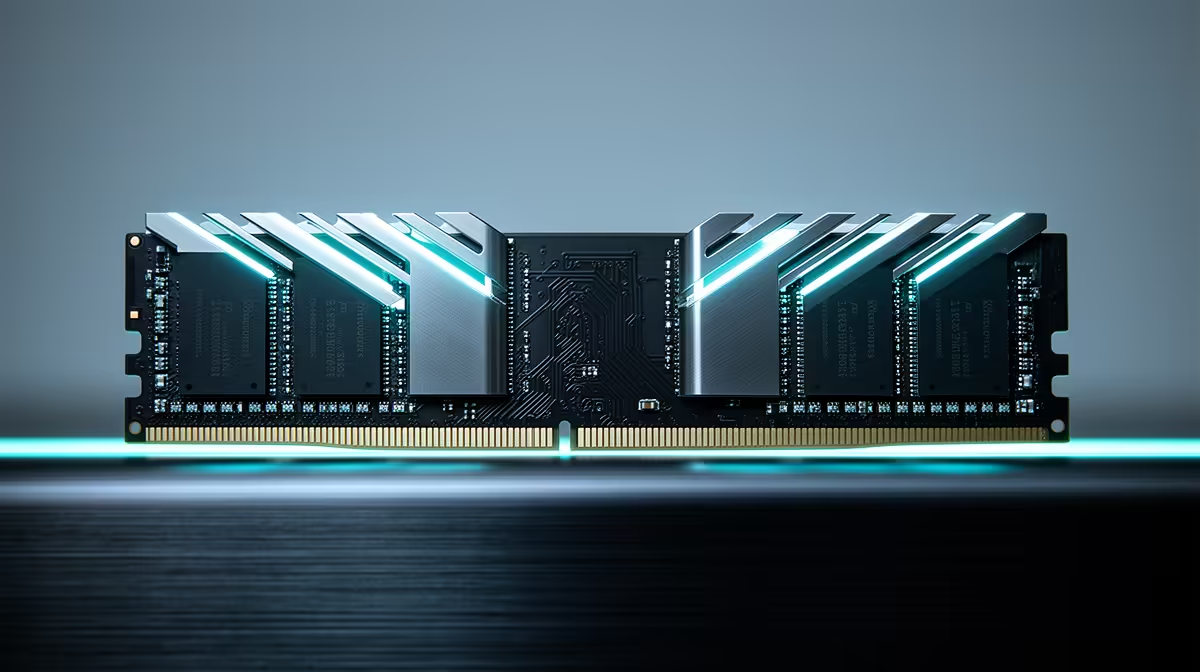
A matched two-DIMM kit provides the intended capacity and dual-channel path on mainstream platforms. It leaves slots open and places less electrical load on the controller than four high-speed DIMMs.
Check the motherboard manual for slot order. Four modules can reduce the stable data rate, especially at large capacity or aggressive XMP and EXPO profiles.
Do not plan to add another separate kit later because the heatspreader name matches. Memory IC and subtimings can change. A full matched-capacity kit is easier to validate.
Supported speed depends on the platform
The CPU memory controller, motherboard traces, BIOS and DIMM configuration decide the stable speed. A kit's rated XMP or EXPO value is an overclocking profile, not a guarantee for every system.
Check the board memory support list for the exact kit and capacity. Use it as evidence of testing, while individual CPU margin can differ.
Start at stock, update BIOS only when a relevant memory fix applies, then enable the supported profile and test.
Timings belong beside data rate
CAS latency printed on a box is one timing. True first-word latency depends on the clock and timing value, with secondary timings and controller ratio adding more.
A lower-speed kit with tighter timings can compete with a higher-speed loose kit in some work. Do not compare MT/s alone.
Use independent application benchmarks for your CPU. Synthetic bandwidth gives context and cannot replace the game or project result.
Price per usable gigabyte
Compare the total price of complete supported kits, not one module. Divide by capacity for context, then add the performance and stability differences.
A fast 16GB kit that needs replacement within a year can cost more than one balanced 32GB kit now. A 64GB kit used at 20GB peak locks money into idle capacity.
Set a budget split: capacity first, stable platform-appropriate speed second, RGB and extreme bins last.
Browse complete kits in the DDR5 memory range. For a live comparison of common capacities, inspect the memory best-seller page and write down full part numbers.
High prices do not justify low capacity twice
When memory prices rise, the temptation is to buy a smaller fast kit and add more later. That can leave you with mismatched modules, four-DIMM speed limits and another purchase.
If the required capacity exceeds the budget, lower speed within the platform's sound range, postpone RGB or choose another balanced component. Do not cut capacity below the workload and expect an SSD to replace it.
If the build date is flexible, track two exact kits and wait for a price trigger. Keep the current system only when it still completes the work.
Validate the final choice
Install the kit in the recommended slots and confirm capacity plus data rate. Run a bootable memory test, an in-system stress test and the actual game or application.
Watch DIMM temperature when sensors exist. High-speed or high-voltage profiles can lose stability as the case warms.
Save the stable BIOS profile and test sleep plus wake. A benchmark pass alone does not prove daily stability.
Repeat the heaviest application after memory installation and compare paging with the old kit. This closes the loop: the upgrade should remove a measured limit, not end at a capacity number shown in BIOS.
FAQ
Does RAM speed still matter?
Yes after capacity is sufficient. CPU-sensitive games and bandwidth-heavy work can gain, while GPU-limited play may change little.
Is 16GB enough?
It can be for focused work and gaming. Measure Available memory and paging during the complete session.
Should I buy slower RAM to afford more capacity?
Yes when the smaller kit would page and the slower kit remains supported and stable. Avoid an extreme speed sacrifice without benchmarks.
Measure peak committed memory, choose one matched capacity kit and spend the remaining budget on stable speed your CPU and board can hold.