Quick Answer
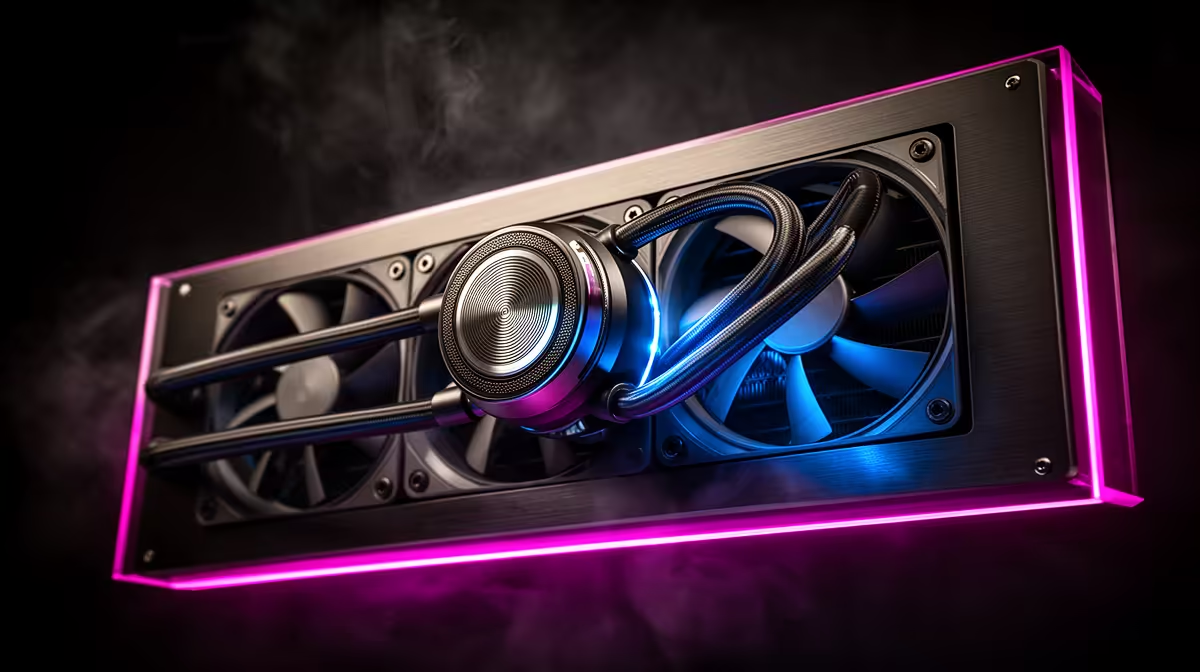
Yes, South Africa's warmer ambient temperatures meaningfully increase CPU temps, making a 360mm AIO more justifiable than in cooler European climates. Gauteng summers regularly push ambient room temps to 28 to 35 degrees Celsius, and every degree of ambient increase translates almost directly into a degree of CPU temperature rise.
How SA Ambient Heat Affects CPU Thermals 🌡️
CPU cooling performance is always measured as a delta above ambient. A 360mm AIO that keeps a Ryzen 9 9900X at 40 degrees above ambient performs identically in Cape Town's 18-degree winter and Johannesburg's 32-degree summer, but the absolute CPU temperatures are 58 degrees versus 72 degrees respectively. At 72 degrees under sustained load, modern CPUs are still within safe range (thermal throttle typically kicks in at 95 degrees), but sustained high temps accelerate silicon aging and make thermal headroom for overclocking much tighter.
Case Airflow and Room Ventilation Matter Too 🔧
SA homes that lack central air conditioning can see gaming room temperatures climb well above outdoor ambient during summer afternoons. A PC case positioned against a wall with restricted airflow compounds the problem. A 360mm AIO with three high-static-pressure fans exhausting hot air directly out of the case (top or rear mount) is more effective in these conditions than a large air cooler, because the AIO moves heat away from the CPU and radiates it outside the case rather than heating the case interior first. In poorly ventilated rooms, a case with positive pressure (more intake than exhaust) can also help by pulling cooler air from floor level, where temperatures are slightly lower.
Choosing the Right 360mm AIO for SA Conditions 🖥️
For SA builders in hot inland regions like Limpopo, Mpumalanga, or the Northern Cape, a 360mm AIO becomes the sensible baseline for any CPU with a TDP of 105W or above. Premium units in the R3,500 to R5,500 range that feature high-static-pressure fans (45 CFM or above per fan) will maintain better thermal headroom in peak summer. Look for units that include fan curves controllable via BIOS or software so you can ramp fan speed automatically when ambient rises. If your gaming room reaches 30 degrees or more in summer, pre-warming your target CPU temperature by at least 8 degrees versus what international reviews report will help you set realistic expectations.
Set a Custom Fan Curve for SA Summer ⚡
In your BIOS or AIO software, create a fan curve that starts ramping at 60 degrees CPU temp rather than the default 70 degrees. This gives the radiator a head start when SA summer ambient pushes baseline temps higher than they would be in a temperate climate lab.
FAQ
Does a 360mm AIO help more than air cooling in SA summers?
For high-TDP CPUs above 125W, yes. Air coolers dissipate heat into the case interior first, which raises ambient inside the case and creates a feedback loop in hot rooms. An AIO bypasses this by moving heat directly to the radiator and out of the case, keeping the thermal loop independent of internal case temps.
Should I put the radiator at the top or front of my case in SA?
Top mounting exhausts warm air upward and out, which is generally preferred for thermal efficiency. Front mounting pulls cool air in over the radiator before it reaches other components. In very hot ambient conditions, front mounting as intake can lower GPU and VRM temps, so test both configurations and monitor with HWInfo64 during a summer gaming session.
What CPU temp is too high for everyday use in a hot SA room?
Sustained temps above 85 degrees Celsius under load should prompt investigation. Peak spikes to 90 to 95 degrees during a brief Cinebench run are within spec for modern CPUs, but if a CPU sits at 90 degrees for hours of gaming in summer, improve case airflow or upgrade the cooler.
Gaming in a hot SA room and need better CPU cooling?
Evetech stocks 360mm AIOs suited to South Africa's warm climate, with options from R1,800 to R6,000. Check the CPU cooler range to find a model that keeps temps in check year-round.