Quick Answer
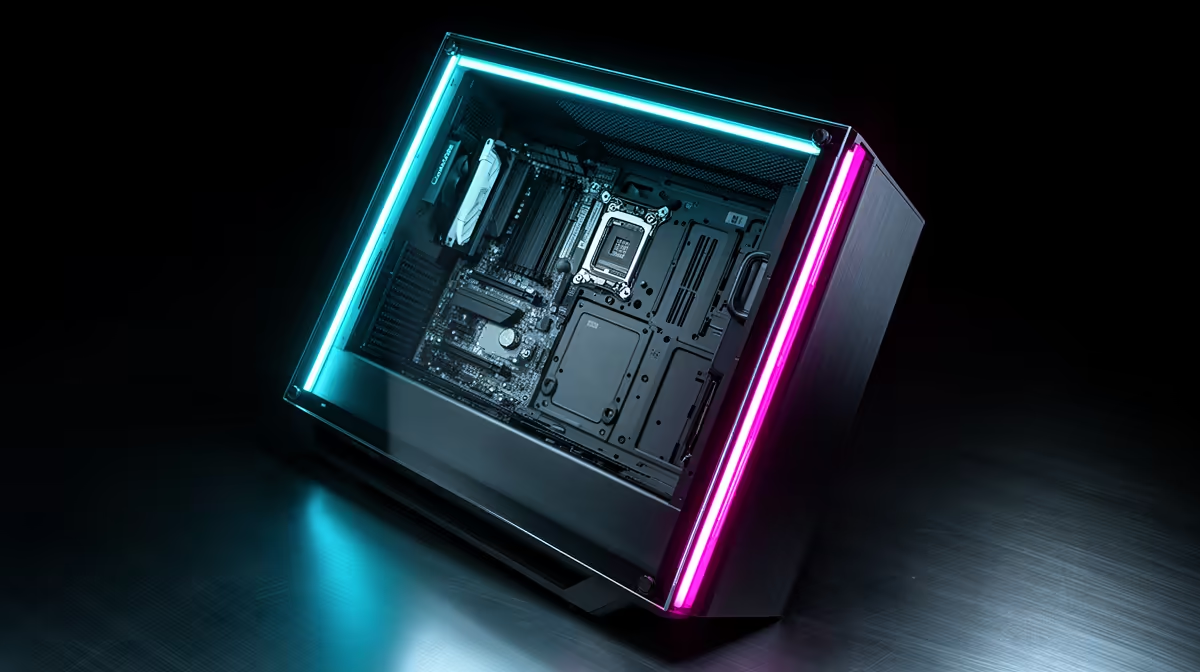
E-ATX cases add roughly 25mm of extra internal width to accommodate the larger 305mm by 330mm E-ATX motherboard footprint compared to the standard ATX 305mm by 244mm board, and that extra space also means more room for GPU clearance, radiator stacking, and cable routing. ATX cases are the right choice for standard mainstream builds; E-ATX cases make sense when you are running a high-core-count HEDT platform or a board with extra PCIe slots and overclocking features.
Size Differences and What They Mean at the Desk 🖥️
An E-ATX case is typically 50 to 80mm taller and 20 to 40mm wider than an equivalent ATX mid-tower. On a desk, this translates to a more imposing footprint that suits a dedicated gaming station but may not fit in tighter desk setups common in SA student residences or compact flat living rooms. A standard ATX mid-tower fits comfortably on most desks without rearranging the space. E-ATX cases rarely come as compact units: most are full-towers starting at 480mm tall, which puts them on the floor beside a desk rather than on it, which is actually an advantage for airflow since floor-level ambient temperatures are typically 3 to 5 degrees Celsius cooler than desk-top level in a South African summer.
Upgrade Space: Where E-ATX Pulls Ahead 🔧
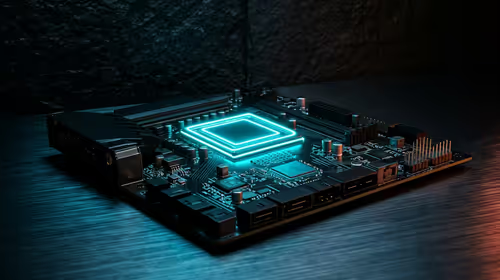
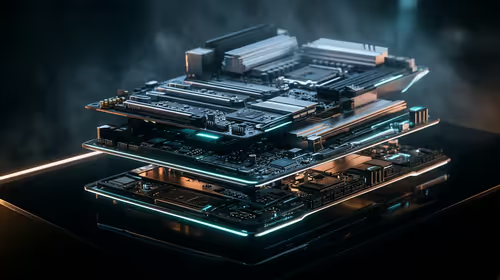
E-ATX motherboards often carry 8 RAM slots instead of 4, four PCIe slots instead of two or three, additional M.2 slots, and more USB and fan headers. For builders who see a system as a long-term investment that will receive incremental upgrades over four to six years, starting with an E-ATX platform allows adding RAM capacity, a second GPU for compute workloads, or an additional PCIe NVMe card without replacing the motherboard. ATX boards top out at 128GB DDR5 on high-end designs; E-ATX and EATX HEDT boards can support 256GB or more, which matters for video editing and 3D rendering workloads.
The Cost Reality for South African Builders 💰
E-ATX cases in the South African market typically start around R2,500 and reach R7,000 or more for flagship designs with full glass panels and premium steel construction. ATX mid-towers cover the R800 to R4,000 range, giving significantly more value options at the entry and mid points. An E-ATX build also requires an E-ATX motherboard, which commands a premium of R3,000 to R8,000 over equivalent ATX boards. The total platform premium for going E-ATX is often R8,000 to R15,000 versus a comparable ATX build, which is justified only when the extra PCIe bandwidth or RAM capacity is genuinely needed.
Check Your Desk Dimensions Before Ordering ⚡
Before committing to an E-ATX full-tower, measure the width and height clearance of your desk cubby or tower position. Many South African office desks have a side tower slot rated for standard mid-towers around 450mm tall. A full-tower E-ATX case at 560mm tall will not fit without modification, leading to floor placement or a new desk purchase.
FAQ
Can I put an ATX motherboard in an E-ATX case?
Yes. An ATX board fits in any E-ATX case because the standoff pattern is a subset of the larger E-ATX grid. You will have unused standoff positions and more empty space in the case, but everything assembles and operates normally.
Do E-ATX cases always support 420mm radiators?
Most do, because the larger internal volume is part of the design philosophy. However, confirm the specific case supports simultaneous front and top radiator mounting before assuming you can stack two large AIOs in the same build.
Is an E-ATX case worthwhile for gaming only builds?
Rarely. Gaming workloads do not use more than four RAM slots, extra PCIe slots, or HEDT-exclusive bandwidth. For pure gaming, a well-built ATX mid-tower with strong airflow gives better value and comparable thermal performance at lower total cost.
Deciding between ATX and E-ATX for your next build?
Browse both form factors side by side on Evetech to compare dimensions, feature sets, and pricing before you commit.