Quick Answer
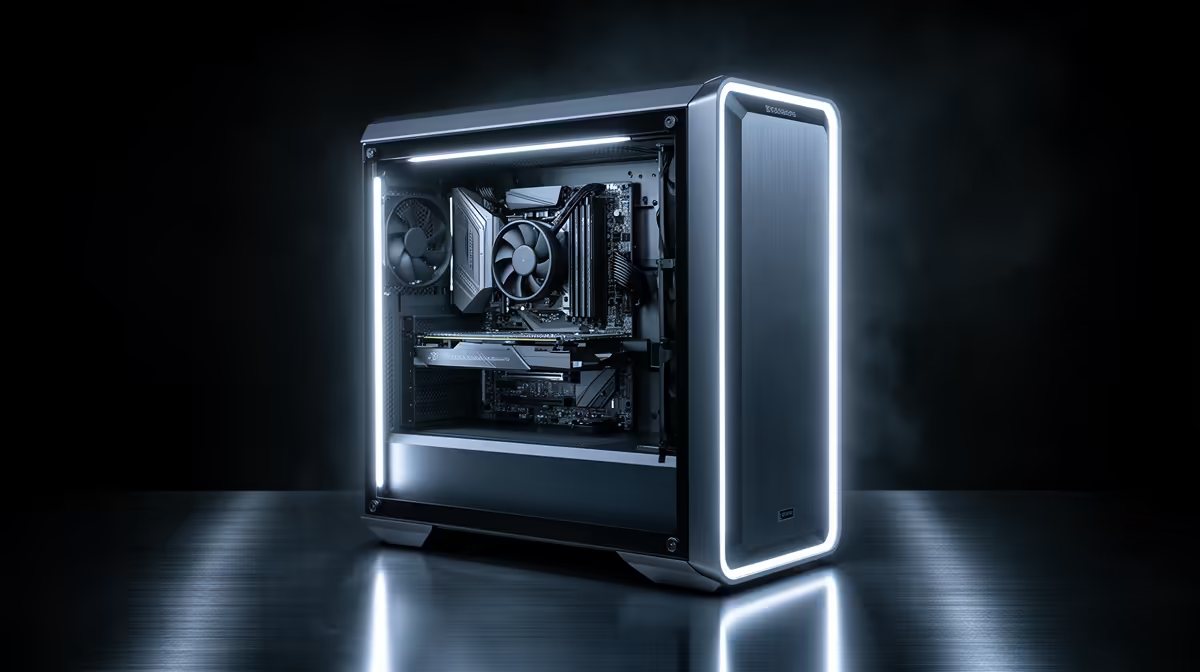
E-ATX cases add physical width to the motherboard tray area to accommodate boards up to 305 x 330mm, compared to the standard ATX maximum of 305 x 244mm. For workstation motherboards on Threadripper Pro or Xeon W platforms, only an E-ATX case or larger provides the correct standoff pattern and side clearance to seat the board without panel interference.
E-ATX vs ATX: The Dimensional Difference 📐
Standard ATX cases have a motherboard tray sized for 305 x 244mm boards. E-ATX boards common in workstation platforms can be 305 x 267mm (mATX-E), 305 x 330mm (true E-ATX), or even larger for HPTX workstation boards. Installing an oversized board in an undersized case is not a matter of forcing it. The side panel will not close, the rear I/O cutout may not align, and critical standoffs may be missing, leaving the board at risk of shorting against ungrounded metal. E-ATX full-tower cases address this with a wider chassis, a matching standoff grid covering the full E-ATX layout, a wider rear I/O cutout, and side panels that close flush over the extended board area.
What Changes Inside the Case 🔧
Beyond physical fitment, E-ATX cases change several aspects of the interior layout. The PSU cable routing distance increases because the board is wider, sometimes requiring longer EPS12V cables for the CPU power header on the far edge. PCIe slots on E-ATX workstation boards often extend to seven, eight, or eleven slots, and the case needs height and mounting provisions to support them. A 420mm top radiator mounted above an E-ATX board with tall VRM heatsinks requires careful clearance verification. Some E-ATX cases solve this with an adjustable top panel or a front-only 420mm radiator position.
ATX Case for a Workstation: When It Still Works 🖥️
Not all workstation builds require E-ATX. AMD Ryzen 9000-series workstation builds using a standard AM5 socket run on ATX boards and fit in any quality ATX mid-tower or full-tower case. The E-ATX requirement appears specifically when using HEDT platforms like AMD Threadripper Pro 7000 WX-series, Intel Xeon W-2400 or W-3400, and similar platforms. For SA professionals building in the R45,000 to R100,000 workstation range, confirming platform and board form factor before selecting a case is essential.
Standoff Count Matters ⚡
E-ATX boards need more standoffs than ATX boards. Before installing your workstation board, count and compare the standoff holes in the case against the mounting holes on your board and install standoffs at every matching position. A workstation board that flexes because of missing standoffs in the extended area can develop trace cracks under thermal cycling over time.
FAQ
Can I use a standard ATX case for a Threadripper Pro build?
No. Threadripper Pro motherboards use the TRX50 socket on E-ATX boards that exceed ATX dimensions. Only cases explicitly listed as E-ATX compatible will physically accommodate these boards and close properly.
What is the cable length difference I should plan for in an E-ATX case?
The second CPU EPS12V cable often routes 15 to 25cm further from the PSU than in an ATX build. Ensure your PSU modular cable set includes cables at least 65 to 70cm long rather than the standard 50cm cables suited to ATX builds.
Are E-ATX cases significantly more expensive than ATX full towers?
Yes, typically by R1,500 to R4,000 at comparable quality levels. Given that E-ATX workstation builds start at R45,000 and up, the case premium is a small fraction of total system cost.
Planning a high-end workstation build?
Evetech stocks full-tower cases with E-ATX support to house Threadripper and Xeon workstation platforms. Browse the case range and spec your workstation build with confidence.