Quick Answer
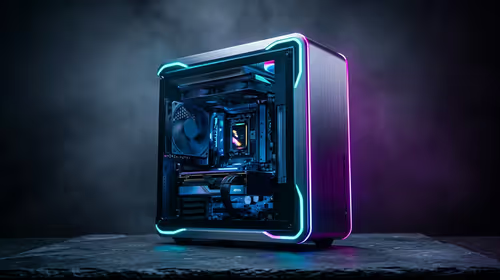
EATX cases differ from ATX cases in motherboard clearance, drive bay count, radiator mount options, and internal volume. For a pure gaming build using a standard ATX board, an ATX case is sufficient. For EATX workstation boards, HEDT platforms, or dual-radiator custom loops, the EATX case's additional clearance justifies the R1,000 to R2,500 price premium.
The Core Dimensional Differences 📐
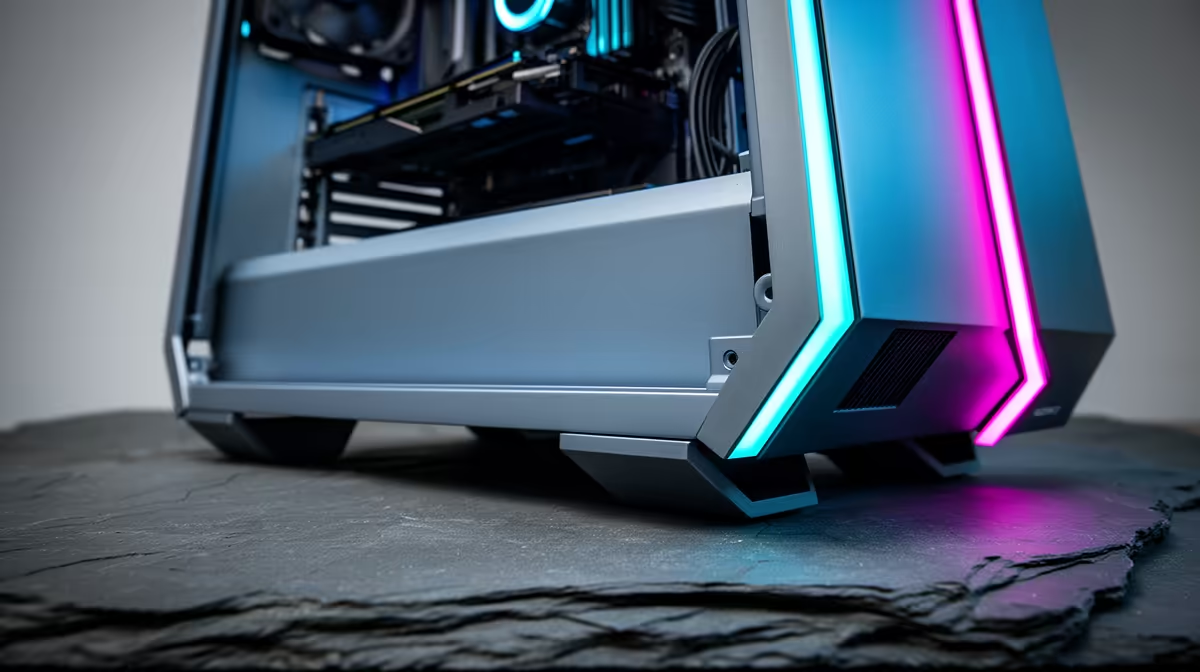
An ATX motherboard measures 305mm x 244mm and fits comfortably in a standard mid-tower case. An EATX board extends to 305mm x 330mm, requiring additional vertical clearance inside the chassis. EATX cases solve this by widening the main chamber horizontally by 40mm to 80mm or placing the motherboard tray lower relative to the top mount rails. This extra space also accommodates the larger VRM heatsink arrays found on high-end EATX boards, which can extend further from the board edge than ATX equivalents. For the South African builder, EATX boards represent some of the most expensive local SKUs, ranging from R9,000 to R20,000, so buying a correctly sized case is not a corner worth cutting.
What Changes for High-End Gaming Builds 🎮
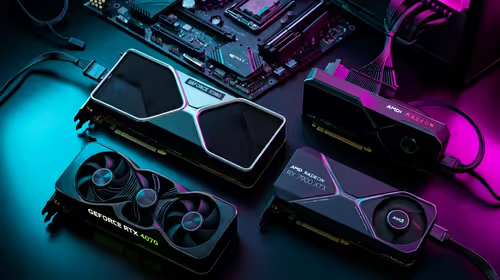
For a pure gaming build with a single RTX 5090 or RX 9070 XT and a standard ATX board, an ATX case provides identical thermal performance to an EATX case in most scenarios. The EATX case's additional volume does not improve GPU or CPU temperatures if the component selection does not demand the extra space. Where EATX cases add tangible value for gaming is in GPU clearance: many EATX cases support 450mm or more GPU length, which future-proofs the build for the very longest triple-fan cards. They also typically include more PCIe bracket slots for capture cards or additional storage controllers, which matters for content creators building a combined gaming and production machine.
What Changes for Workstation Builds 🔧
Workstation and HEDT builds benefit most from EATX cases. AMD Threadripper platforms use EATX boards exclusively, and the TRX50 and TRX70 chipset boards require full EATX case support to mount and cable correctly. These systems also run multiple NVMe drives, PCIe expansion cards, and dual-radiator cooling loops that consume every cubic centimetre of available internal volume. An EATX case with removable drive cages, dual-chamber design, and multiple 360mm radiator positions handles this complexity cleanly. ATX cases simply cannot accommodate the board and all its associated hardware without significant compromise.
Confirm E-ATX Support Specifically, Not Just Full-Tower ⚡
Not all full-tower cases support EATX motherboards. Full-tower refers to external case height, while EATX is an internal clearance specification. Check the motherboard support list in the case spec sheet explicitly for EATX up to 305mm x 330mm, rather than assuming a large case fits a large board.
FAQ
Is an EATX case noticeably larger than an ATX mid-tower on a desk?
Yes. EATX full-tower cases are typically 50mm to 100mm taller and 20mm to 40mm wider than a standard mid-tower. The footprint difference is modest, but the height can matter for tower placements under desks with limited vertical clearance.
Do ATX cases support all features an EATX board needs?
No. An EATX board in an ATX case often cannot fit because the board physically overlaps the case frame. Some large mid-tower cases advertise EATX support, but clearance is marginal for very wide boards. The safest choice for any EATX board is a case explicitly rated for that form factor.
Are EATX cases significantly more expensive than ATX cases?
At the entry level, the premium is R1,000 to R2,500 for an EATX case versus a comparable ATX case. At the premium tier (R5,000 and above), the price gap narrows as both form factors reach similar feature levels. The cost is proportional to the platform investment if you are running a Threadripper or HEDT board.
Deciding between EATX and ATX for your next build?
Evetech stocks cases in both form factors alongside the motherboards, GPUs, and cooling gear to complete either configuration.