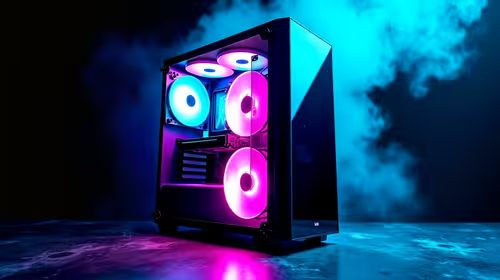
You’re in the final squad, the zone is closing in, your heart is pounding… and then, darkness. The familiar beep of the UPS is the only sound as your high-end rig drains its battery in minutes. We’ve all been there. But what if your PC sipped power instead of guzzling it? Building an energy efficient gaming PC isn't about sacrificing frames for frugality; it's the ultimate strategic upgrade for uninterrupted gaming through loadshedding. ⚡
Why an Energy Efficient Gaming PC is a Must-Have in SA
In South Africa, "watts" isn't just a number on a power supply box; it's a direct measure of how long you can stay in the game when Eskom flips the switch. A PC that draws 500W will drain a UPS twice as fast as one that draws 250W. It's that simple.
But efficiency offers more than just longer battery life. A more energy efficient gaming PC also runs cooler and quieter, as the components don't need to work as hard or dissipate as much heat. This can lead to a longer lifespan for your hardware and a more comfortable gaming environment. It’s about building smarter, not weaker.
Choosing Core Components for a Low-Wattage Powerhouse
The heart of any energy efficient gaming PC lies in three key components: the CPU, the GPU, and the Power Supply Unit (PSU).
The Brains: CPU
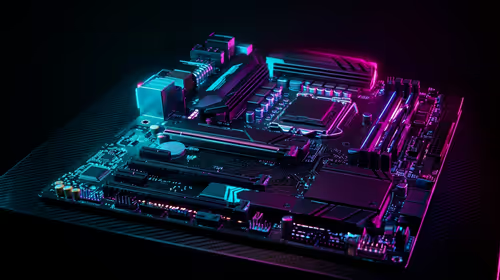
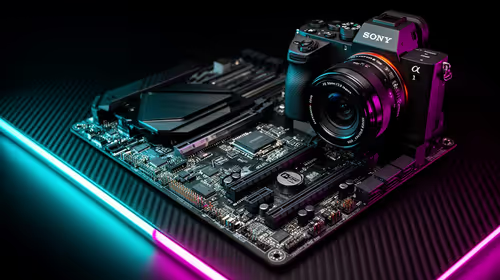
Modern processors have made huge leaps in performance-per-watt. AMD's Zen architecture, for example, is renowned for delivering incredible multi-core power without a massive electricity bill. A CPU from the Ryzen 7 series can handle intense gaming and multitasking while keeping power draw surprisingly low. Starting with one of these is a great first step, and many AMD Ryzen 7 upgrade bundles offer a perfectly matched CPU and motherboard combo.
The Brawn: GPU
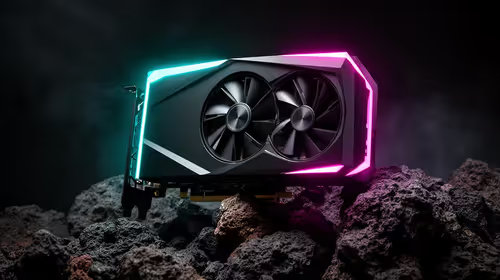
Your graphics card is typically the most power-hungry component. While you still want epic performance, look for cards with a good balance. Newer architectures from NVIDIA and AMD are designed with efficiency in mind. Techniques like undervolting—slightly reducing the voltage to the GPU—can also slash power consumption with a minimal impact on frame rates.
Know Your Wattage! 💡
Before you buy, use an online PSU calculator. Add up the TDP (Thermal Design Power) of your planned CPU and GPU, add about 150W for everything else (RAM, drives, fans), and you'll have a good estimate. This helps you choose the right size PSU and understand how long your UPS will really last during loadshedding.
The Backbone: PSU
Never skimp on the power supply. Look for a unit with an "80 Plus" rating—Bronze at a minimum, but Gold or Platinum is ideal. This rating certifies its efficiency. An 80 Plus Gold PSU is at least 87% efficient at all loads, meaning less energy is wasted as heat. This small investment pays for itself in electricity savings and system stability. A great way to ensure all your core parts work well together is by starting with pre-selected Intel and AMD-based bundle packs that take the guesswork out of it.
Smart Builds and Upgrade Paths 🔧
If picking every single part feels daunting, a barebone kit is a brilliant shortcut to an efficient PC build. These kits typically include a case, motherboard, and a power supply that are already matched for size and thermal performance. They provide a fantastic canvas, letting you focus on choosing the CPU, RAM, and GPU that fit your needs.
Whether you're Team Red or Team Blue, these kits offer a solid foundation. You can explore a range of AMD barebone kits or their Intel barebone kits counterparts to see how a streamlined starting point can simplify building a lean, mean, loadshedding-beating machine.
Software Tweaks to Optimise Power Usage
Your hardware is only half the story. A few simple software adjustments can further reduce your PC's power consumption:
- Cap Your Frame Rate: Does your game run at 250 FPS in the menu? Capping the frame rate to your monitor's refresh rate (e.g., 144Hz) in your GPU's control panel can dramatically lower power draw when you don't need those extra frames.
- Use Windows Power Plans: Switch to the "Balanced" power plan for everyday use. It allows your CPU to throttle down when idle, saving power without you even noticing.
- Close Background Apps: That browser with 50 tabs open is using CPU cycles and power. Close what you don't need before jumping into a game.
An energy efficient gaming PC is more than just a trend; for South African gamers, it’s a vital piece of strategy for staying online and in the fight. 🚀
Ready to Build Your Loadshedding-Proof Rig?
Building a balanced, power-conscious PC is the ultimate strategy for uninterrupted gaming in South Africa. Start with a solid foundation and build the dream machine that won't let you down. Explore our massive range of upgrade bundles and find the perfect parts to conquer your world.