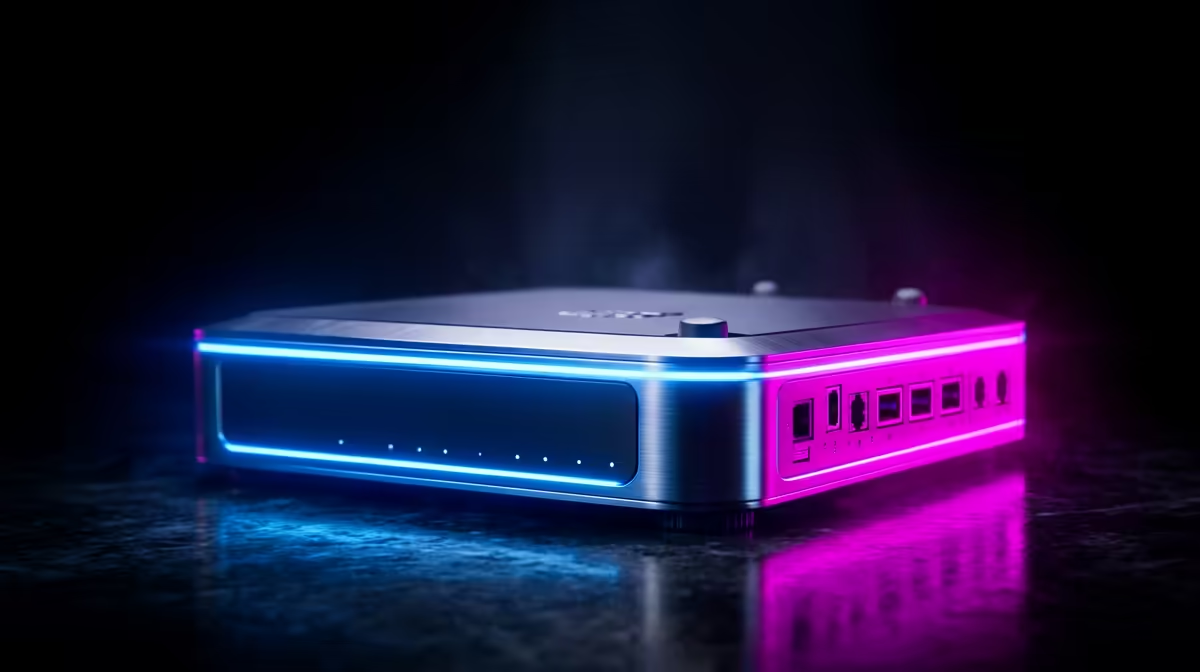
Mesh systems solve a different problem to a single router: whole-home coverage without dead zones. The local field varies widely on node count, backhaul type, and wired port provision.
Quick Answer
The mesh kits worth comparing in SA use a dedicated wireless backhaul or, better, wired backhaul, and ship as 2 or 3-node packs. Expect roughly R4,000 for dual-band 2-packs and up to R14,000 for tri-band Wi-Fi 7 3-packs covering 500 square metres or more.
What Separates Good Mesh From Bad
Backhaul is the single most important factor. A tri-band system reserves one radio purely for node-to-node traffic, preserving speed as you add hops. Even better, kits that support wired Ethernet backhaul keep full throughput at distant nodes when you can run a cable.
Coverage claims should be read against your floor plan and wall material. A double-storey home or thick face-brick walls cut range sharply, so favour an extra node over a single high-power unit.
Choosing Node Count For Your Home
A 2-node kit suits a typical 3-bedroom home of around 150 to 250 square metres. Larger or multi-storey homes benefit from a 3-node pack. If a gaming PC sits near the main node, wire it directly for the lowest, steadiest latency. Budget-wise, a capable dual-band 2-pack starts near R4,000, while a tri-band Wi-Fi 7 3-pack can run to R14,000 depending on coverage and wired-port count.
FAQ
Is a tri-band mesh worth the extra over dual-band?
For larger homes, yes. The dedicated backhaul radio stops throughput collapsing as data hops between nodes, which dual-band kits struggle to avoid.
Can I wire the mesh nodes instead of using wireless backhaul?
Many kits support Ethernet backhaul, which gives the best performance. If you can run a cable to a node, do so.
How many nodes do I need for a double-storey house?
Plan for at least three nodes, one per floor plus a central unit, especially with thick interior walls.
Map your dead zones first, then pick a tri-band 2 or 3-node mesh and wire any node that sits near a gaming PC.