A count of 2304 CUDA cores tells you that parallel compute resources exist inside the GPU. It does not tell you which workstation task will use them, how long that task will take or whether memory becomes the earlier limit. Understanding 2304 CUDA cores for workstation performance requires a path from software support to measured project results.
Quick Answer
The A1000's 2,304 CUDA cores support up to 6.74 TFLOPS FP32, alongside separate RT and Tensor hardware for other accelerated professional operations.
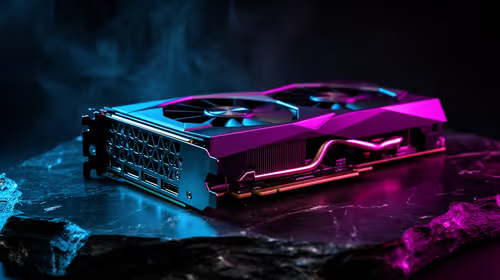
The A1000's 2304 CUDA cores can support professional operations implemented for CUDA. At R12,099, the card uses Ampere and includes 8GB GDDR6 with a 128-bit memory interface. Measured benefit varies across applications, tasks and complete workstation platforms.
🧭 What the CUDA count does and does not say
CUDA cores are processing elements in an NVIDIA GPU. Suitable workloads can be divided across many operations when software is written to use the CUDA platform. The number therefore has meaning within a supported execution path, not as an independent speed rating.
Architecture affects how a core count should be interpreted. The A1000 uses Ampere, so its 2304-core total belongs to that design. Comparing it with a number from another architecture without complete card and workload evidence can produce a misleading ranking.
The count does not describe graphics-memory capacity. Physical dimensions, power, connectors, clocks and application certification are separate model checks that the core total cannot answer. Record those separately before purchase because each can eliminate an otherwise suitable card.
Most importantly, 2304 cores do not promise a render time, viewport rate or compute throughput. A benchmark requires an application version, input, settings and the rest of the workstation. Remove any one of those and the result no longer answers a reproducible question.
🧭 Find the work that can use CUDA
Begin inside the application. Confirm whether the relevant feature supports CUDA and whether the RTX A1000 can be selected as the processing device. A renderer may use CUDA for final computation while scene preparation remains on the CPU. An engineering tool may accelerate one solver but not another.
Create a baseline from a typical job. Record software version, project, device mode, quality settings and elapsed time. Then add a difficult recurring job that represents the upper end of normal production. These two tests reveal whether the compute resources align with everyday work and credible growth.
Observe output correctness as well as duration. A faster result that changes required quality or fails a feature is not a successful workstation outcome. Stability across repeated runs also matters for professional use.
Use Evetech's professional graphics card category to compare candidates only after the CUDA-enabled operation is defined. This keeps the test consistent and prevents unrelated benchmark figures from taking over the purchase.

🧭 Memory can set the boundary first
The A1000 carries 8GB GDDR6. Geometry, textures, render assets, frames or compute data may need practical space in that capacity. If a required job cannot fit, additional compute resources cannot replace the missing working area.
Its memory uses a 128-bit interface. Bus width is one characteristic of the subsystem and is not the same as the 8GB figure. Do not infer bandwidth or application speed from width alone; test the complete card under the selected task.
Watch the application for memory warnings, failed operations or behaviour changes while running both test jobs. Pair those observations with allocation data rather than relying on a percentage without context. Different programs reserve and cache memory differently.
The R12,099 price belongs to this complete balance: 2304 CUDA cores, Ampere, 8GB GDDR6 and 128-bit memory. If the job is memory-bound or CPU-bound, paying for the CUDA resources may not address the measured constraint.
🧭 Include the wider system
GPU compute jobs often depend on CPU preparation, system RAM and storage. Time the stages separately where possible. If data loading dominates, a graphics-only upgrade may leave total completion nearly unchanged even when the accelerated phase becomes shorter.
For local AI workloads, check framework, model, precision and memory requirements directly. CUDA availability is one check; model fit and end-to-end responsiveness demand separate evidence. The AI PC selection offers a platform comparison when several components need attention.
Before buying, verify card fit, power and connectors for the exact workstation. Compute specifications cannot answer installation questions. Keep those checks beside the application test in the decision sheet.
Consider the R12,099 PNY A1000 after the test plan identifies a supported task, not as proof that a workload will accelerate.
Interpret comparisons responsibly
Compare complete GPUs under one workload. Keep project, software, settings, output and platform as consistent as possible. Record results in a table with compute time, memory behaviour, stability and total task duration.
Avoid dividing price by CUDA cores. That calculation assumes every core contributes equally to the target task and ignores architecture, memory and application support. Instead, divide the purchase decision into pass conditions: supported, fits the project, completes in time and installs in the platform.
A 2304-core card can be appropriate when it clears those conditions at R12,099. It can also be the wrong choice if a required file exceeds 8GB, a feature lacks support or another workstation stage dominates. The test makes that difference visible.
Design a core-count experiment with controls
Keep one project and output fixed, then compare device modes or complete GPUs without changing quality. Record warm-up behaviour and repeat the timed operation enough to notice large variation. A single run can be distorted by caching or background activity.
Do not change scene complexity to make a card appear faster unless the change itself is the subject of the test. Preserve a clean copy of the input and note every adjustment.
When results differ, examine memory use and stage timing before crediting the CUDA count. The experiment should reveal whether compute resources affected the critical phase, not merely produce a ranking with unexplained causes.
Use the same measurement vocabulary across teams. Define elapsed time, output correctness, memory warning and failure before collecting results. This stops one group from treating a successful launch as a pass while another requires the complete job.
Store raw timings and notes, not only an average. Variation can reveal background work, thermal conditions or inconsistent project state that deserves investigation.
A repeatable vocabulary makes later core-count comparisons easier even when applications differ, because readers understand what each recorded result actually means.
Eighteen RT cores are rated up to 13.2 TFLOPS of ray tracing, while 72 Tensor cores reach up to 53.8 TFLOPS on their relevant path. The card supplies those units through 8GB GDDR6 at 192GB/sec. This arrangement lets one compact GPU serve several kinds of supported workstation processing, although each application's engine decides which resources contribute to the actual task.
Frequently Asked Questions
How can 2304 CUDA cores support workstation tasks?
They are parallel processing resources for software operations implemented to use CUDA. The exact effect depends on the application and workload.
Which workstation card has this count?
The PNY NVIDIA RTX A1000 contains 2304 CUDA cores on Ampere architecture and costs R12,099.
What memory sits beside the CUDA resources?
Memory capacity is 8GB and the type is GDDR6. A 128-bit figure answers the separate interface-width question.
Will every application improve?
No. The program and specific feature must use the GPU, while memory, CPU work, storage and settings can still constrain the result.
How should buyers compare core counts?
Keep architecture, memory, application support, project and platform constant enough to make the measurement meaningful. Never rank unlike cards by count alone.
Ready to connect CUDA resources to a measurable workstation task?
Browse Evetech's professional cards after selecting the exact operation, project and output standard that every candidate must complete.