Bolt a desktop graphics card to a laptop through an eGPU and you expect desktop-class frames. You get close, but not all the way, and where you plug the display in decides how close. Send the picture to an external monitor wired to the GPU and you give up roughly a fifth of the performance against a true desktop. Route those frames back to the laptop's own screen and the loss grows past thirty percent, because the frames take a slower round trip. Knowing why turns a frustrating result into a one-cable fix.
Quick Answer
An eGPU feeding an external monitor connected directly to the graphics card loses around 20 percent of the frames compared with the same GPU in a desktop. Display the game on the laptop's built-in screen instead and the loss climbs to over 30 percent, because the frames must travel back across the connection to reach the internal panel. The fix is simple: plug your monitor straight into the eGPU.
Where the eGPU Performance Loss Comes From
An eGPU connects to the laptop over a single cable, usually Thunderbolt or USB4, and that link carries far less data than the slot a desktop card sits in. The card itself is just as fast, but the pipe feeding it is narrower, so some performance is left on the table before you even pick a display. That is the baseline eGPU tax, and on its own it accounts for the roughly 20 percent gap against a desktop when the monitor is wired directly to the card.
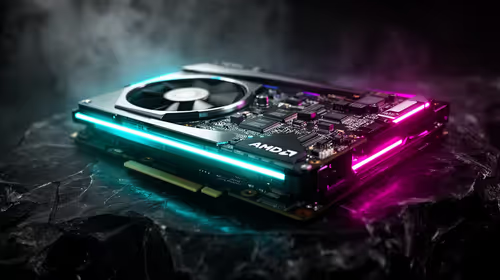
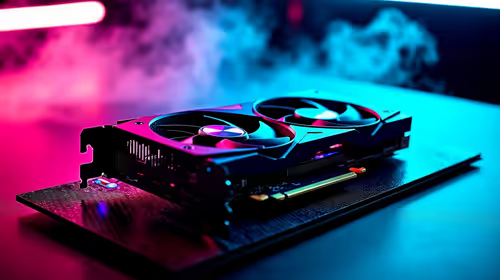
The card draws the frames, holds them in its own memory, and pushes them out of its own video ports. When your monitor plugs into the eGPU enclosure, those finished frames go straight from the card to the screen. They never go back over the cable to the laptop. That direct path is why this configuration is the faster of the two.
Why the Laptop Screen Costs You More
The laptop's built-in panel is wired to the laptop, not to the eGPU. So when you choose the internal screen, the frames the external card just rendered have to make a return trip: out of the GPU, back across the same single cable to the laptop, and only then onto the internal display. The cable now carries traffic in both directions instead of one, and that congestion is what pushes the loss past 30 percent.
The Bidirectional Trip in Plain Terms
Think of the cable as a one-lane road. With an external monitor on the GPU, traffic flows one way: the card sends frames out its own exit. With the laptop screen, the road has to carry frames out to the card and the finished frames back to the laptop on the same lane. That two-way load is the bidirectional routing penalty. It is not the card slowing down; it is the connection doing double duty and becoming the bottleneck.
The Numbers Side by Side
Against a desktop running the identical GPU, an external monitor on the eGPU sits at roughly minus 20 percent, while the laptop's internal screen drops to minus 30 percent or worse. The difference between the two, around ten percentage points or more, is entirely down to that return trip. It is free performance you reclaim just by changing which screen you use.
The Fix and What to Check
The fix costs nothing: connect your monitor directly to a video output on the eGPU enclosure rather than relying on the laptop's screen, and the bidirectional penalty disappears. A few things help you get the most from the setup:
- Use the GPU's own ports. Plug HDMI or DisplayPort into the eGPU box, not the laptop.
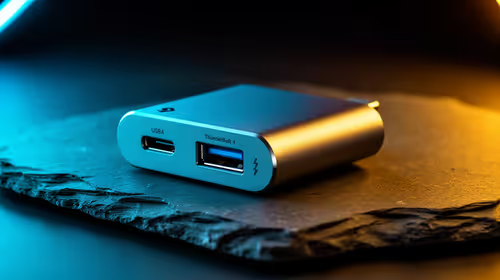
- Mind the cable standard. A Thunderbolt or USB4 link carries far more than a plain USB-C data cable, so use the right one for the lowest baseline loss.
- Choose the enclosure carefully. Bandwidth, power delivery, and port layout vary between boxes, so match the enclosure to your card and your monitor.
If you are building toward an eGPU setup, it is worth comparing the docking and connectivity options Evetech stocks so the link and ports do not become the limit. And since the card is the part doing the work, scanning the best-selling graphics cards at Evetech helps you pick one whose performance is worth pairing with an external enclosure in the first place.
Who Should Run an eGPU Anyway
An eGPU makes sense for someone who wants one portable laptop most of the time and serious graphics power at a desk some of the time, without owning two machines. Accept the roughly 20 percent tax against a desktop as the cost of that flexibility, plug the monitor into the card, and you get a genuinely capable gaming and creation station that packs away to a single laptop when you travel. If you only ever sit at one desk, a desktop avoids the tax entirely; the eGPU is for people who value mobility and power in the same purchase.
Frequently Asked Questions
How much performance does an eGPU lose compared with a desktop?
With an external monitor wired straight to the eGPU, expect around 20 percent fewer frames than the same card in a desktop, because the single connecting cable carries less data than a desktop slot. Using the laptop's internal screen pushes the loss past 30 percent.
Why is the laptop's internal screen slower with an eGPU?
The internal panel is wired to the laptop, not the GPU, so rendered frames must travel back across the cable from the eGPU to reach it. That return trip makes the cable carry traffic both ways at once, and the congestion is what drives the extra loss.
Should I use an external monitor or the laptop screen with an eGPU?
Use an external monitor plugged directly into the eGPU enclosure. That keeps frames on a one-way path from the card to the screen and avoids the bidirectional penalty, recovering ten percentage points or more over the internal display.
Does the cable type affect eGPU performance?
Yes. A Thunderbolt or USB4 connection carries far more data than a basic USB-C data cable, which sets the baseline performance before any display choice. Using the correct high-bandwidth link gives you the lowest possible loss.
Is an eGPU worth it despite the performance loss?
For someone who wants a portable laptop and desk-bound graphics power without buying two machines, yes. The roughly 20 percent tax is the price of that flexibility. If you only work at one desk, a desktop avoids the penalty entirely and is the better choice.