


80+ Gold vs 80+ Platinum for Couch co-op gaming in SA
80+ Gold vs 80+ Platinum for couch co-op gaming is about PSU efficiency, heat, fan behaviour, quality, and wattage headroom, not direct FPS. SA buyers should compare the whole build.
Read moreA fanless monitor offers a completely silent computing experience, perfect for a focused office environment. Discover how passive cooling works, its benefits for productivity, and why your next display should be noiseless. Say goodbye to distracting fan hum for good! 🤫✨

Tired of that faint, almost unnoticeable hum from your desk? In the quiet moments of a focused work session, even the smallest sound can become a massive distraction. For South African professionals and creators seeking pure, uninterrupted concentration, the solution is simple: a fanless monitor. These silent workhorses deliver crisp visuals without adding a single decibel to your workspace, creating the perfect environment for deep work and creativity. Ready for some peace and quiet? 🤫
At its core, a fanless monitor is a display that uses passive cooling to manage heat. Instead of relying on a small, whirring fan, it dissipates warmth through cleverly designed heatsinks and ventilation, built right into its chassis. It’s silent by design.
You might be thinking, "Do monitors even have fans?"
While most standard office displays are passively cooled, some high-performance models do use active cooling. This is common in screens with cutting-edge technology, like G-Sync Ultimate modules or incredibly bright, full-array local dimming (FALD) backlights for HDR content. These components generate extra heat that needs a fan to manage. A fanless design, however, guarantees absolute silence, making it the gold standard for quiet environments. For most users, our vast selection of PC monitors are already engineered for silent operation.
Choosing a fanless monitor isn't just about killing noise; it's about optimising your entire workflow and environment. The benefits are tangible and can genuinely boost your productivity.
For coders, writers, sound engineers, or anyone in a home office in Cape Town trying to tune out the neighbour's hadedas, silence is golden. A silent office display eliminates auditory distractions, allowing you to sink into a state of deep focus and get more done. For tasks demanding high detail, pairing this silence with the sharpness of crystal-clear 4K and 5K monitors creates an unparalleled productivity zone.
Fewer moving parts mean fewer points of failure. A fan is a mechanical component that can wear out or clog with dust over time, potentially leading to overheating and a shorter lifespan for your display. A passively cooled monitor removes this variable entirely, offering rock-solid reliability for years to come. No fans, no dust bunnies, no problem.
Passive cooling often allows for thinner and more elegant designs. Without the need to accommodate a bulky fan assembly, manufacturers can create displays that look as good as they perform. This makes a fanless monitor a perfect fit for a clean, modern desk setup, especially when paired with immersive curved monitors that wrap you in your content.
silent monitor deserves a tidy workspace. Use cable sleeves and under-desk cable trays to hide your power and display cords. This not only looks fantastic but also improves airflow around your PC and peripherals, keeping everything running cool and quiet. Complete your clean setup with the right [monitor accessories](https: www.evetech.co.za PC-Components buy-monitor-accessories-368) like a sleek monitor arm.
It's important to be realistic. While a fanless monitor is the ideal choice for most office and creative work, the most extreme end of the performance spectrum sometimes requires active cooling.
Top-tier high-performance gaming monitors pushing thousands of nits of brightness for HDR1000+ certification might incorporate a fan to sustain that peak output. However, for 99% of users—including most gamers—a fanless design provides all the performance you need without any of the noise. The trade-off is often for a level of brightness or processing power that is overkill for typical desktop use.
The great news is that you don't have to hunt for a "fanless" label. The vast majority of displays, from everyday workhorses to versatile portable monitors, are already silent. The key is to focus on the features that matter to you—resolution, size, and colour accuracy—and rest assured that your new screen will contribute to a peaceful and productive workspace.
Whether you're upgrading your home office in Durban or building a new creative studio in Johannesburg, a silent screen is a cornerstone of a great setup. Be sure to check out our latest monitor deals to find incredible value on your next display.
Ready to Reclaim Your Quiet? A silent workspace isn't a luxury... it's a productivity powerhouse. Explore our massive range of PC monitors and find the perfect silent screen to conquer your workday.
A fanless monitor uses passive cooling methods, like heatsinks and strategic ventilation, to dissipate heat without any moving parts. This results in a completely silent operation.
Yes, for focus-intensive work, a fanless monitor is ideal. The absence of fan noise creates a quieter, less distracting environment, which can significantly boost productivity.
No, fanless monitors are designed to manage heat effectively through passive cooling. While they may feel warm to the touch, they operate well within safe temperature limits.
Passive cooling in monitors relies on large heatsinks and natural convection. Heat from components is transferred to the heatsink, which then radiates it away into the surrounding air.
The primary benefit of a silent office monitor is reduced distraction. They also consume less power and have fewer mechanical parts that can fail, improving long-term reliability.
Absolutely. Many manufacturers now offer high-performance fanless 4K monitors, providing crisp visuals for professional tasks without adding any background noise to your workspace.
Generally, yes. With no moving fan to wear out or clog with dust, a fanless design has fewer points of failure, which often contributes to better long-term reliability.
80+ Gold vs 80+ Platinum for couch co-op gaming is about PSU efficiency, heat, fan behaviour, quality, and wattage headroom, not direct FPS. SA buyers should compare the whole build.
Read more
80+ Platinum or 80+ Titanium for competitive should be shortlisted around the job it must do. South African buyers should compare fit, performance, compatibility, and upgrade room, warranty path, and upgrade room before treating any pick as best.
Read more
The real world difference between IPS and OLED for AAA single-player gaming is immersion versus versatility. OLED lifts contrast and dark scenes, while IPS can suit bright rooms, mixed PC use, and SA buyers watching total setup cost.
Read more
HDMI 2.1 vs HDMI 2.0 for SA MMO needs a workload-first comparison. For SA buyers, judge real performance, platform fit, warranty path, power needs, and upgrade timing before choosing either side.
Read more
USB4 and Thunderbolt 4 differ for competitive esports through dock, display, and capture consistency. Use this real world difference between usb4 and thunderbolt 4 for competitive guide to keep SA tournament desks tidy without assuming better ping.
Read more
Magnetic switches vs Mechanical switches depends on Competitive esports needs, platform limits, and budget fit. Compare compatibility, latency, upgrade path, and real setup constraints before choosing for an SA build.
Read more
B850 motherboard FPS drops needs a methodical troubleshooting pass. Review drivers, thermals, power settings, background apps, cables and game settings before replacing parts in an SA gaming setup.

Gaming PC FPS drops in South Africa often come from drivers, thermals, background apps, power plans, or in-game settings. Check one change at a time and use the same scene before buying upgrades for your local setup.

Difference between PCIe 5.0 and PCIe 4.0 explained for PC builders starts with bandwidth, lanes, and support. SA builders should match the motherboard, GPU, NVMe drive, and budget before choosing a platform.
Windows 11 mechanical keyboard setups rarely cause display banding directly. Fix color banding by checking HDR, colour depth, GPU range, monitor profiles, and any new RGB utility conflicts.

Steam Big Art Mode enlarges library artwork in Big Picture Mode and on Steam Deck, while the same beta adds configurable screensavers. Both features are optional and currently require the Steam beta client.
Diablo 4 HDR settings work best after Windows and the display are calibrated, then the game's black point, brightness and white point are adjusted in that order. Use visible shadow detail and controlled highlights, not copied values from another screen.

The best HOTAS for Elite Dangerous is a separate stick-and-throttle set with enough analogue axes for pitch, roll, yaw and thrust, plus local support. Evetech's captured flight-simulation sample lists the complete Logitech X56 at R4,999.
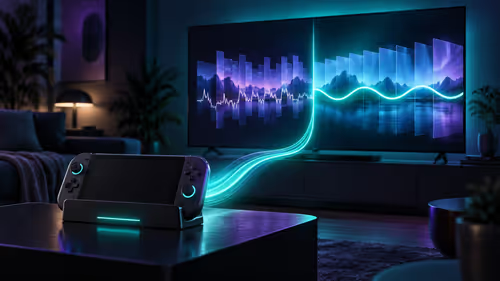
Nintendo Switch 2 docked VRR arrives with system version 23.0.0 and also requires a dock update. The connected TV or monitor and the running software must support VRR before the output can follow changing frame rates.

NVIDIA lists 550W required system power for the RTX 5060 reference specification, based on a high-end test system. A quality 550W unit can be enough, but CPU draw, transient load, connectors and ageing decide real headroom.

The VAIO T combines a 13.3-inch display with a multi-flip mechanism for laptop, tablet and outward-facing viewing modes. Orders begin in Japan on 18 September; South African availability is unconfirmed.

OpenRGB's master branch now carries changes labelled for 1.0 final, including translation and platform work, but the official tags page still lists 1.0rc3.1 as the newest packaged release. Stable users should wait for the signed release channel.
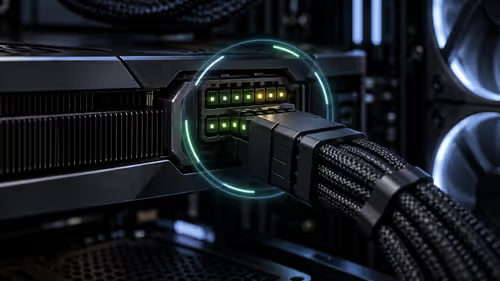
The Cooler Master GPU Shield Adapter monitors current on individual 12+4-pin contacts, adds visual and audible warnings, and can reduce system power during a severe abnormality. Local availability is unconfirmed.