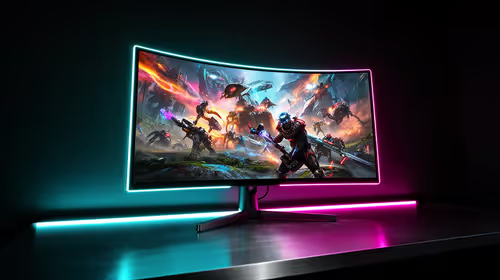
Stuttering gameplay and ugly screen tearing can ruin a perfect headshot. For South African gamers, fixing this often comes down to one big decision: FreeSync vs G-Sync. These technologies promise buttery-smooth visuals by syncing your graphics card to your monitor, but they aren't created equal. Choosing the right one depends on your GPU, your budget, and how seriously you take your gaming. Let's break down which adaptive sync tech is best for your setup.
The Screen Tearing Struggle: What is Adaptive Sync?
Ever been in a fast-paced game like Apex Legends or Warzone and noticed the image looks like it's been sliced in half horizontally? That’s screen tearing. It happens when your graphics card (GPU) sends out frames at a different rate than your monitor can display them. The result is a jarring visual glitch that breaks immersion.
Adaptive Sync technology solves this. It allows the monitor to adjust its refresh rate in real-time to match the frame rate of your GPU.
- GPU sends 87 frames per second? Your monitor displays at 87Hz.
- GPU drops to 55 FPS in a huge explosion? Your monitor adjusts down to 55Hz instantly.
This perfect synchronisation eliminates tearing and dramatically reduces stutter, making gameplay feel incredibly fluid. The two dominant types of Adaptive Sync are NVIDIA's G-Sync and AMD's FreeSync.
G-Sync: NVIDIA's Gold Standard
G-Sync is NVIDIA's proprietary solution, and for a long time, it was the undisputed king of smooth gaming. To get the official G-Sync badge, a monitor needs to have a dedicated hardware module built into it. This chip handles the communication with your NVIDIA GeForce GPU, ensuring a flawless connection.
The Pros & Cons of G-Sync
- Pros: It offers an incredibly consistent, high-quality experience. The strict certification means any G-Sync monitor you buy from our wide range of PC monitors has passed rigorous testing for image quality, refresh rate range, and low input lag. G-Sync Ultimate models take this even further with superior HDR support.
- Cons: The dedicated hardware and licensing fees mean G-Sync monitors are typically more expensive. You also must have an NVIDIA graphics card to use it.
The G-Sync vs FreeSync debate often starts with price, but for competitive players who demand absolute perfection, the premium for true G-Sync can be worth it.
FreeSync: AMD's Flexible & Affordable Answer
On the other side of the ring is AMD's FreeSync. Unlike G-Sync, FreeSync is an open standard built on top of the DisplayPort Adaptive-Sync protocol. This means monitor manufacturers can implement it without paying licensing fees to AMD, making the technology much more widespread and affordable. 🖥️
The Pros & Cons of FreeSync
- Pros: The biggest advantage is cost. You can find some of the best PC monitor deals on displays that feature FreeSync. This has made high-refresh-rate, tear-free gaming accessible to more South African gamers than ever before.
- Item
The battle of FreeSync vs G-Sync becomes much closer when you compare G-Sync with FreeSync Premium models.
Pro Tip: Enabling G-Sync on a FreeSync Monitor ⚡
Did you know many FreeSync monitors can work with NVIDIA cards? NVIDIA calls these 'G-Sync Compatible'. To enable it, connect your monitor via DisplayPort, open the NVIDIA Control Panel, go to 'Set up G-Sync', check 'Enable G-Sync, G-Sync Compatible', and select your monitor. It’s a great way to get smooth gameplay without the G-Sync price tag!
What About "G-Sync Compatible" Monitors?
The lines have blurred in recent years. Recognising the popularity of FreeSync, NVIDIA created the "G-Sync Compatible" program. These are essentially top-tier FreeSync monitors that NVIDIA has tested and certified to deliver a solid, tear-free experience with GeForce GPUs.
While they don't have the dedicated G-Sync hardware module, they offer a fantastic middle-ground. You get a smooth, reliable experience that's very close to native G-Sync but at a more wallet-friendly FreeSync price point. When browsing for all gaming monitors, you'll see this label frequently, and it represents excellent value.
FreeSync vs G-Sync: The Verdict for South African Gamers 🇿🇦
So, which one should you choose? It boils down to your hardware and your budget.
For the Budget-Conscious Gamer:
Winner: FreeSync. No contest. The value for money is unmatched. You can get a high-refresh-rate monitor that eliminates tearing for a fraction of the cost of a G-Sync equivalent. This allows you to put more of your budget towards a better GPU or CPU.
For the Competitive NVIDIA User:
Winner: G-Sync or a G-Sync Compatible monitor. If you're running a GeForce RTX card and play competitive titles where every frame matters, the consistency of a certified monitor is a huge advantage. Whether it's a stunning curved monitor for immersion or a flat panel for pure speed, the certification guarantees performance.
For the High-End Enthusiast:
Winner: It's a tie. Both G-Sync Ultimate and FreeSync Premium Pro offer incredible HDR performance and flawless adaptive sync. If you're investing in one of the latest 5K & 4K monitors, your choice will likely be determined by whether you have an NVIDIA or AMD GPU. Even some of the newest portable monitors are getting these high-end features for gaming on the go.
Ultimately, the technology is just one piece of the puzzle. Once you've chosen your display, don't forget to grab the right monitor accessories like a quality VESA mount or cables to complete your perfect setup. ✨
Ready to Find Your Perfect Match?
The FreeSync vs G-Sync debate is all about finding the right balance of performance and price for your rig. Explore our massive range of gaming monitors and find the perfect screen to conquer your world, tear-free.