Quick Answer
Fully modular PSUs are better for clean builds and enthusiast cable management; semi-modular units are the smarter value choice for most mid-range builds because the always-needed cables (24-pin ATX and EPS CPU) are fixed, and the savings over a fully modular equivalent typically reach R300 to R700 at the same wattage.
What Each Design Actually Gives You 🔧
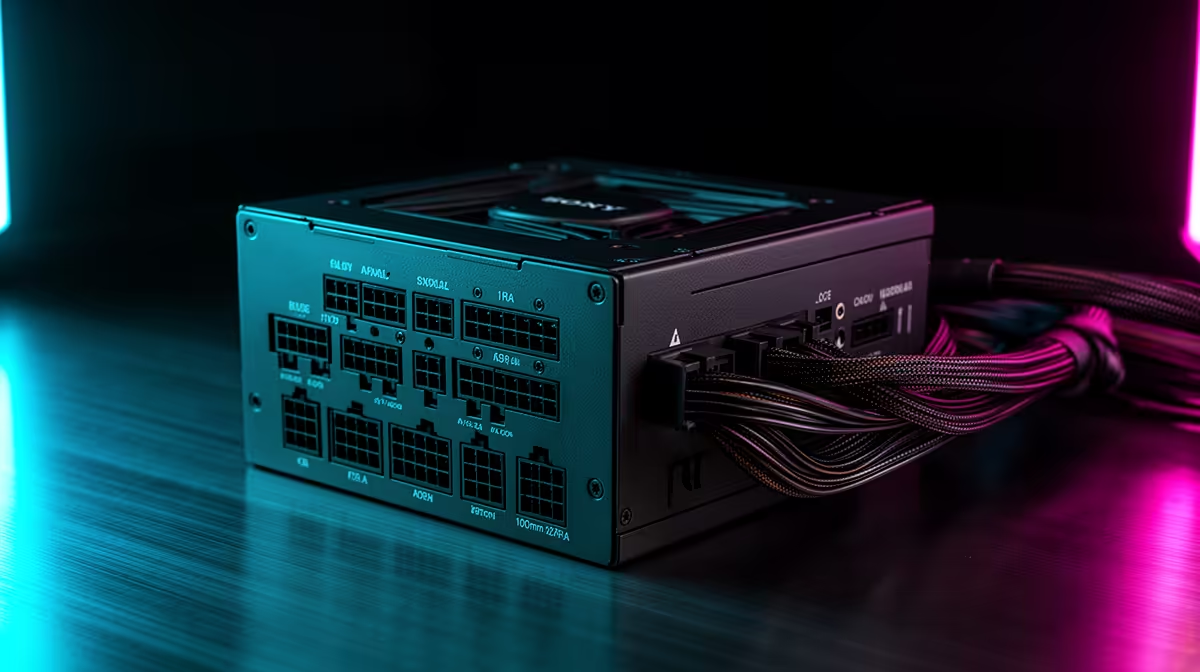
A fully modular PSU ships with every cable detachable. This means zero unused cables lurking in your case; you connect the 24-pin, the EPS, the PCIe leads, and the SATA runs your build actually needs, and store the rest. For compact mid-tower builds with a window, or for ITX systems where airflow is critical, this level of control is worth the premium. A semi-modular PSU permanently attaches the 24-pin ATX and usually one or two EPS CPU connectors, reasoning that every ATX system will need those regardless. All PCIe, SATA, and Molex leads remain detachable. Since those fixed cables always get used, the semi-modular approach costs less while still solving the biggest cable-clutter problem: the pile of unused PCIe and SATA leads.
When to Choose Fully Modular 💡
Fully modular is worth the extra spend in three situations. First, if you are using a custom-sleeved cable kit to match a specific build aesthetic; sleeved 24-pin cables often need to replace the stock cable, which is only possible on a fully modular unit. Second, if you are building inside a tight ITX or compact mATX chassis where routing even the fixed cables is awkward and every centimetre of clearance matters. Third, if the system will be regularly opened for hardware upgrades and cable management reset each time. Enthusiast builders who swap components frequently appreciate starting from a clean cable slate each time.
The SA Value Calculation for Semi-Modular 💰
For a typical South African gaming build, the semi-modular option at the same wattage and efficiency rating from the same brand saves R400 to R700. On a build already stretching to R20,000 or R30,000 for GPU and CPU, that gap is meaningful only if aesthetics are a priority. A Ryzen 7 9700X plus RTX 5070 build inside a mid-tower ATX case genuinely looks clean with a semi-modular 850W Gold unit and a bit of velcro cable management. You would need to look hard to tell the difference from outside the case. The honest answer: if budget allows, go fully modular for the flexibility. If budget is tighter, semi-modular is not a compromise that costs you performance.
Label Your Stored Cables After a Fully Modular Build ⚡
After completing the build, label or bag the unused cables by type before storing them. Six months later when you add a second SSD or replace a fan, you will not need to dig through a box of unlabelled cables trying to identify a SATA power lead versus a peripheral connector.
FAQ
Does a fully modular PSU affect power delivery quality compared to semi-modular?
No. The modular connector system on the PSU chassis adds negligible resistance and has no measurable impact on voltage delivery or stability. The electrical design inside the PSU, not the external connector system, determines power quality.
Can I mix cables from different PSU brands on a fully modular unit?
No, and this is a critical safety point. PSU cable pinouts are not standardised across brands. Using another brand's modular cables can create short circuits or damage components. Only use cables designed for your specific PSU model.
Which is better for an ITX build: fully modular or semi-modular?
Fully modular is strongly preferred for ITX builds. ITX cases leave very little room behind the motherboard tray for cable hiding, and fixed cables on a semi-modular unit that cannot be routed cleanly will end up coiled inside the main chamber, where they directly obstruct airflow in an already thermally challenged enclosure.
Building something clean or just practical?
Evetech carries both fully modular and semi-modular PSUs across 650W to 1600W, stocked locally so you can pick the right cable system for your build without waiting on imports.