

Storage Specs Explained for Beginners
Storage Specs Explained for Beginners. Plain-English explanation of what it means, why it matters & how it affects your buying decisions in SA.
Read moreGaming earbuds: compare IEMs and TWS for PC gaming in 2025 to pick the best low-latency sound, mic clarity, and comfort fast 🎧⚡
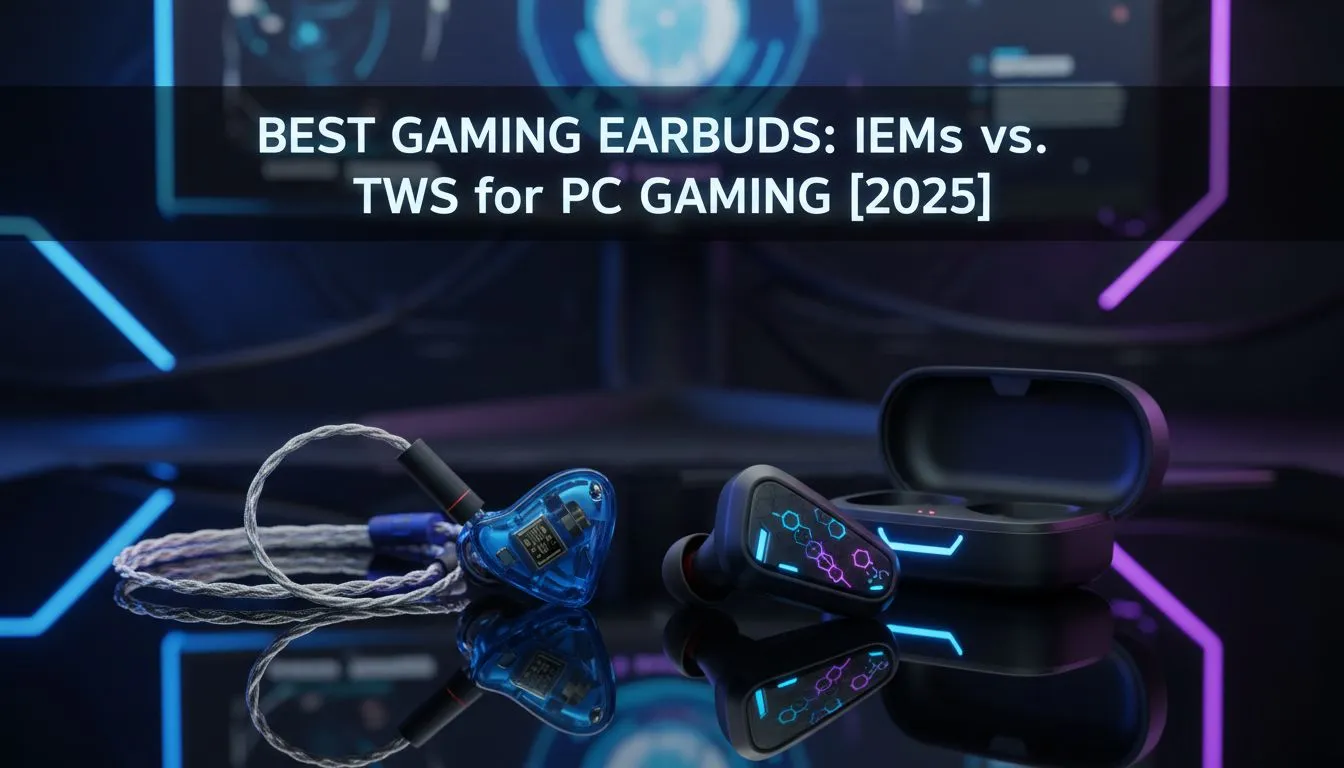
Ditch the "gamer dent" in your hair and say goodbye to sweaty ears during a South African summer. In 2025, the debate isn't just about headsets anymore; it is about the rise of compact audio. Whether you are a competitive shooter fan or an immersive RPG explorer, choosing between In-Ear Monitors (IEMs) and True Wireless Stereo (TWS) buds is the new upgrade path. Let's break down the best audio solution for your rig. 🎧
For years, bulky cans were the gold standard. But walk into a LAN or watch a local tournament stream, and you will see a shift. Gamers are moving toward minimalism. This pairs perfectly with a clean desk setup featuring a wireless gaming mouse and a clutter-free aesthetic.
The main contenders? IEMs, the wired audiophile darlings, versus TWS earbuds, the kings of convenience. Both have evolved significantly, but they serve very different masters.
In-Ear Monitors (IEMs) are essentially high-end wired earphones. Originally designed for musicians, they have been adopted by pro gamers (like CS2 and Valorant pros) for one reason: pinpoint directional audio.
Because they are wired, latency is physically impossible. You hear the footstep the exact moment it happens. If you have invested in high-refresh-rate PC monitors to see enemies first, IEMs ensure you hear them first too. They also don't require batteries, meaning they will never die on you during a ranked match.
However, they do have cables. While this guarantees quality, it can feel restrictive if you are used to leaning back. But for pure sound fidelity, they often outperform traditional gaming headsets at the same price point in ZAR.
True Wireless Stereo (TWS) buds offer incredible freedom. No wires to snag on your armrest or tangle with your gaming controllers.
In the past, Bluetooth lag made gaming impossible. In 2025, top-tier gaming TWS buds come with a 2.4GHz USB-C dongle. This brings latency down to near-zero levels, comparable to wired connections. If you value a minimalist setup and want to grab a snack without taking your audio off, TWS is the winner.
Just remember battery life. Most gaming buds last 4–6 hours on a single charge. If you pull all-nighters, you might need a charging break.
Here is the hard truth... neither IEMs nor TWS buds have amazing microphones. The microphones are located too far from your mouth or rub against your shirt collar.
If you are communicating with a squad, or if you are investing in streaming essentials to start your Twitch career, do not rely on earbud mics. Your teammates will hear every click of your gaming keyboard more clearly than your voice.
The pro move? Pair your comfortable earbuds with a dedicated standalone microphone. This gives you the comfort of earbuds with broadcast-quality voice clarity.
Whether you choose IEMs or TWS, the 'seal' is everything. If the ear tip is too small, you lose bass and directional cues. If it's too big, it hurts. Experiment with the different silicone or foam tips included in the box to ensure passive noise isolation. It helps block out the fan noise from your rig when your GPU is working hard!
It comes down to your gaming lifestyle.
Choose IEMs if:
Choose TWS if:
Your PC is built for speed—from your GPU to your lightning-fast solid state drives. Don't let your audio be the bottleneck that slows your reaction time.
Upgrade Your Audio Experience Whether you want the pinpoint accuracy of wired IEMs or the freedom of wireless TWS, sound is half the battle. Browse our extensive range of audio gear and find the perfect fit for your ears and your budget.
IEMs usually offer lower latency and precise imaging for competitive PC gaming, while TWS provide wireless convenience for casual play.
Many 2025 TWS models offer low-latency modes and solid sound for gaming, but they can trail IEMs in ultimate positional accuracy.
Yes. High-quality IEMs deliver clearer imaging and tighter bass for enemy localization. Consider wired or low-latency IEMs for FPS.
Very important: audio lag can cost kills. Prioritize wired IEMs or TWS with gaming mode to get true low latency earbuds for PC.
Yes—choose models with tested mics or pair with a boom mic. Check gaming earbud microphone quality before you buy.
Focus on latency, mic clarity, soundstage, comfort, and battery life. For PC play, low latency and accurate imaging matter most.
Top picks vary: audiophile IEMs for competitive play and the latest TWS for wireless convenience. Check updated best gaming earbuds 2025 lists.
Storage Specs Explained for Beginners. Plain-English explanation of what it means, why it matters & how it affects your buying decisions in SA.
Read more
Will RDNA 5 Use the Same Silicon as the Next. Plain-English explanation of what it means, why it matters & how it affects your buying decisions in SA.
Read more
Google Workspace on Mac: Drive, Docs, Sheets and. Everything you need to know with SA pricing, step-by-step instructions & expert recommendations.
Read more
Back-to-School Parent Guide: Storages. Everything you need to know with SA pricing, step-by-step instructions & expert recommendations.
Read more
to Esports Tournaments. Everything you need to know with SA pricing, step-by-step instructions & expert recommendations.
Read more
Easter Storage Buying Guide. Hand-picked gift ideas at every budget tier. SA pricing & Evetech availability included.
Read more
AMD RX 9050 XT: Rumoured Specs, Price & Release. SA-focused analysis with local pricing data, real-world insights & actionable buying advice.
Can RTX 4080 Super Run AI Workloads for SA Developers Detailed answer with SA data, expert analysis & practical recommendations for local buyers.
Can RTX 4090 Run AI Workloads for SA Developers Detailed answer with SA data, expert analysis & practical recommendations for local buyers.
Top Settings for Intel Arc B580 at Ultrawide 1440p picks evaluated on performance, value & SA availability with current Rand pricing from Evetech.
RTX 4060 CS2 Low Settings at 1080p: FPS Results. Real-world benchmark data, FPS numbers & performance analysis. What SA gamers can actually expect.
Visual Artifacts: Possible GPU Issue Issue #1. Diagnosis steps, proven fixes & when to seek professional help. SA-specific support info included.
Can the RTX 4090 Handle 1440p 144Hz Gaming. Performance testing verdict with real data & practical recommendations for SA buyers.
Top ASUS GPU Under R15000 picks evaluated on performance, value & SA availability with current Rand pricing from Evetech.
GTA 6 Max Settings on RTX 5070. Tested & verified settings for best FPS and visual quality on SA hardware budgets.
Cyberpunk 2077 Max Settings on RTX 5080. Tested & verified settings for best FPS and visual quality on SA hardware budgets.
Starfield Max Settings on RTX 5070 Ti. Tested & verified settings for best FPS and visual quality on SA hardware budgets.
Top RTX 5090 Under R5000 picks evaluated on performance, value & SA availability with current Rand pricing from Evetech.