Choosing a gaming laptop in SA can feel like navigating a minefield of acronyms... GPU, CPU, TGP? It's enough to make your head spin. But don't stress. This gaming laptop specs guide is your map to finding the perfect portable powerhouse, ensuring your hard-earned Rands get you the best possible frame rates. We'll break down the jargon and focus on what truly matters for a lekker gaming experience, from Cape Town to Polokwane. 🚀
Understanding the GPU: Your Gaming Engine
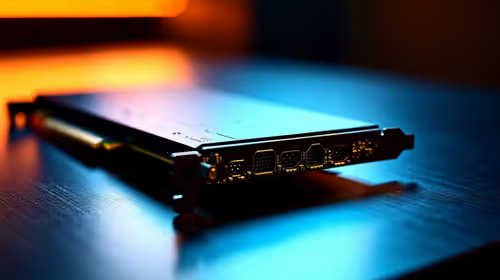
The Graphics Processing Unit (GPU) is the single most important component for gaming. It's the workhorse that renders the beautiful visuals in your games. When you're looking at specs for a gaming laptop, the GPU model (like an NVIDIA GeForce RTX 4060 or RTX 4070) tells you its performance tier. A higher number generally means more power.
But there's a hidden stat you must know: Total Graphics Power (TGP). This measures how much power (in watts) the laptop can supply to the GPU. A higher TGP allows the GPU to run faster, delivering more frames per second (FPS). This is why two laptops with the exact same RTX 4060 can have different performance levels. High-performance models like the MSI Raider series are often configured with higher TGP values to maximise their graphical muscle.
Check the TGP! ⚡
Always look for the TGP value, listed in watts (W), on the product spec sheet. An RTX 4070 with a 140W TGP will significantly outperform one limited to 90W. It's a crucial detail that separates good gaming laptops from great ones.
The CPU: The Brains of the Operation
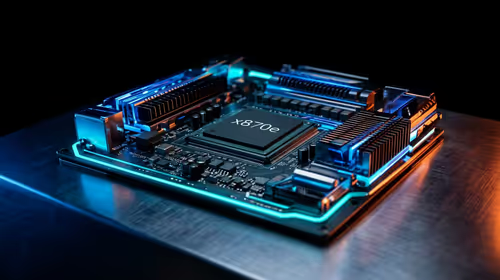
If the GPU is the engine, the Central Processing Unit (CPU) is the brain. It handles game logic, physics, AI, and all the background tasks that make your PC run. For gaming, you don't need the absolute best CPU on the market, but a weak one will bottleneck even a powerful GPU, causing stuttering and low FPS.
Look for modern processors from Intel (like the Core i5, i7, or i9) or AMD (Ryzen 5, 7, or 9). A good rule of thumb for a balanced build is pairing a mid-range GPU with a mid-range CPU. For many South African gamers, an Intel Core i7 or AMD Ryzen 7 provides the perfect sweet spot for performance without breaking the bank.
RAM and Storage: Speed and Space 🔧
How Much RAM Do You Need?
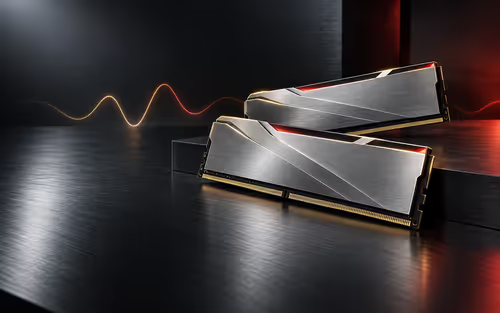
Random Access Memory (RAM) is your laptop's short-term memory. For modern gaming, 8GB is the absolute minimum, but 16GB of DDR5 RAM is the new sweet spot. It gives you enough headroom to run demanding games, Discord, and a few browser tabs without your system slowing to a crawl. For future-proofing or heavy multitasking, 32GB is a great option.
SSD is Non-Negotiable
Forget old-school hard drives (HDDs). A Solid State Drive (SSD) is essential for a modern gaming laptop. It drastically reduces game load times and makes the entire system feel snappy. Look for laptops with at least a 1TB NVMe SSD. This gives you enough space for your operating system and a healthy library of games. Many balanced machines like the MSI Vector come standard with fast NVMe storage.
The Display: Your Window to New Worlds ✨
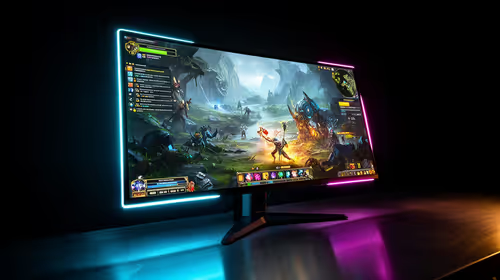
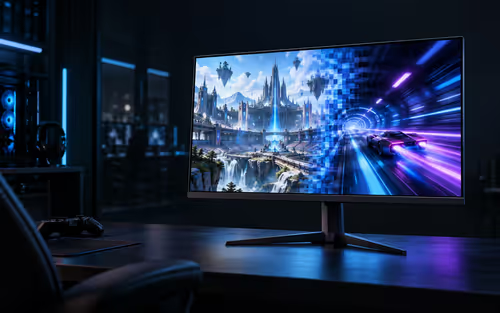
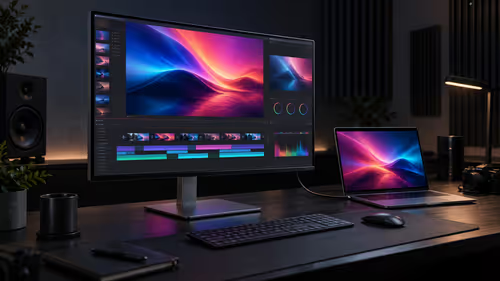
A powerful GPU is wasted if your screen can't keep up. This final part of our gaming laptop specs guide focuses on the display. Here are the key specs to watch:
- Refresh Rate: Measured in Hertz (Hz), this is how many times the screen updates per second. The standard is 60Hz, but for smooth gaming, you want 120Hz or higher. This makes motion look incredibly fluid, especially in fast-paced shooters.
- Resolution: This is the number of pixels on the screen. 1080p (Full HD) is still the most popular choice for laptop gaming as it's easier for GPUs to run. 1440p (QHD) offers a sharper, more detailed image but requires a more powerful GPU (like an RTX 4070 or higher) to maintain high frame rates.
- Colour Accuracy: Look for panels with good sRGB coverage (close to 100%) for vibrant and accurate colours that make your games pop.
Finding the right combination of these specs is key, and you can explore the full range of MSI gaming laptops to see how different models balance display quality with internal hardware.
Ready to Find Your Perfect Rig?
This gaming laptop specs guide has armed you with the knowledge to choose wisely. Now it's time to find the machine that matches your budget and your favourite games. Explore our massive range of gaming laptop specials and find the perfect portable powerhouse to conquer your world.