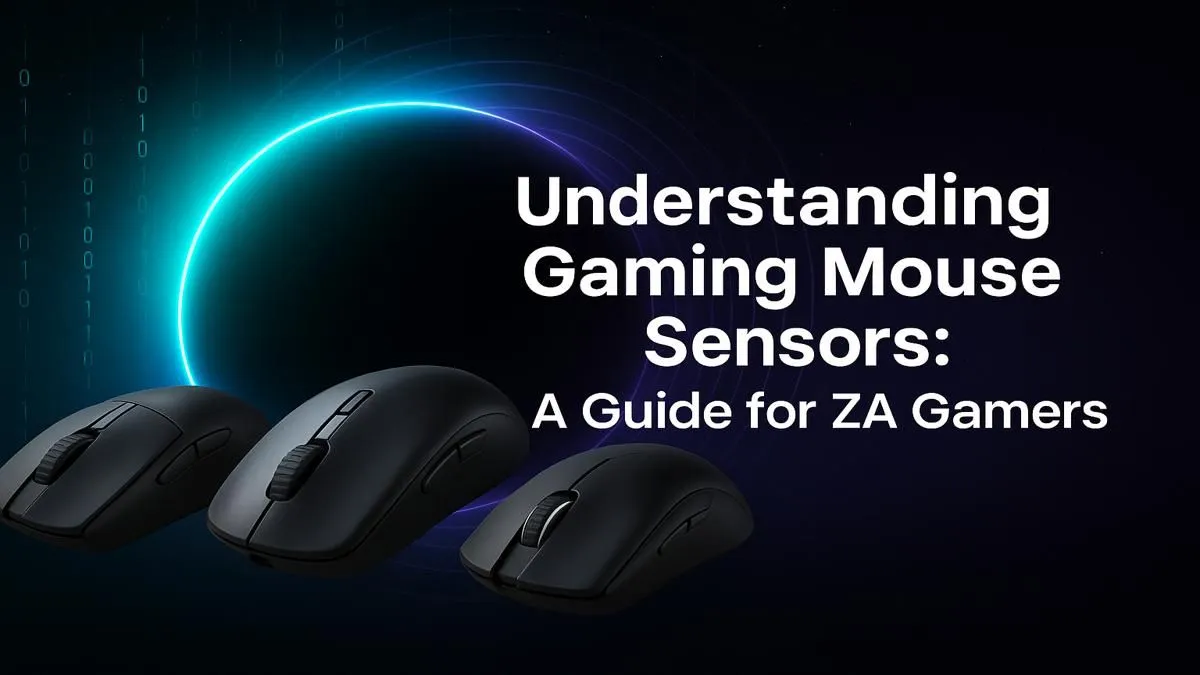
Ever lined up the perfect headshot in Valorant, only for your crosshair to inexplicably stutter? Or lost a 1v1 in Apex because your aim just… gave up? Before you blame your internet connection (again), look down at your mouse. The tiny, unsung hero inside it—the sensor—is the brain of your entire operation. This gaming mouse sensor guide is for South African gamers who are tired of losing gunfights to faulty hardware. Let's dive in. 🚀
The Heart of the Beast: Understanding Your Gaming Mouse Sensor
At its core, a gaming mouse sensor is a tiny, high-speed camera. It constantly takes thousands of pictures of the surface beneath it every second, comparing them to determine direction and speed. This data is what moves your cursor or crosshair on screen. For years, the debate was "Optical vs. Laser," but today, high-end optical sensors (like PixArt's industry-leading models) have become the gold standard for gaming. They offer raw, unfiltered tracking without the prediction or acceleration issues that can plague older or cheaper laser sensors, ensuring your movement is translated 1:1 to the screen.
Decoding the Jargon: Key Sensor Specs for Gamers 🔧
Understanding the spec sheet is the first step to making a smart purchase. Let's break down the numbers that actually matter in this gaming mouse sensor guide.
DPI (Dots Per Inch): More Isn't Always Better
DPI measures how sensitive your mouse is. A mouse set to 1600 DPI will move the cursor 1600 pixels for every inch it physically moves. Marketers love to advertise massive DPI numbers like 25,000+, but the truth is, almost no pro gamer uses anything that high. Most esports athletes play on settings between 400 and 1600 DPI. Why? Lower DPI allows for more precise, controlled movements, which is crucial for building muscle memory. The key is to find a DPI that feels comfortable for your playstyle, not to chase the biggest number on the box. You can browse a wide variety of options across all our gaming mouse components to see the different DPI ranges available.
Polling Rate (Hz): The Speed of Communication
Polling rate, measured in Hertz (Hz), is how often your mouse reports its position to your PC. A 1000Hz polling rate means it's sending an update 1000 times per second (every 1 millisecond). This is the standard for modern gaming mice and provides a smooth, responsive feel. While some newer models boast 4000Hz or even 8000Hz, the difference is barely perceptible to most humans and can put extra strain on your CPU. For the vast majority of gamers, a stable 1000Hz is the perfect sweet spot, a feature you'll find on nearly all quality wired gaming mice today.
LOD (Lift-Off Distance): Keeping Your Aim True 🎯
LOD is the height at which the mouse sensor stops tracking after you lift it off the mousepad. For gamers who use low DPI settings, a low LOD is critical. You're constantly lifting and repositioning your mouse to make large turns, and you don't want the cursor to move erratically while the mouse is in the air. A good gaming mouse has a very low LOD (around 1-2mm) or allows you to customise it in the software. This ensures that when you place your mouse back down, your crosshair is exactly where you expect it to be. Many premium wireless gaming mice now offer advanced LOD customisation.
Quick LOD Test ✨
Don't know your mouse's LOD? Try the 'CD test'. Stack two CDs on your mousepad and place your mouse on top. If the cursor still moves, your LOD is relatively high. If it stops tracking, it's nice and low. It's a simple trick to gauge a key performance metric!
Does a Better Sensor Really Make You a Better Gamer?
Yes and no. A top-tier sensor won't give you the aim of a pro overnight. Skill comes from practice. However, a bad sensor will actively hold you back. Inconsistent tracking, random spin-outs, or unwanted acceleration are variables that destroy muscle memory. A flawless sensor eliminates these problems. It provides a reliable, predictable foundation so that every flick and every micro-adjustment you make is purely down to your own skill. The best part? You no longer need to spend a fortune for that flawless performance. The technology has become so good that even many fantastic gaming mice under R1000 feature sensors that were considered top-of-the-line just a few years ago.
For those with a bit more to spend, the options for a mouse under R2000 often bundle that same flawless sensor with lighter designs, more durable switches, and better cables, creating an even more premium package.
Choosing Your Weapon: A Practical Guide for ZA Gamers
So, what's the final verdict from this gaming mouse sensor guide? When choosing your next mouse, don't get blinded by marketing hype. Focus on these three things, in this order:
- Shape & Comfort: The best sensor in the world is useless if the mouse feels awkward in your hand.
- A Flawless Sensor: Look for a modern optical sensor from a reputable brand (e.g., PixArt 3370, Focus+, HERO). This guarantees 1:1 tracking.
- Weight & Features: Decide if you prefer a lightweight design, need extra buttons, or want wireless freedom.
For enthusiasts who want the absolute pinnacle of performance, the market for a high-end mouse above R2000 offers cutting-edge tech, ultra-light materials, and the latest sensors. And no matter your budget, always keep an eye on the latest gaming mouse deals, where you can often find a top-tier model at an incredible price.
Ready to Upgrade Your Aim? A great gaming mouse sensor won't instantly make you a pro, but it gives you a stable, reliable foundation to build true skill. Stop fighting your gear and start climbing the ranks. Explore our massive range of gaming mouse deals and find the perfect mouse to conquer your game.