

Complete Guide: Setting Up AIO Liquid 420mm
Setting Up AIO Liquid 420mm. Tested & verified settings for best FPS and visual quality on SA hardware budgets.
Read moreGDDR6 vs GDDR6X — Learn how these GPU memory types differ in speed, power draw, and gaming performance to pick the right card for your build 🔍🎮
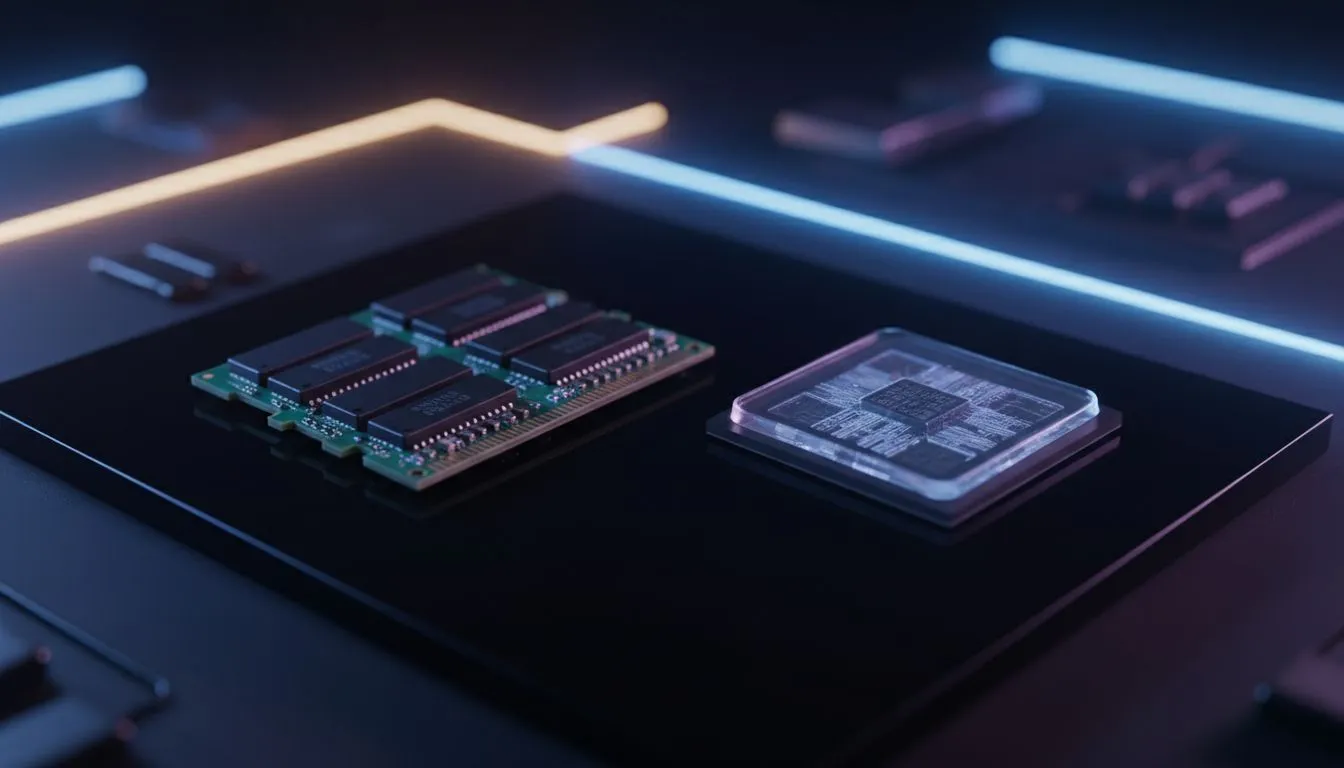
Buying a new GPU in South Africa is a significant investment. You are likely staring at spec sheets wondering why one card costs R2,000 more than another... even when they look identical. Often, the secret lies in the VRAM. Deciding between GDDR6 vs GDDR6X: What They Are and How They Compare is the first step to ensuring your rig handles the latest AAA titles at 4K. 🚀
GDDR6 is the industry standard for high-performance graphics memory. It offers a massive jump over the older GDDR5 generation, providing the bandwidth necessary for modern 1440p gaming. You will find this memory type across a wide variety of hardware, including most Radeon Graphics Cards currently on the market. It is efficient, reliable, and keeps costs down for mid-range builds.
If GDDR6 is a fast highway, GDDR6X is a multi-lane super-expressway. Developed by Micron in collaboration with NVIDIA, GDDR6X uses a technology called PAM4 multi-level signalling. Instead of sending just two bits of data per cycle, it sends four. This allows for much higher bandwidth without needing absurdly high clock speeds.
This premium memory is almost exclusively found in high-end GeForce Graphics Cards like the RTX 4080 and 4090. Because it moves data faster, it reduces bottlenecks when you are pushing ultra-high textures or heavy ray-tracing workloads. ⚡
GDDR6X tends to run hotter than standard GDDR6 because of its higher data density. If you are buying a high-end card, look for models with robust backplate cooling or thermal pads on the memory modules to ensure long-term stability during those hot South African summer gaming sessions.
When looking at a GDDR6 vs GDDR6X comparison, the most noticeable difference is the "ceiling" of performance. GDDR6X can reach speeds of up to 21 Gbps or higher... whereas standard GDDR6 typically tops out around 16 to 18 Gbps. For the average gamer at 1080p, this difference is negligible. However, if you are editing 4K video or playing Cyberpunk 2077 with every setting maxed out, that extra bandwidth prevents stuttering.
Premium brands like MSI often use advanced Tri Frozr cooling designs to manage the extra heat generated by GDDR6X. It is a trade-off: you get world-class speed, but your system needs to be able to breathe.
Your choice depends entirely on your budget and your monitor. If you are building a budget-friendly or mid-tier PC, standard GDDR6 is more than enough. It runs cooler and costs less. But for enthusiasts who want the absolute best, the extra investment in a card with GDDR6X is worth every cent.
Before you make a final decision, it is worth browsing the full range of graphics cards to see how prices fluctuate between different memory configurations. ✨
Ready to Find Your Perfect Match? The GDDR6 vs GDDR6X debate is complex, but for maximum power, choice, and value in South Africa, Evetech has you covered. Explore our massive range of graphics card specials and find the perfect machine to conquer your world.
GDDR6 is a current-generation graphics DRAM used in GPUs, offering high bandwidth and energy efficiency for gaming and creative workloads.
GDDR6X uses PAM4 signaling to deliver higher bandwidth than GDDR6 but can increase power draw and thermal output.
GDDR6X can boost performance at high resolutions and demanding settings; its impact depends on the GPU and game engine.
High-end NVIDIA GPUs (some RTX 30 and 40 series models) adopted GDDR6X for extra bandwidth on flagship cards.
Yes. GDDR6X often increases power consumption and thermals compared to GDDR6 due to its signaling and higher speeds.
GDDR6X's bandwidth helps memory-bound AI and content tasks, but HBM or larger VRAM may be better for heavy AI models.
Choose GDDR6 for balanced efficiency and larger VRAM, or GDDR6X when maximum bandwidth matters, like 4K gaming or GPU-bound workloads.
Setting Up AIO Liquid 420mm. Tested & verified settings for best FPS and visual quality on SA hardware budgets.
Read more
Intel XTU Download & Setup Guide: Intel CPU. Clear setup instructions with SA-specific considerations, troubleshooting tips & recommended components.
Read more
Cyberpunk 2077 Max Settings on RTX 4090. Tested & verified settings for best FPS and visual quality on SA hardware budgets.
Read more
The Complete Guide to GPU. Everything you need to know with SA pricing, step-by-step instructions & expert recommendations.
Read more
NVCleanstall Download & Setup Guide: NVIDIA. Clear setup instructions with SA-specific considerations, troubleshooting tips & recommended components.
Read more
to Driver Installation for Beginners. Everything you need to know with SA pricing, step-by-step instructions & expert recommendations.
Read more
AMD RX 9050 XT: Rumoured Specs, Price & Release. SA-focused analysis with local pricing data, real-world insights & actionable buying advice.
Can RTX 4080 Super Run AI Workloads for SA Developers Detailed answer with SA data, expert analysis & practical recommendations for local buyers.
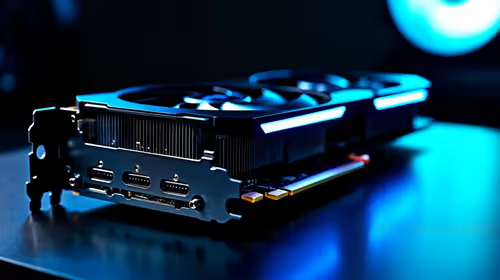
Can RTX 4090 Run AI Workloads for SA Developers Detailed answer with SA data, expert analysis & practical recommendations for local buyers.
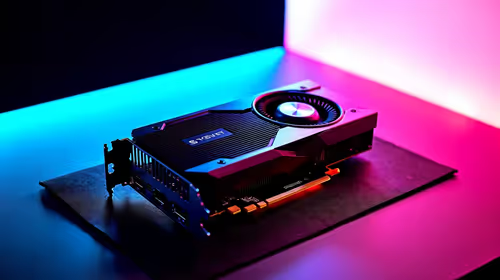
Top Settings for Intel Arc B580 at Ultrawide 1440p picks evaluated on performance, value & SA availability with current Rand pricing from Evetech.

RTX 4060 CS2 Low Settings at 1080p: FPS Results. Real-world benchmark data, FPS numbers & performance analysis. What SA gamers can actually expect.

Visual Artifacts: Possible GPU Issue Issue #1. Diagnosis steps, proven fixes & when to seek professional help. SA-specific support info included.
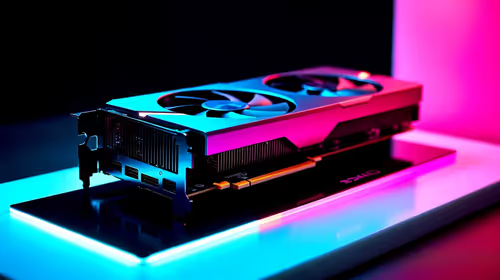
Can the RTX 4090 Handle 1440p 144Hz Gaming. Performance testing verdict with real data & practical recommendations for SA buyers.

Top ASUS GPU Under R15000 picks evaluated on performance, value & SA availability with current Rand pricing from Evetech.
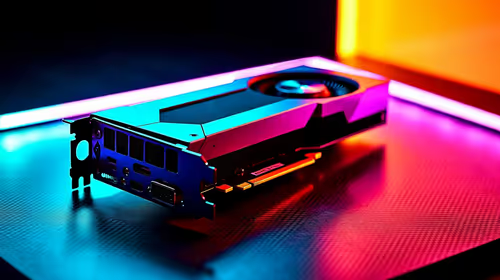
GTA 6 Max Settings on RTX 5070. Tested & verified settings for best FPS and visual quality on SA hardware budgets.
Cyberpunk 2077 Max Settings on RTX 5080. Tested & verified settings for best FPS and visual quality on SA hardware budgets.
Starfield Max Settings on RTX 5070 Ti. Tested & verified settings for best FPS and visual quality on SA hardware budgets.
Top RTX 5090 Under R5000 picks evaluated on performance, value & SA availability with current Rand pricing from Evetech.