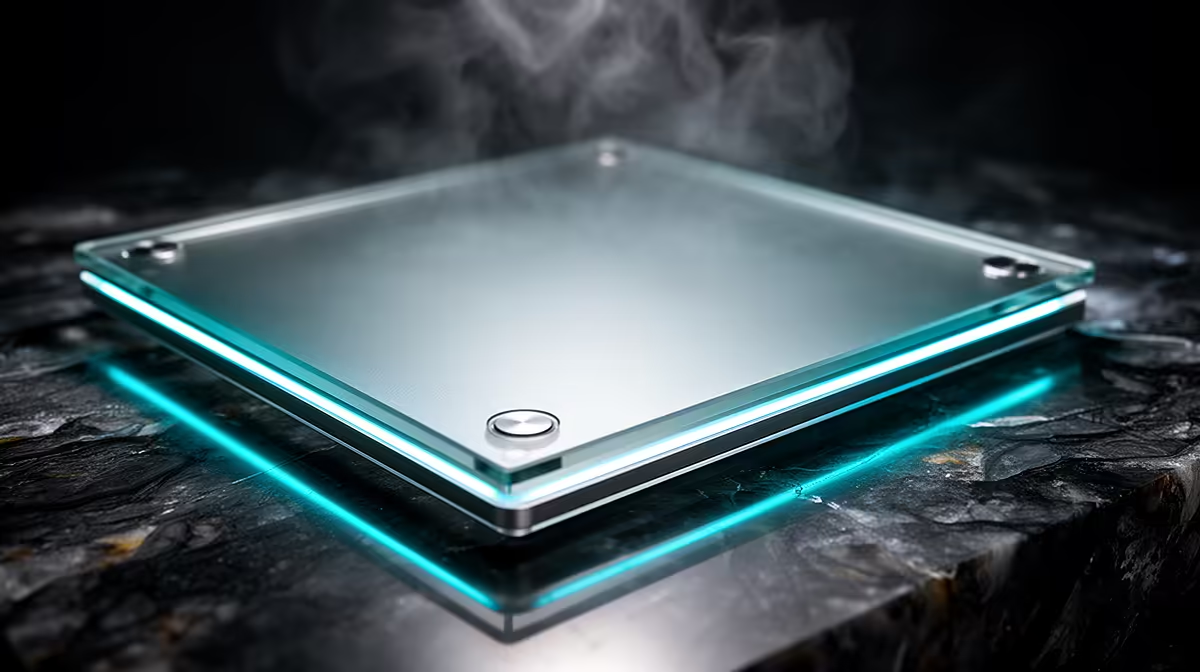
Pull a finished print off a sheet of glass build plate and the bottom comes away mirror-smooth and dead flat. Bend a spring-steel PEI sheet over a desk edge and the same print pops free in seconds with no scraper, no glue, no waiting for the bed to cool. Both surfaces solve the first-layer problem in opposite ways, and the right choice depends on what you print most and how much patience you have for the moment after the print finishes.
Quick Answer
For absolutely flat, glossy-bottomed prints on a large bed, glass wins. For fast, tool-free removal across PLA, PETG and most everyday filament, a flexible PEI spring-steel sheet wins, and that is why it has become the default surface on most current printers. Budget roughly R250 to R600 for a replacement PEI sheet and R200 to R500 for a borosilicate glass plate.
How each surface actually holds and releases a print
Glass is one of the flattest mass-produced surfaces you can buy, which is exactly why it gives such a clean, uniform first layer. The catch is that glass does not grip most filament on its own. You add adhesion with a glue stick, hairspray or a PVA-based release agent, and you wait for the plate to cool before the print lets go. On a cold plate the bond often releases with an audible click. On a warm one you fight it.
A flexible PEI sheet works the other way around. The PEI coating grips PLA and PETG firmly while the bed is hot, then releases its hold as the spring steel cools. Lift the magnetic sheet off the printer, flex it, and the print detaches because the rigid plastic cannot follow the curve of the bending steel. No scraper near your fingers, no gouged surface.
Flatness, warping and large prints
The reason glass keeps a loyal following is dimensional accuracy on big, flat-bottomed parts. A wide bracket or a phone stand printed on glass comes out with a base you could set a spirit level on. Borosilicate glass specifically distributes heat very evenly across its entire surface, which helps suppress the corner warping that ruins large PETG and ABS prints. Standard soda-lime glass is cheaper but expands and contracts more under thermal cycling, and it can crack if temperature changes are sudden.
PEI sheets are flat enough for the vast majority of prints, but a thin spring-steel sheet can develop very slight high or low spots over time, especially after heavy use or aggressive removal. For a 100mm cube you will never see the difference. For a 250mm flat panel where edge lift matters, glass has a real edge. If your printer ships with a textured PEI sheet, expect a lightly stippled bottom finish rather than the glossy face glass leaves behind. Anyone weighing up a printer upgrade can compare current models in the 3D printer range at Evetech to see which bed type each one ships with.
Maintenance over a year of printing
PEI is genuinely low effort. A wipe with isopropyl alcohol every five to ten prints keeps adhesion consistent, and the sheet shrugs off knocks. Glass is close to indestructible and will outlast several PEI sheets, but the glue or release-agent routine becomes part of every print session, and a dropped glass plate can chip or shatter.
Filament-by-filament breakdown
Knowing which material favours which surface saves failed prints.
PLA sticks well to both, though PEI needs no adhesive while glass needs a thin glue layer. PEI wins on convenience. Glass wins when you want the flattest, most mirror-smooth base.
PETG grips reliably to PEI but can bond too hard on a smooth PEI sheet, so a textured or powder-coated PEI surface is safer. On glass with a glue-stick barrier, PETG releases cleanly once cool and produces a very flat bottom.
ABS needs a hot bed and an enclosure regardless of surface. Glass distributes that heat evenly across a large print and helps suppress layer-line splitting on tall parts. PEI handles ABS too, but the even heat retention of a thick glass plate is a genuine advantage for multi-hour ABS prints.
TPU prints well on PEI with no adhesive, but the flexibility of the part and the flexibility of the spring-steel sheet can work against each other on removal if the part bonds aggressively. A light glue release layer solves it on either surface.
Which to pick for your filament and habits
If you print mostly PLA and PETG and you value popping prints off fast, a flexible PEI sheet is the easier daily driver. If you print large flat parts, run a lot of ABS, or you simply want the cleanest possible glossy bottom and do not mind a glue stick, glass earns its place. Many makers keep both and swap depending on the job, since a magnetic base accepts either surface. The right scraper, glue stick and spare sheet are worth keeping on hand, and the consumables that go with 3D printing turn up regularly on the accessories best sellers list.
Frequently Asked Questions
Do I need glue on a PEI sheet?
For PLA and PETG, usually no. The PEI coating grips these filament types well on its own. A thin glue layer can act as a release barrier for stickier materials like PETG that bond too hard, protecting the coating from being torn.
Why does my print not stick to glass?
Bare glass offers very little adhesion for most filament. You need a glue stick, hairspray or a release agent applied to the plate, plus a correctly set first-layer height, before the print will hold.
Can I use the same magnetic base for both surfaces?
Yes. Most modern printers use a magnetic mounting base that accepts either a spring-steel PEI sheet or a glass plate with a magnetic backing, so you can swap surfaces for different jobs.
Which surface lasts longer?
Glass lasts longest and is hard to wear out, though it can chip if dropped. A PEI sheet has a finite coating life and will eventually need replacing after heavy use, but it is inexpensive to swap.
Is textured or smooth PEI better for flat prints?
Smooth PEI gives a glossier, flatter bottom that comes closest to glass. Textured PEI leaves a fine stippled finish that hides first-layer imperfections and grips strongly, which many people prefer for everyday parts.
Does glass heat more evenly than a PEI spring-steel sheet?
Borosilicate glass is an especially good thermal conductor across its face, making it marginally better at eliminating hot and cold spots on large beds. For most desktop-sized printers, both surfaces heat evenly enough that it is not a deciding factor unless you are printing large flat parts where any thermal gradient causes corner lift.
Ready to dial in your first layer? Browse the current 3D printer lineup and bed surfaces in the 3D printer range at Evetech and pick the setup that matches how you print.