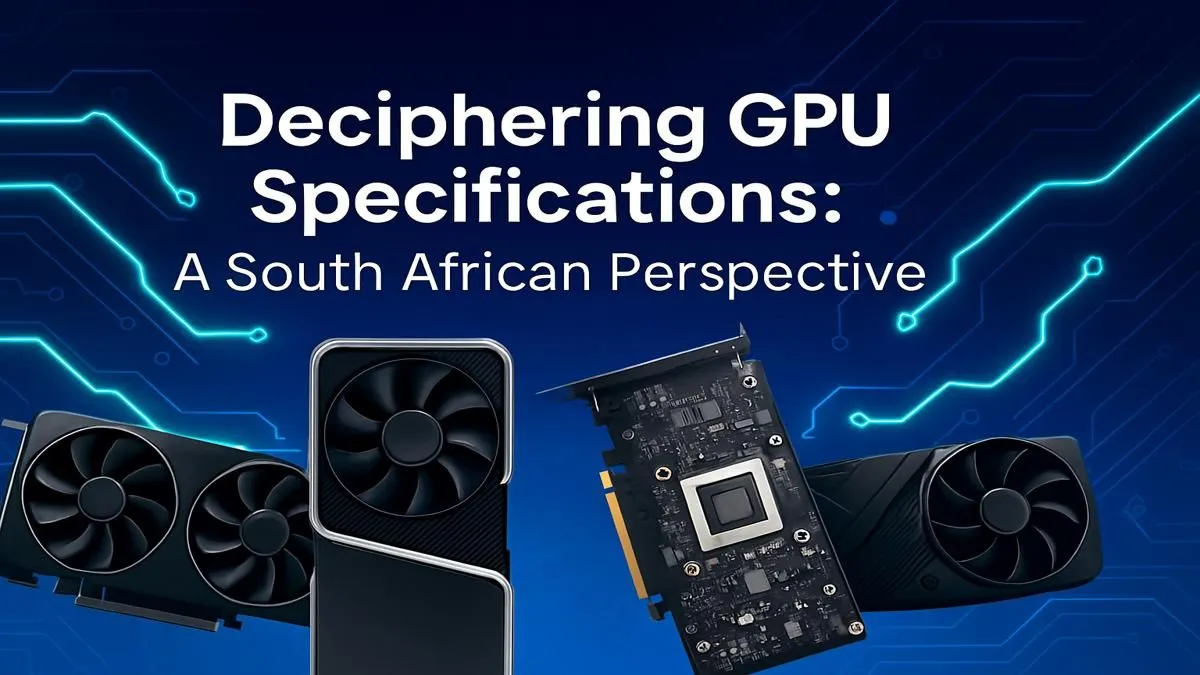
Staring at a graphics card box in South Africa can feel like trying to read another language. VRAM, Boost Clock, CUDA Cores… what does it all mean for your frame rates in Warzone or Apex Legends? Don't stress, we're here to help. This guide explains the essential GPU specs you need to know, helping you spend your hard-earned Rands on performance that truly matters, not just marketing hype. Let's decode the tech together. ✨
The Core GPU Specs: What Really Matters?
When you're trying to understand graphics card specs, a few key numbers determine most of the performance. Getting a handle on these will make your next purchase much easier.
### Clock Speed (MHz/GHz): The Engine's RPM
Think of clock speed as the engine speed of your GPU. Measured in megahertz (MHz) or gigahertz (GHz), it tells you how many processing cycles the graphics chip can perform per second. A higher number generally means faster performance. Most modern cards have a "Base Clock" and a "Boost Clock"—the boost clock is the maximum speed the card can automatically reach under the right thermal conditions for an extra burst of power.
### VRAM (Video RAM): Your GPU's Short-Term Memory
Video RAM, or VRAM, is super-fast memory that lives on the graphics card itself. Its job is to store all the data your GPU needs right now, like game textures, models, and frame data. The more VRAM you have (measured in gigabytes, or GB), the higher the resolution and texture quality you can run smoothly. For 1080p gaming, 8GB is a good starting point, while 1440p and 4K gamers should look for 12GB or more. You'll find a wide range of VRAM options across the latest NVIDIA GeForce graphics cards.
### CUDA Cores / Stream Processors: The Digital Workforce 🔧
These are the actual processors doing the heavy lifting. NVIDIA calls them CUDA Cores, while AMD calls them Stream Processors. You can think of them as a team of workers; the more workers you have, the more tasks can be completed at the same time. While you can't compare the core counts directly between brands, a higher number within the same generation from the same manufacturer (like comparing two AMD Radeon graphics cards) almost always points to better performance.
Beyond the Basics: Specs for Power Users
Ready to go deeper? These next-level GPU specifications are what separate a good card from a great one, especially for enthusiasts and creative professionals.
### Memory Bus Width & Bandwidth: The Data Highway
If VRAM is the storage warehouse, the memory bus is the highway connecting it to the GPU core. A wider bus (measured in bits, e.g., 128-bit, 256-bit) allows more data to travel at once. This, combined with the VRAM's speed, determines the total memory bandwidth (measured in GB/s). Higher bandwidth is crucial for preventing bottlenecks at high resolutions. It's a key spec to watch, even on newer cards like those in the Intel ARC lineup.
### Specialised Cores (RT & Tensor Cores)
Modern GPUs aren't just for raw rasterization anymore. They now include dedicated hardware for specific tasks:
- RT Cores (Ray Tracing Cores): These accelerate the complex calculations needed for ultra-realistic lighting, shadows, and reflections through ray tracing.
- Tensor Cores (AI Cores): These power AI-driven features like NVIDIA's DLSS or Intel's XeSS, which use machine learning to boost your frame rates with minimal impact on image quality.
These specialised cores are a big focus for both gaming and productivity, often found in high-end gaming cards and dedicated workstation graphics cards.
Don't Forget the Power Supply! ⚡
A powerful new GPU often needs more juice. Before you buy, check the card's recommended Power Supply Unit (PSU) wattage. Also, make sure your PSU has the correct power connectors (e.g., 8-pin or 12VHPWR). An underpowered PSU can cause system instability and crashes, especially under load. It's a small check that saves a big headache!
Putting It All Together: A Practical Guide
Understanding GPU specs isn't about finding the card with the single biggest number. It's about balance. A card with a massive 16GB of VRAM but a narrow memory bus might struggle at 4K. Similarly, a super-high clock speed won't help if the card doesn't have enough processing cores.
Always consider your primary use case. What resolution do you play at? Which games are your favourite? A balanced card that excels at 1080p might be a better value purchase for you than an overpowered 4K monster. Also, think about the ecosystem, including cooling and power, which might require new graphics card accessories to get the most out of your upgrade.
So, Which GPU is Right for You?
Now that this GPU specs guide has armed you with knowledge, you can browse with confidence. Remember to match the specs to your monitor's resolution and the demands of the games you love to play. Whether you're building a new rig from scratch or just giving your current PC a much-needed boost, finding the right balance of performance and price is the key to victory. You can see how all these specs come together across a wide selection of NVIDIA and AMD graphics cards to find a model that fits your needs perfectly.
Ready to Find Your Perfect GPU? 🚀
Understanding GPU specs is the first step to a legendary gaming experience. Now it's time to find the card that fits your build and budget. From entry-level 1080p heroes to 4K beasts, we've got the hardware to power up your gameplay. Check out our best graphics card deals and find the perfect match for your rig.