Quick Answer
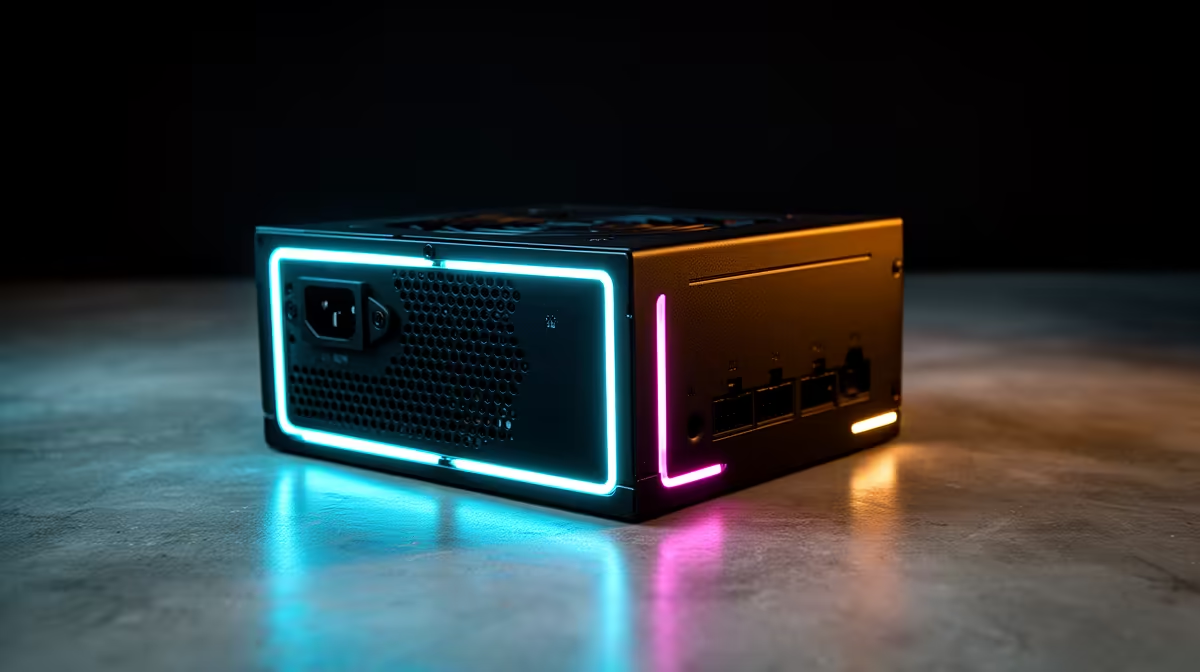
A more efficient PSU generates less waste heat from the same system load. At 80 Plus Gold versus Bronze efficiency, the difference is roughly 20W to 35W of heat inside the case at typical gaming loads, translating to measurable reductions in case ambient temperature and GPU thermals in constrained airflow situations.
How PSU Efficiency Creates Heat 🌡️
Every PSU converts alternating current from the wall into direct current for your components. No conversion is perfect; the gap between power drawn from the wall and power delivered becomes waste heat inside the PSU chassis. An 80 Plus Bronze unit achieves roughly 82% to 85% efficiency at typical gaming loads. An 80 Plus Gold unit reaches 87% to 90%, and Platinum extends to 89% to 92%. On a 600W system draw, Bronze dumps roughly 85W to 105W of waste heat into the PSU and case; Gold dumps 65W to 80W; Platinum around 55W to 70W. The gap between Bronze and Gold is approximately 20W to 35W of additional heat the case cooling system must manage.
Why Heat Inside the PSU Matters for Case Thermals 🔧
Most PSUs mount at the bottom of mid-tower cases with an intake fan drawing air from below. In a compact mid-tower running an RTX 5070 Ti and Ryzen 7 9700X in South Africa's summer heat, a 30°C ambient room temperature already challenges the cooling system. Adding 20W to 35W of unnecessary PSU waste heat to that environment raises GPU junction temperatures by 1°C to 4°C in practice. That is the difference between a GPU running at 82°C and one hitting the 87°C thermal throttle threshold.
Efficiency Ratings at High SA Ambient Temperatures ♨️
The 80 Plus certification is conducted at 23°C ambient. At the 30°C to 35°C room temperatures common in Gauteng, Limpopo, and KwaZulu-Natal during summer, efficiency drops by 1% to 3% relative to the rated figure. A Gold unit still outperforms Bronze substantially, but the absolute figures are lower than what the badge implies. This real-world degradation makes choosing Gold or Platinum over Bronze more meaningful in South African conditions than in European markets where ambient temperatures remain moderate year-round.
Monitor PSU Fan Speed as a Heat Proxy ⚡
HWiNFO64 can read the PSU fan speed via the motherboard, which is a proxy for internal PSU load and temperature. If the PSU fan consistently ramps to maximum speed during gaming in a room at 28°C or above, consider whether a higher-efficiency unit would keep it cooler and quieter in SA summer conditions.
FAQ
Does an efficient PSU make a noticeable difference in my GPU temperature?
In compact builds and during SA summer conditions, yes. Reducing 20W to 35W of internal case heat can lower GPU junction temperature by 2°C to 5°C when airflow is already stretched. In large full-tower cases with aggressive cooling, the difference may be under 2°C.
Does running a higher-wattage PSU at low load improve efficiency?
Not beyond a point. 80 Plus efficiency peaks at 50% load for most units. Oversizing a PSU purely for efficiency gains at light load is counterproductive; size correctly and choose a high efficiency tier instead.
Is an 80 Plus Bronze PSU acceptable in a mid-range SA build?
Bronze is acceptable for budget builds but Gold units have become competitively priced in South Africa. 80 Plus White units offer no meaningful advantage and should be avoided. For any build above R15,000, the marginal cost of the Gold tier is a sensible spend.
Battling high case temperatures in a South African summer?
Browse Evetech's Gold and Platinum-rated power supplies that reduce waste heat at the source, keeping your GPU and CPU cooler without extra case fans.