Quick Answer
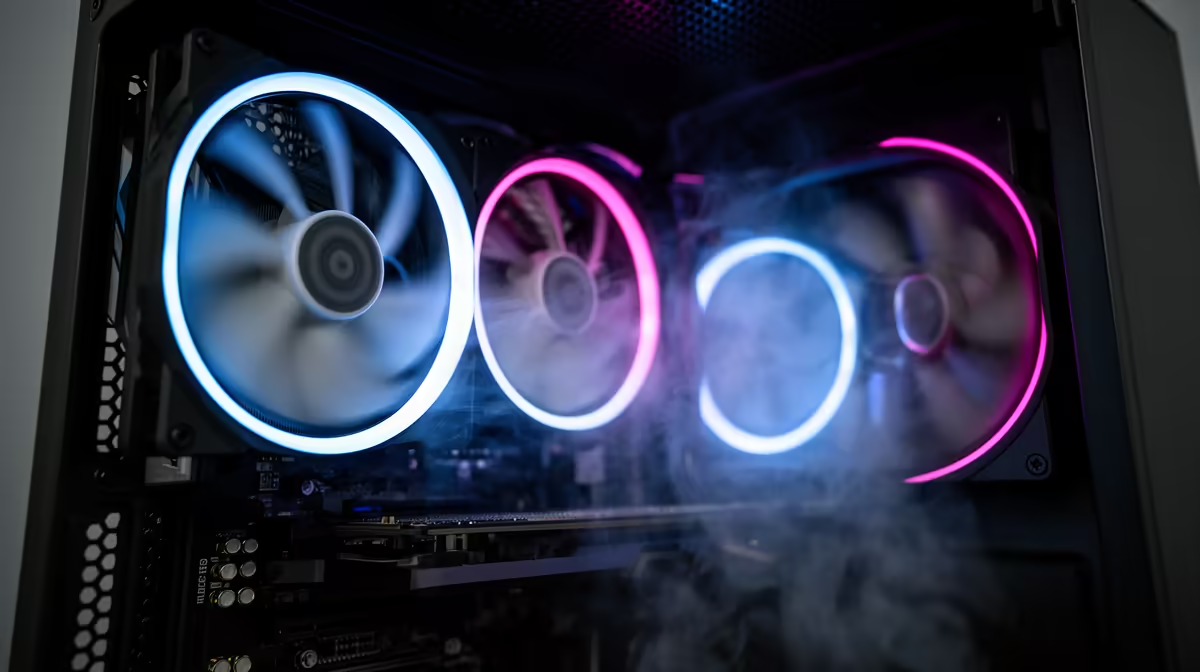
For a standard high-end gaming PC, three 140mm fans (two front intake, one rear exhaust) provide strong airflow. Four fans (three front intake, one rear exhaust) is better if you are running a high-TDP GPU like an RTX 5080 or 5090 without liquid cooling.
Understanding Airflow Balance in a Gaming Case 💨
A well-configured gaming PC case maintains positive air pressure: more air enters than exits, keeping unfiltered dust ingress through gaps and seams to a minimum.
The 140mm fan size has a practical advantage over 120mm: at the same rotational speed, a 140mm fan moves roughly 25 to 30 percent more air and generates less noise because it operates at lower RPM to achieve the same CFM target. For a quiet high-performance build, 140mm fans are the preferred choice at every position they physically fit.
For a build using an RTX 5080 at full load producing approximately 320W of heat, two front 140mm intake fans at 1,000 RPM provide roughly 90 to 120 CFM of intake. This is adequate to keep GPU temperatures under 80 degrees Celsius in a medium-quality mid-tower case with a mesh front panel.
When More Fans Provide Diminishing Returns 🔧
Adding a fourth 140mm fan to a three-fan setup in an enclosed mid-tower provides a smaller improvement than the initial jump from one to three fans. At four fans, the airflow is typically maximised for the case volume, and additional fans beyond this reduce noise and cost returns without proportionate cooling gains.
Full-tower cases with 420mm radiator support benefit from six 140mm fans mounted on the radiator plus one to two exhaust fans, but this is a cooling infrastructure question rather than a standard airflow configuration. For a mid-tower build without liquid cooling, three to four 140mm fans is the practical and noise-optimised sweet spot.
Fan Placement Strategy for SA Gaming Setups 🏠
In South African homes during summer, ambient temperatures in gaming rooms regularly reach 28 to 34 degrees Celsius in Gauteng and coastal areas. Positive pressure airflow with filtered front intakes prevents dust accumulation on heatsinks, which matters during the dry Highveld winter months when dust particles are finer and more pervasive.
For a case like the Lian Li Lancool 216 (which ships with two pre-installed 160mm fans) or the Fractal Design Torrent (which includes three 180mm and two 140mm fans), the pre-installed fan count is already optimised for the case volume.
Run Intake Fans Slightly Faster Than Exhaust ⚡
Set your front intake 140mm fans at 800 to 1,000 RPM and your rear exhaust fan at 700 to 900 RPM. This maintains slight positive pressure inside the case, which keeps dust filtered at the front mesh rather than allowing it to enter through unfiltered gaps. Adjust these curves in your motherboard's fan control software, targeting GPU temperature as the primary sensor trigger.
FAQ
Are pre-installed fans in cases usually ARGB or plain?
It depends on the case tier. Budget cases at R800 to R1,500 typically include plain single-colour or non-lit fans. Mid-range cases at R1,500 to R3,000 increasingly include ARGB fans with included hub controllers.
Should top fans be intake or exhaust in a gaming case?
Exhaust in almost all configurations. Hot air rises, so top-mounted exhaust fans naturally draw heat upward and out.
How do I know if my case airflow is inadequate?
If GPU temperatures exceed 85 degrees Celsius under sustained gaming load or CPU temperatures spike above 95 degrees Celsius during stress, airflow is a contributing factor. First confirm that all case fans are spinning and correctly oriented (arrows on the fan frame indicate both airflow direction and rotation direction).
Upgrading your case airflow?
Evetech stocks 140mm fans in plain and ARGB variants from brands suited to both quiet and performance-focused builds. Visit the fans and cooling section to find the right set for your case.