Tired of staring at loading screens in Cape Town while your mates in Jozi are already dropping in? That agonizing wait is often your storage drive gasping for air. While traditional SSDs were a big leap, the real magic lies in NVMe technology. But how NVMe SSDs work isn't just marketing fluff; it's a fundamental redesign of how your PC accesses data, unlocking speeds that make older drives look like they're stuck in traffic on the N1. 🚀
What Makes NVMe SSDs So Incredibly Fast?
To understand the genius behind NVMe SSD speed, we first need to look at the old way of doing things. For decades, storage drives—from clunky mechanical hard drives to the first solid-state drives—connected to your PC using an interface called SATA. The problem? SATA was designed for spinning platters, not lightning-fast flash memory. It's like forcing a Formula 1 car to obey the rules of a horse-drawn cart.
The Old Bottleneck: SATA and AHCI
The SATA interface, combined with its communication protocol (AHCI), could only handle one queue of commands with up to 32 commands in it. This was fine for finding a single file on a spinning disk, but it created a massive traffic jam for modern SSDs that can handle multiple requests at once. Even today, many reliable 2.5-inch SSDs use this technology and offer a fantastic upgrade over old hard drives, but they can't touch the raw performance of their newer siblings.
The New Superhighway: PCIe and the NVMe Protocol ⚡
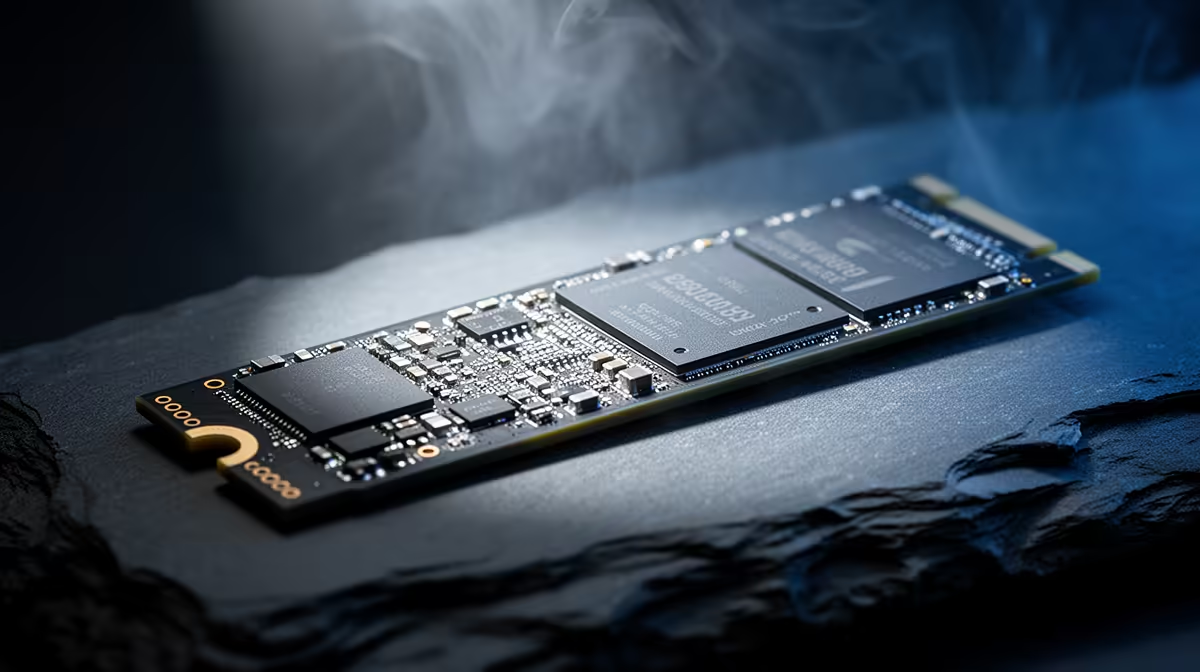
This is where the magic happens. How NVMe SSDs work is by completely bypassing the slow SATA bus. Instead, they slot directly into your motherboard's PCIe (Peripheral Component Interconnect Express) lanes—the same high-speed interface your graphics card uses! This gives them a direct, multi-lane highway to your CPU.
The NVMe (Non-Volatile Memory Express) protocol is the language spoken over this highway. It was built from the ground up for flash memory, allowing for a staggering 65,536 command queues, each capable of holding 65,536 commands. The difference in raw throughput is astronomical, eliminating bottlenecks and letting the true speed of the flash chips shine.
Understanding the Tech Lingo
When you start browsing for a new drive, you'll see terms like "Gen4," "x4," and "M.2." It can seem confusing, but it's actually quite simple. These terms define the physical connection and the speed limit of your drive. Understanding them is key to exploring the full range of SSDs available in South Africa.
PCIe Lanes and Generations
Think of PCIe as a highway:
- Lanes (e.g., x4): These are the number of lanes on the highway. Most consumer NVMe SSDs use four lanes (x4) for maximum bandwidth.
- Generations (e.g., Gen3, Gen4, Gen5): This is the speed limit on each lane. Each new generation roughly doubles the speed of the previous one. A Gen4 drive is twice as fast as a Gen3 drive, and Gen5 is twice as fast again.
Check Your Motherboard! 🔧
Before you buy, check your motherboard's specs! To get the full advertised speed of a Gen4 NVMe SSD, you need a motherboard with a Gen4 M.2 slot. You can still use a Gen4 drive in a Gen3 slot, but it will run at the slower Gen3 speeds. Don't pay for speed you can't use!
How NVMe Speed Impacts Your Gaming and Workflow
Okay, so the tech is impressive. But what does this next-gen storage speed mean for your daily use in SA?
- Gaming: Load times in massive open-world games like Cyberpunk 2077 or Starfield can shrink from minutes to mere seconds. In-game stuttering caused by asset streaming is drastically reduced.
- Content Creation: Editing 4K video footage or working with huge project files in Photoshop becomes buttery smooth. Rendering and export times are slashed.
- General Use: Your PC will boot up in a flash. Applications will launch instantly. Everything just feels… snappy. ✨
The best part? This incredible performance is more affordable than ever. With frequent specials and price drops, you can often find some of the best SSD deals in ZAR and give your rig the single biggest performance boost possible.
Is an NVMe SSD Upgrade Right for You?
For almost any PC user in 2024 and beyond, the answer is a resounding yes. If you're a gamer, a content creator, or simply someone who hates waiting, the performance leap is undeniable. The efficiency of how NVMe works makes it the new standard for primary boot drives and gaming libraries.
If you're building a new PC or looking for the most impactful upgrade for your current one, investing in a quality drive is a no-brainer. It fundamentally changes your entire computing experience, making everything faster and more responsive. Ready to see what all the fuss is about? It's time to explore our curated range of high-speed NVMe SSDs.