Quick Answer
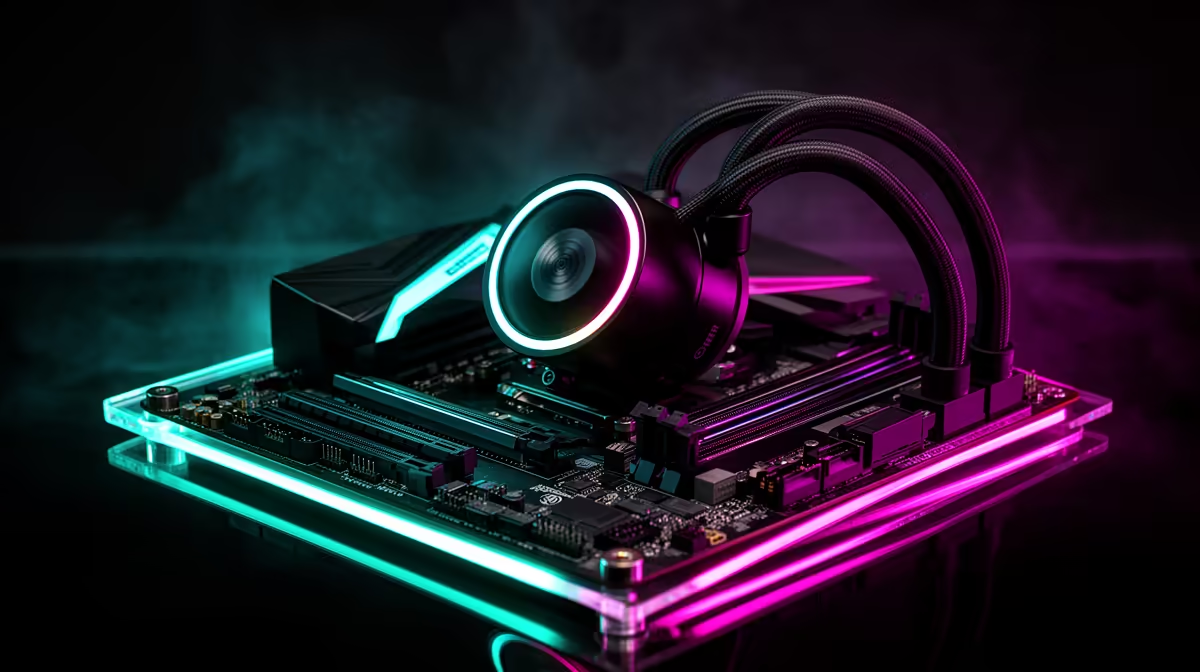
Mount the radiator to the top or front of the case (top preferred for heat exhaust), attach fans in push configuration, secure the pump head to the CPU socket with the provided bracket, connect pump and fan headers to the correct motherboard headers, and route tubes to minimise stress on the fittings.
Preparing the Case and Radiator Mount 🔧
Before touching the cooler, confirm your case supports a 360mm radiator at the intended location. Top-mounting the radiator is generally preferred for exhaust: hot air naturally rises, and a top-mounted radiator exhausting upward works with convection rather than against it. Install the fans on the radiator before mounting it to the case; working space becomes very tight once the radiator is secured to the top panel. The standard configuration is fans pushing air through the radiator from inside the case toward the top exhaust panel. If mounting at the front, fans pull air from outside the case through the radiator into the main chamber, which works well in cases with restricted top ventilation.
CPU Socket Mounting and Thermal Paste 🖥️
Modern 360mm AIO coolers ship with socket-specific brackets for AM5 (Ryzen 7000 and 9000 series) and LGA1851 (Intel Core Ultra 200 series). Use the bracket labelled for your socket and follow the included manual precisely because incorrect bracket orientation causes uneven mounting pressure and degraded thermal contact. Apply thermal paste in a small pea-sized amount at the centre of the IHS if the cooler does not include pre-applied paste; the mounting pressure distributes it correctly. Tighten the four mounting screws in a cross pattern and gradually increase torque rather than fully tightening one screw at a time to prevent uneven pressure.
Cable Routing for a Clean Finish 📡
The pump head requires connection to a CPU_FAN or AIO_PUMP header; the AIO_PUMP header typically allows higher sustained RPM. Route all cables from the pump head and radiator fans behind the motherboard tray where possible. Tubing should run with a gentle curve rather than a sharp bend, which restricts coolant flow and stresses the fittings at the pump head and radiator over time. Keep tubing runs away from GPU fans if the layout allows.
Burp the AIO After First Boot ⚡
After installing a 360mm AIO and first powering on, run the system for ten minutes, then gently tilt the case side to side and front to back to release air pockets in the loop. Air bubbles cause a characteristic gurgling sound and reduce cooling efficiency. Most bubbles settle within the first hour of use.
FAQ
Should 360mm AIO fans push or pull air through the radiator?
Push (fans mounted on the intake side, blowing through the fins) is marginally more effective because the fans operate on undisturbed air. Most builders use push; high-performance setups sometimes use push-pull with fans on both sides, but this requires extra clearance inside the case.
What CPU temperatures should a 360mm AIO achieve on a Ryzen 9 9950X?
Under sustained all-core load on a Ryzen 9 9950X (170W TDP), a quality 360mm AIO should hold package temperatures between 75°C and 88°C in a well-ventilated case at 25°C ambient. Temperatures above 95°C under sustained load indicate inadequate thermal paste application, poor mounting pressure, or insufficient case airflow.
How often does the AIO coolant need replacing?
Closed-loop AIO units are sealed and do not require coolant top-ups or replacement under normal use. The coolant lasts the operational life of the unit, typically five to seven years. Persistent gurgling that does not resolve after burping may indicate a fitting issue and the unit should be replaced.
Ready to keep your high-performance CPU under control?
Browse Evetech's 360mm AIO liquid cooler range with options for AM5 and LGA1851 sockets, stocked locally for fast delivery to your build.