Quick Answer
To prevent PSU failure in high-humidity coastal SA environments: choose a PSU with conformal-coated PCBs and Japanese-branded sealed capacitors, keep the PC room at a stable temperature to minimise thermal cycling condensation, use a case with positive pressure airflow, and place silica gel packets near the PC when it is powered off for extended periods.
How Coastal Humidity Kills PSUs 💧
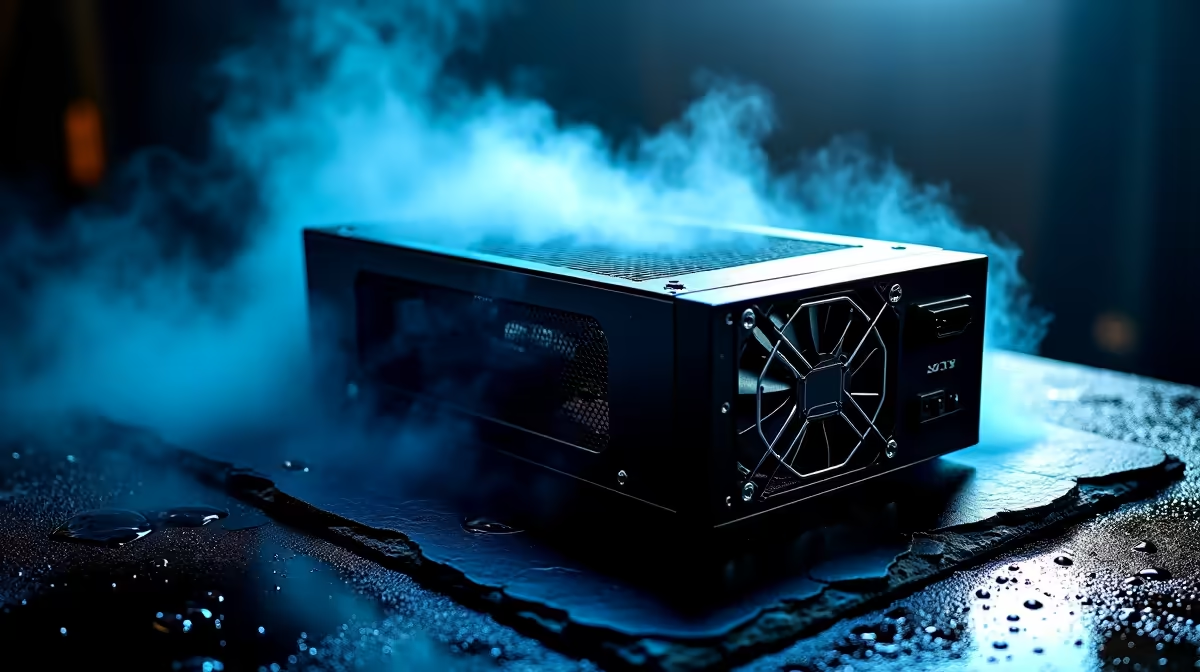
PSU failure in humid coastal environments typically follows one of three paths. The first is electrolytic capacitor degradation: moisture permeating through the vent scores of budget capacitors enters the electrolyte, increasing ESR and reducing capacitance, leading to voltage spikes that can damage GPU or CPU power circuits. The second is PCB trace corrosion: copper traces oxidise and develop surface corrosion that can cause trace breaks or shorts. The third is fan bearing moisture ingress: sleeve bearing fans absorb moisture into the bearing gap, accelerating shaft wear. In Durban's climate where ambient humidity averages 75 to 80% year-round, all three failure modes progress significantly faster than in the drier Highveld climate of Johannesburg.
Selecting a PSU Specifically for Coastal SA 🛡️
Four specification checkpoints for coastal PSU selection. First: conformal or lacquer PCB coating, listed explicitly in the product specification. Second: Japanese-branded capacitors (Nippon Chemi-Con, Nichicon, Rubycon) with sealed tops rather than vent-scored tops. Third: hydraulic or dual ball bearing fan with sealed bearing chambers. Fourth: full rated output at 40 degrees Celsius ambient. PSUs meeting all four criteria in the 850W class are available from Seasonic, be quiet!, and Corsair at Evetech in the R4,500 to R6,500 range.
Environmental Controls That Extend PSU Life 🌡️
Hardware selection is only one part of the solution. Keep the room at a stable temperature: large day-night temperature swings in coastal areas cause repeated condensation-evaporation cycles on internal components. A stable room temperature of 22 to 25 degrees Celsius minimises this cycling. Ensure the PC case has positive pressure airflow with filtered intakes; this reduces the volume of humid external air passing through the PSU. When the PC is powered off for more than 24 hours, place two to three silica gel packets near the PC air intake (available at hardware stores for R30 to R50 per pack).
Run the PC Daily to Minimise Condensation Cycles ⚡
A PC powered on daily reaches a warm internal temperature that prevents condensation forming on components. If you are away for extended periods in Durban, arrange for the PC to be powered on briefly each day or use silica gel packets near the case intake.
FAQ
Does a PSU warranty cover humidity-related failure in South Africa?
Generally no. Manufacturer warranties cover manufacturing defects, not environmental damage from high-humidity operation without appropriate protection. Choosing a PSU with conformal coating and proper environmental controls means the unit is less likely to fail from humidity in the first place.
Should I use a dehumidifier in my PC room in coastal SA?
A dehumidifier maintaining relative humidity between 45 and 55% in the PC room is an effective protection measure. A portable unit for a 15 to 20 square metre room costs R1,500 to R2,500. For a PC setup containing R30,000 or more in components, this is excellent insurance in Durban where maintaining humidity control without dehumidification is difficult in summer.
Are there specific PSU brands that perform better in coastal SA conditions?
Be quiet!, Seasonic Prime, and Corsair HX series are consistently cited for long-term reliability in varied climate conditions. All three offer units with quality capacitor specifications and explicit PCB coating on premium models stocked at Evetech.
Protecting your build from South Africa's coastal humidity?
Evetech stocks PSUs from brands known for humidity-resilient construction, including conformal-coated designs suited to Durban, Cape Town, and East London conditions. Browse the power supply range at Evetech.